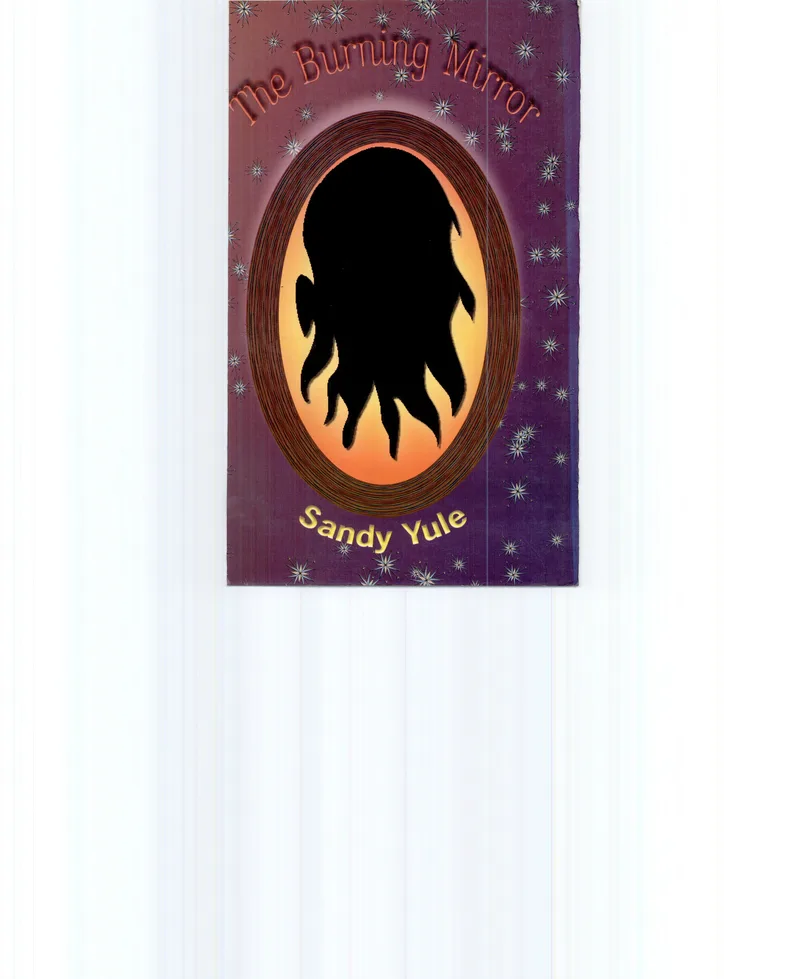
The Burning Mirror
 79
79

The Burning Mirror
Sandy Yule’s The Burning Mirror offers a peculiar, almost alchemical distillation of occult thought. Unlike the sprawling encyclopedias that often dominate the genre, Yule presents ideas with a stark, unadorned clarity that can be both illuminating and challenging. The chapter discussing the "Lesser Banishing Ritual of the Pentagram" as a tool for psychic house-cleaning, rather than mere ceremonial rote, is particularly striking. However, the text occasionally suffers from an internal logic that assumes prior esoteric knowledge, leaving certain arguments feeling somewhat insular. The prose, while precise, rarely offers the lyrical quality found in some earlier esoteric writers. Nevertheless, for those willing to engage with its demanding yet rewarding structure, The Burning Mirror provides a unique perspective on consciousness transformation.
📝 Description
79
Sandy Yule's The Burning Mirror, published in 2005, focuses on occult principles through personal experience.
The Burning Mirror is a work of occult philosophy that eschews beginner material and broad historical surveys for a direct engagement with metaphysical ideas. Yule structures the text to emphasize conceptual exposition, requiring close reader attention. It addresses consciousness as a force that intent and symbolism can shape, treating the astral plane as a dynamic dimension rather than a mere afterlife.
The book suits readers already familiar with esoteric concepts, particularly those who have read authors like Aleister Crowley or Dion Fortune. It is for those who wish to move beyond introductory texts and examine the philosophical underpinnings of occultism more deeply. Those interested in the development of specific metaphysical disciplines or the symbolic language within spiritual traditions will also find value here.
Published in 2005, The Burning Mirror appeared during a period of renewed esoteric interest, influenced by the late 1990s digital expansion of occult communities. While not aligned with specific historical movements like the Golden Dawn revival, it reflects a contemporary trend of synthesizing diverse traditions. Its release predates the current surge in online occult courses, marking it as a more scholarly contribution to the field at that time.
The Burning Mirror emerged in 2005, a time when the internet had begun to foster new connections within occult communities. It represents a contemporary approach to esotericism, synthesizing various traditions rather than strictly adhering to older magical orders. The book's focus on personal, experiential understanding of occult principles positions it within a lineage that values direct gnosis over purely academic study, though it demands intellectual rigor.
💡 Why Read This Book?
• Understand the "Burning Mirror" concept as a tool for focused self-transformation, moving beyond simple introspection to active psychic refinement, as detailed within its pages. • Grasp the book’s unique perspective on the "astral plane," viewing it not as a passive realm but as an interactive energetic field shaped by conscious will. • Learn about the practical application of symbolic rituals, moving beyond their purely ceremonial aspects to recognize their function in reordering one's internal landscape, a core tenet explored by Yule.
⭐ Reader Reviews
Honest opinions from readers who have explored this book.
❓ Frequently Asked Questions
When was The Burning Mirror first published?
The Burning Mirror was first published in 2005, placing it within the early 21st-century landscape of esoteric literature.
What is the central metaphor of 'The Burning Mirror'?
The central metaphor of 'The Burning Mirror' is a symbol for intense self-reflection and the fiery, transformative process of purifying and reshaping the psyche.
Does The Burning Mirror require prior knowledge of occultism?
While not strictly a beginner's text, The Burning Mirror assumes a certain familiarity with foundational esoteric concepts, making it more accessible to those with some background in the subject.
What kind of esoteric tradition does The Burning Mirror draw from?
The book synthesizes various esoteric principles, with a strong emphasis on consciousness, symbolism, and practical application, often drawing from Western Hermetic and Gnostic currents.
Is The Burning Mirror a historical survey of occultism?
No, The Burning Mirror is not a historical survey. It focuses on specific metaphysical concepts and their experiential application rather than a broad historical overview.
What is the author's background, Sandy Yule?
Information regarding Sandy Yule's specific background is not widely disseminated, typical for many authors in specialized esoteric fields who focus on the work itself.
🔮 Key Themes & Symbolism
Consciousness as a Transformative Force
The work posits consciousness not as a passive recipient of experience, but as an active, malleable agent capable of profound alteration. Yule explores techniques that aim to refine and direct this force, using the "burning mirror" as a central symbol for the process of self-examination that leads to psychic purification and a restructuring of one's inner reality. This theme emphasizes the individual's power to effect change through focused intent and disciplined awareness, moving beyond mere philosophical contemplation to practical application.
The Astral Plane as an Energetic Landscape
Rather than treating the astral plane as a distant, ethereal dimension, The Burning Mirror presents it as an accessible, dynamic energetic landscape intimately connected to the practitioner's psyche. The book suggests that this plane can be navigated and influenced through specific mental and symbolic operations. This perspective encourages readers to see their inner states as directly impacting and being impacted by this non-physical environment, highlighting the importance of psychic hygiene and conscious projection.
Symbolism and Psychic Reordering
A significant focus is placed on the potent role of symbolism in facilitating psychic change. The "burning mirror" itself is a prime example, but the text likely explores other archetypal symbols and their function in reordering the mind and spirit. The work suggests that understanding and consciously engaging with these symbols can unlock deeper levels of awareness and effect tangible shifts in perception and behavior, aligning the inner world with desired outer manifestations.
The Alchemical Nature of the Self
The book implicitly frames the spiritual path as a form of inner alchemy. The "burning mirror" symbolizes the transformative fire, and the entire process described can be seen as a metaphor for the breaking down, purification, and reintegration of the self. This aligns with traditional alchemical aims of achieving a perfected state, applied here to the psychological and spiritual dimensions of human existence. The emphasis is on internal processes of dissolution and regeneration.
💬 Memorable Quotes
Direct passages from the work, attributed to the author.
“The mirror reflects not what is, but what can be made.”
— This suggests the 'burning mirror' is not merely for passive observation but an active tool for manifestation, symbolizing the power of focused will and intention to shape reality.
“Astral currents are shaped by the force of focused desire.”
— This highlights the dynamic nature of the astral plane, emphasizing that it is not static but responsive to the practitioner's directed will and emotional energy.
“Pyramid of intent, built stone by symbolic stone.”
— This metaphor illustrates the methodical construction of a magical working or spiritual goal, where each symbolic element acts as a crucial building block.
“Within the self lies the crucible of all transformation.”
— This points to the internal locus of control and change, suggesting that true esoteric work is primarily an inner process, not an external manipulation.
💡 Key Ideas
Editorial paraphrase of the work's core concepts — not direct quotes.
The fire purifies, leaving the essential essence.
This paraphrased concept speaks to the alchemical aspect of the 'burning mirror,' where the intense process burns away dross to reveal the core truth or being.
🌙 Esoteric Significance
Tradition
The Burning Mirror draws heavily from Western Esoteric traditions, particularly Hermeticism and Gnosticism, with elements that echo Neoplatonic philosophy. It emphasizes the immanence of the divine within the human and the power of consciousness to interact with subtle realms. This work departs from more rigid, ritualistic approaches by focusing on the internal, alchemical transformation of the practitioner, viewing the esoteric path as a process of self-realization rather than adherence to external dogma.
Symbolism
The titular 'Burning Mirror' serves as a potent symbol for self-reflection, purification, and the fiery illumination of hidden aspects of the psyche. The concept of the 'astral plane' is presented not merely as a spiritual destination but as an energetic landscape, a symbolic construct navigable through focused intent. Other potential symbols might include fire (transformation, purification), light (knowledge, revelation), and the mirror itself (reflection, self-awareness), all employed to illustrate the internal alchemical processes.
Modern Relevance
Contemporary practitioners of psychological alchemy and consciousness studies may find resonance with Yule's approach. Thinkers focused on the power of intention and the subjective nature of reality, as well as those exploring modern forms of Hermeticism or Gnostic-inspired personal gnosis, could draw inspiration. The book's emphasis on internal transformation through symbolic engagement aligns with current trends in personalized spiritual practices and the integration of esoteric philosophy into daily life.
👥 Who Should Read This Book
• Advanced students of Hermeticism seeking to deepen their understanding of consciousness manipulation and internal alchemy, moving beyond foundational rituals. • Metaphysical researchers interested in the symbolic representation of psychic states and the practical application of esoteric concepts in personal development. • Practitioners of self-transformation who are drawn to works that emphasize direct experience and the active shaping of one's inner world through focused will.
📜 Historical Context
Published in 2005, Sandy Yule’s The Burning Mirror arrived during a period of significant resurgence in esoteric studies, fueled by early internet communities that facilitated access to obscure texts and cross-cultural dialogue. While not directly aligned with movements like the Hermetic Order of the Golden Dawn revival of the late 20th century, it reflects a contemporary inclination to synthesize diverse metaphysical traditions. Its focus on consciousness and symbolic application stands in contrast to more historically-oriented occult scholarship or purely ceremonial magic texts. The work emerged without major contemporary academic engagement or significant public controversy, positioning itself as a more private study for dedicated practitioners. It predates the widespread online course phenomenon, offering a more text-centric approach to complex occult philosophy.
📔 Journal Prompts
The nature of the "burning mirror" as a tool for shaping potential.
Personal interpretations of the "astral plane" as an energetic landscape.
The efficacy of symbolic construction in achieving internal reordering.
Reflections on the "crucible of transformation" within the self.
How the concept of "essential essence" applies to current life challenges.
🗂️ Glossary
Burning Mirror
A central metaphor representing a tool for intense self-reflection, psychic purification, and the fiery transformation of consciousness.
Astral Plane
Conceptualized not just as a spiritual realm, but as a dynamic, energetic landscape responsive to conscious intent and desire.
Psychic Reordering
The process of consciously restructuring one's mental and emotional states, often through symbolic engagement and focused will.
Essential Essence
The core, purified nature of a being or concept, revealed after the dross or impurities have been removed through transformative processes.
Crucible of Transformation
Metaphor for the internal space or process within the self where profound psychological and spiritual change occurs.
Symbolic Construction
The deliberate use and arrangement of symbols to create a desired effect or structure within the mind or subtle realms.
Focused Desire
Directed and concentrated will or longing, understood as a potent force capable of shaping energetic environments like the astral plane.