The invisible landscape
 84
84

The invisible landscape
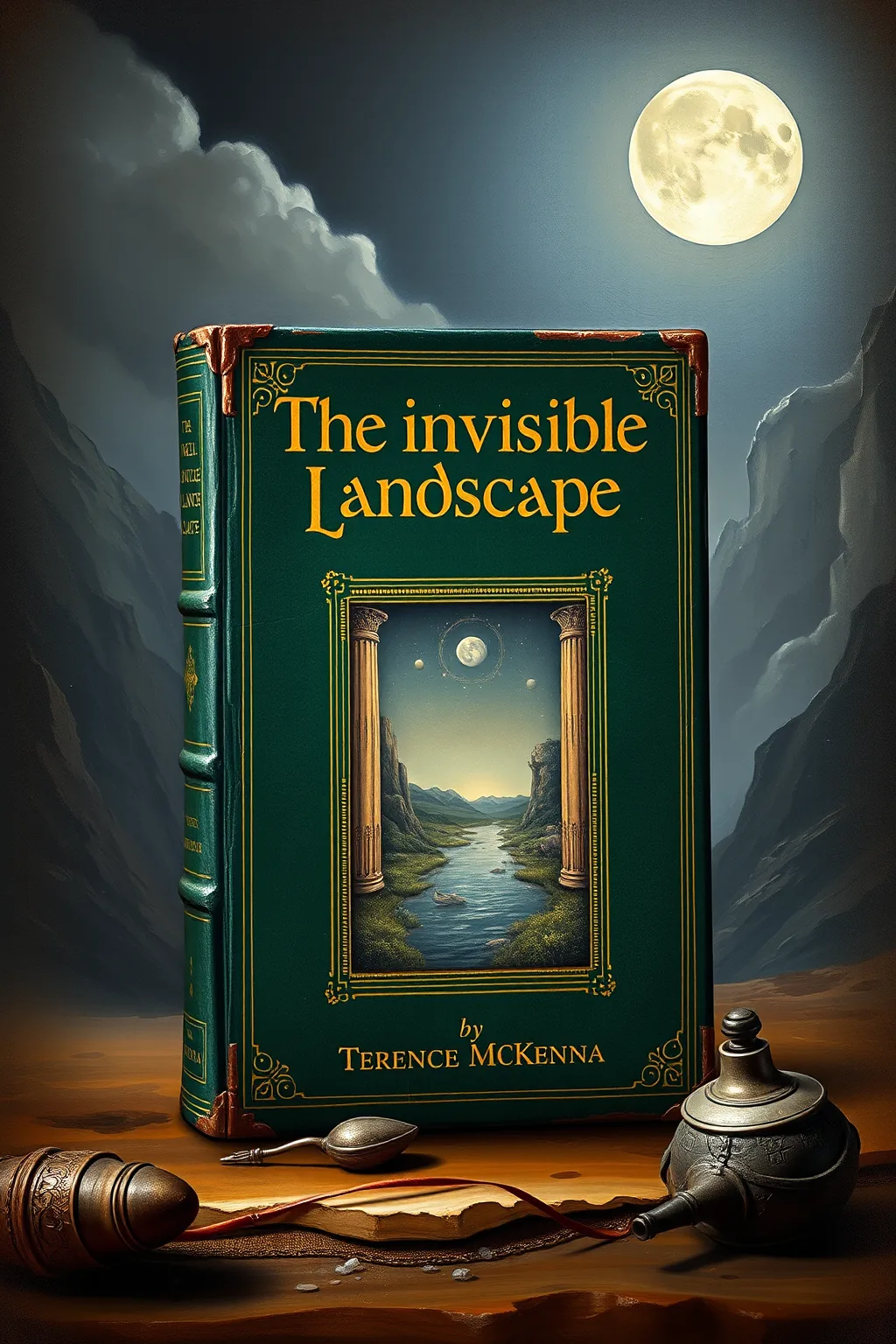
McKenna's The Invisible Landscape feels less like a book and more like a concentrated broadcast from another dimension. His relentless pursuit of the "Logos" through the lens of psilocybin is both exhilarating and, at times, exhausting. The strength lies in McKenna's unparalleled ability to articulate complex, often bewildering, concepts with a vibrant, almost evangelical fervor. His "Stoned Ape" hypothesis, while speculative, is presented with such conviction it demands consideration. However, the book’s primary limitation is its density; the interwoven theories, particularly the Timewave Zero, can become difficult to follow without a dedicated glossary or considerable prior exposure to McKenna’s work. A passage detailing the perceived alien intelligence within the psilocybin experience—often described as a "machine intelligence" or "talking dolphin"—highlights both the book's unique vision and its potential for subjective interpretation. It’s a challenging but essential text for understanding McKenna's unique contribution to psychedelic thought.
📝 Description
84
Terence McKenna's The Invisible Landscape, published in 1993, offers a dense compilation of his theories on consciousness and reality.
Published in 1993, The Invisible Landscape collects the ideas of ethnobotanist and mystic Terence McKenna. It is not structured as a traditional narrative but instead presents McKenna's energetic viewpoints on consciousness, psychedelics, and the nature of reality. The book discusses his theories about psilocybin mushrooms, artificial intelligence, and the structure of time. McKenna also proposes the existence of a 'Logos,' a form of divine intelligence or informational field accessible through specific substances.
This work is for readers interested in speculative consciousness studies, ethnobotany, and psychedelic research. It suits those who question standard reality models and look for different perspectives on human potential and the cosmos. Fans of McKenna's lectures and other writings will find a concentrated expression of his signature concepts here. It also appeals to individuals examining the connections between technology, mysticism, and altered states of awareness, especially those open to questioning established scientific and philosophical ideas.
The Invisible Landscape emerged in 1993, a time of renewed interest in psychedelics after decades of suppression. McKenna's work contributed to this discourse by presenting complex theories on psychedelic experience mechanisms, drawing connections to emerging ideas in complexity and information science. His approach, though often outside mainstream academia, engaged with concepts of altered states of awareness and the potential for accessing non-ordinary realities through entheogenic means.
💡 Why Read This Book?
• Understand the "Stoned Ape" hypothesis, McKenna's provocative theory linking psilocybin consumption to early human cognitive and linguistic development, offering a unique evolutionary perspective. • Explore the concept of the "Logos" as presented by McKenna, a perceived intelligent, non-material entity accessible through specific entheogenic states, providing a framework for direct spiritual experience. • Examine the "Timewave Zero" algorithm, a complex system for mapping historical novelty and predicting future trends, offering a unique, albeit challenging, model for understanding time and cultural evolution.
⭐ Reader Reviews
Honest opinions from readers who have explored this book.
❓ Frequently Asked Questions
What is the central thesis of Terence McKenna's The Invisible Landscape?
The central thesis revolves around the idea that psilocybin mushrooms are key catalysts for human consciousness evolution and offer direct access to a universal intelligence, the 'Logos,' which can be perceived in altered states.
What is the 'Stoned Ape' theory mentioned in the book?
The 'Stoned Ape' theory posits that early hominids consuming psilocybin mushrooms experienced accelerated cognitive development, leading to advancements in language, social structures, and consciousness.
What is 'Timewave Zero'?
Timewave Zero is a complex, fractal mathematical model developed by McKenna that attempts to chart the ebb and flow of novelty in history, predicting periods of radical change and eventual singularity.
Does The Invisible Landscape discuss artificial intelligence?
Yes, McKenna explores the idea of artificial intelligence, suggesting parallels between the 'Logos' encountered in psychedelic states and potential future AI, often referring to it as 'machine intelligence'.
When was The Invisible Landscape first published?
The Invisible Landscape was first published in 1993, placing it within a period of renewed interest in psychedelic research and countercultural thought.
Is this book suitable for beginners in psychedelic studies?
While foundational, the book's dense theoretical framework and unique terminology may present a challenge for absolute beginners. Prior familiarity with McKenna's ideas or related topics is beneficial.
🔮 Key Themes & Symbolism
Psilocybin and Human Evolution
McKenna controversially proposes that the psilocybin mushroom was not merely a recreational substance but a critical factor in the evolutionary leap of Homo sapiens. He theorizes that regular consumption by early hominids, particularly the "Stoned Ape," accelerated cognitive development, facilitated the emergence of language, and sparked the beginnings of culture and self-awareness. This perspective reframes psychedelics as fundamental tools in humanity's biological and conscious progression, moving beyond simple pharmacological effects to consider their role in shaping our very nature.
The Logos and The Other
A core tenet of the book is the existence of a non-material, intelligent field or entity McKenna calls the 'Logos.' This 'Logos' is described as a benevolent, alien intelligence that can be contacted through profound psychedelic states, particularly those induced by high doses of psilocybin. McKenna details encounters with this 'Other,' often characterizing it as a 'machine intelligence' or a 'voice' speaking in a resonant, compelling manner, offering insights into the fundamental nature of reality and consciousness beyond human comprehension.
Timewave Zero and Temporal Mechanics
McKenna introduces his 'Timewave Zero' theory, a complex, self-referential fractal algorithm derived from the I Ching. This model attempts to quantify the novelty of events in spacetime, positing that history moves towards an asymptote of infinite novelty. The book explains how this wave can be used to analyze historical trends and predict future developments, suggesting a cyclical yet accelerating nature to time itself. It offers a unique metaphysical framework for understanding the unfolding of reality and humanity's place within it.
The Nature of Reality
The Invisible Landscape challenges conventional, materialistic views of reality by presenting a worldview where consciousness and information are primary. McKenna argues that our perceived reality is a construct, and that deeper, more fundamental realities can be accessed through altered states. He suggests that the universe is imbued with intelligence and that subjective experiences, particularly those mediated by psychedelics, offer genuine insights into these hidden dimensions. The book advocates for exploring these subjective landscapes as valid paths to knowledge.
💬 Memorable Quotes
Direct passages from the work, attributed to the author.
“The psychedelic experience is a journey to the land of the far-out.”
— McKenna uses this simple yet evocative phrase to describe the profound departure from consensus reality that psychedelics facilitate. It suggests a realm that is not just different, but fundamentally alien and distant from our everyday perceptions.
“Psilocybin is a doorway.”
— This concise statement reflects McKenna's core belief in the transformative potential of psilocybin. It positions the mushroom not as an end in itself, but as a crucial tool or gateway that enables access to deeper levels of consciousness and reality.
“The universe is a thought that is thinking itself.”
— This philosophical interpretation suggests a pantheistic or panpsychist view of existence, where the cosmos is fundamentally conscious. It implies that reality is an unfolding process of self-awareness, with all beings participating in this universal cognition.
💡 Key Ideas
Editorial paraphrase of the work's core concepts — not direct quotes.
The shaman is a person whose soul is out of his body, travelling in the Elsewhere.
This quote captures McKenna's view of the mystic or shaman as an explorer of non-ordinary realities. It emphasizes the dissociative and journeying aspects of ecstatic states, where the consciousness detaches from the physical form to engage with other dimensions or planes of existence.
The Logos is a kind of machine intelligence that has been with us since the beginning.
This paraphrased concept highlights McKenna's recurring idea of a non-human, intelligent presence encountered in psychedelic states. He often describes this intelligence with technological or alien characteristics, suggesting it is an ancient, fundamental aspect of the cosmos, not of human origin.
🌙 Esoteric Significance
Tradition
McKenna's work draws loosely from shamanic traditions, Gnosticism, and speculative philosophy, rather than adhering strictly to a single esoteric lineage. He engages with concepts like the Gnostic 'Demiurge' or 'Archons' when discussing alien intelligences, and his emphasis on direct, visionary experience aligns with certain mystical paths. However, he synthesizes these with scientific speculation, particularly in ethnobotany and information theory, creating a unique, hybrid esoteric framework that prioritizes endogenous psychedelics as keys to unlocking universal knowledge.
Symbolism
A central symbol is the psilocybin mushroom itself, representing a direct conduit to the 'Logos' and a catalyst for evolutionary consciousness. The 'machine intelligence' or 'talking dolphin' encountered in visions serves as a symbol of non-human, potentially alien, consciousness that exists beyond our biological and cultural limitations. The 'Timewave Zero' also functions symbolically, representing a cosmic clock or predictive engine that maps the flow of novelty and destiny within the universe.
Modern Relevance
McKenna's ideas continue to influence contemporary psychedelic research, consciousness studies, and certain strands of transhumanism and digital philosophy. Thinkers exploring the intersection of psychedelics and artificial intelligence, or those investigating altered states for insights into cosmology, often reference his work. His emphasis on 'timeless' archetypal experiences and the potential for direct contact with alien intelligences remains a touchstone for those pushing the boundaries of both spiritual and scientific inquiry.
👥 Who Should Read This Book
• Individuals fascinated by ethnobotany and the historical role of psychoactive plants in human development, seeking a speculative evolutionary theory. • Explorers of consciousness interested in direct experiences of non-ordinary reality and the possibility of encountering non-human intelligences. • Enthusiasts of Terence McKenna's lectures and philosophical ideas, looking for a concentrated exposition of his theories on psychedelics, time, and the nature of the cosmos.
📜 Historical Context
The Invisible Landscape emerged in 1993, a period marked by a resurgence of interest in psychedelics following the cultural impact of the 1960s and subsequent legal crackdowns. While mainstream science remained largely skeptical, underground research and countercultural exploration continued. McKenna’s work stood in contrast to the more clinical or psychotherapeutic approaches favored by emerging organizations like the Multidisciplinary Association for Psychedelic Studies (MAPS), founded by Rick Doblin in 1986. His theories, heavily influenced by ethnobotany and speculative philosophy, offered a radical, evolutionary perspective that resonated with a segment of the counterculture and psychedelic community, even as figures like Timothy Leary had already explored similar themes decades prior. The book contributed to a broader discourse on consciousness, information theory, and the potential for non-ordinary states to reveal hidden aspects of reality.
📔 Journal Prompts
The Stoned Ape hypothesis and its implications for human social structures.
Encountering the 'Logos': What does this concept suggest about universal consciousness?
Mapping personal 'novelty' according to the principles of Timewave Zero.
The role of entheogens in accessing 'the Elsewhere'.
Reflecting on the 'machine intelligence' archetype described by McKenna.
🗂️ Glossary
Logos
In McKenna's framework, a perceived divine or alien intelligence, often encountered in profound psychedelic states, that acts as a source of universal knowledge and consciousness.
Stoned Ape
McKenna's theory that psilocybin mushrooms played an important role in human evolution, enhancing cognitive abilities, language, and culture in early hominids.
Timewave Zero
A complex fractal algorithm developed by McKenna to chart the flow of novelty in history, predicting periods of radical change and potential future events.
The Elsewhere
A term used by McKenna to describe the non-ordinary, often hallucinatory or visionary, realms accessed during deep psychedelic or shamanic states.
Psilocybin
The naturally occurring psychedelic compound found in certain species of mushrooms, which McKenna believed was crucial for human consciousness development.
Machine Intelligence
A concept McKenna used to describe the nature of the 'Logos' or alien intelligence encountered, suggesting it possesses characteristics of advanced, non-biological computation.
Novelty
In the context of Timewave Zero, the measure of how unique or unprecedented an event is, contributing to the overall acceleration towards an asymptote of infinite novelty.
🔮 Readers Also Liked
Browse all →![ERIC ED051965: The Remedial [Reading] Teacher: Special Training and Professional Responsibilities.](/img/thumb/eric-ed051965-the-remedial-reading-teacher-special-training-and-professional-responsibilities-eric.webp)








More by Terence McKenna
All books →



More Free Occult Philosophy Books
View all →