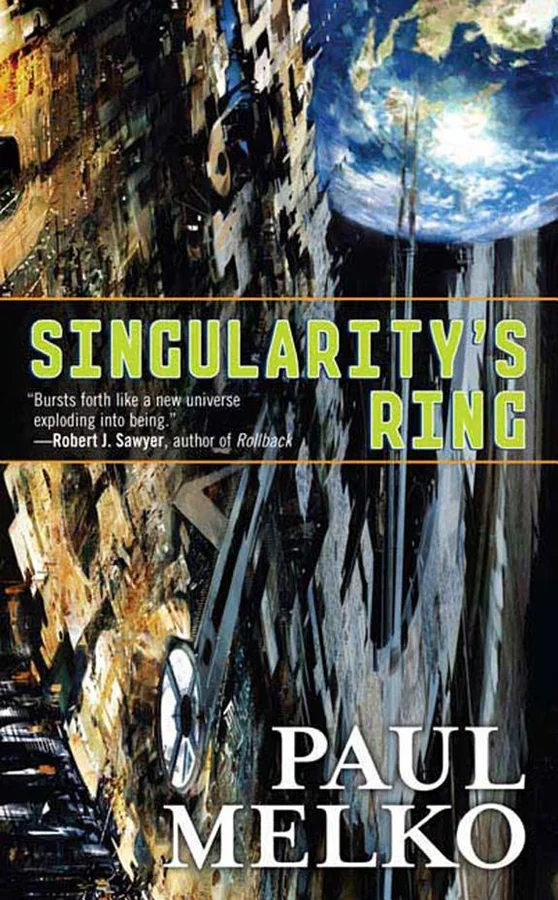
Singularity's Ring
 78
78

Singularity's Ring
Melko’s debut, Singularity’s Ring, offers a compelling vision of humanity picking up the pieces after a mass departure. The core concept—a vigorous space program as a societal balm—is intriguing. I found the depiction of the surviving society’s shared trauma and its sublimation into a grand, outward-looking project to be the novel’s strongest element. The narrative, however, occasionally falters in its pacing, particularly in the middle sections where the focus on the technicalities of space expansion sometimes overshadows character development. A passage describing the ‘Ring’ project itself, intended to harness solar energy on a grand scale, effectively illustrates the desperate ingenuity of the survivors, but the emotional arc of the central characters could have benefited from more consistent exploration. It's a solid, intelligent work that posits an unusual response to an apocalyptic event. A thoughtful, if uneven, exploration of humanity's drive to survive and expand.
📝 Description
78
Paul Melko's 2009 novel, Singularity's Ring, imagines humanity's struggle after a mass exodus from Earth.
Singularity's Ring follows the survivors left behind on Earth after a significant portion of humanity departs for the stars. The novel examines their efforts to rebuild civilization and find new purpose, primarily through an ambitious space exploration initiative. Melko charts the societal and psychological impact of this monumental event, showing how humanity adapts to a fundamentally altered existence. The story focuses on the survivors' attempts to forge a new identity and future in the shadow of those who left.
This science fiction narrative appeals to readers interested in speculative fiction that considers existential themes and societal reconstruction. It suits those who appreciate stories blending hard science fiction with philosophical questions about human resilience and the drive to explore. The novel is for readers who seek narratives that consider the long-term consequences of large-scale societal shifts.
While not explicitly religious, Singularity's Ring engages with themes common in esoteric thought, such as humanity's collective destiny and the search for meaning in the face of cosmic scale. The novel's depiction of a divided humanity, with some ascending to a higher plane of existence (space) while others remain, echoes Gnostic ideas of spiritual separation and the struggle for transcendence. The survivors' quest for a new identity and purpose on Earth after a perceived 'fall' or abandonment can be seen as a secular exploration of themes related to spiritual regeneration and the search for lost knowledge or a new cosmic order.
💡 Why Read This Book?
• Learn how a civilization processes existential abandonment by investing in a massive space program, as detailed in the novel's depiction of the post-exodus era. • Understand the psychological mechanisms of societal recovery through collective endeavor, exemplified by the survivors' focus on building the 'Ring' for solar energy. • Gain insight into the philosophical questions surrounding humanity's drive to explore, even after a catastrophic event like the departure of 90% of the population.
⭐ Reader Reviews
Honest opinions from readers who have explored this book.
❓ Frequently Asked Questions
What is the central premise of Paul Melko's Singularity's Ring?
Singularity's Ring is set after 90% of humanity leaves Earth. The remaining population attempts to recover from this immense trauma by launching an ambitious space program, exploring themes of societal rebuilding and human resilience.
When was Singularity's Ring first published?
The novel Singularity's Ring by Paul Melko was first published on April 28, 2009.
What kind of science fiction does Singularity's Ring represent?
It falls into the category of speculative fiction that examines societal and psychological impacts of large-scale events, blended with elements of space exploration and future technological development.
Does the book focus on the people who left Earth or those who remained?
The book primarily focuses on the 10% of humanity who remained on Earth and their subsequent efforts to rebuild their society and future.
What is the 'Ring' mentioned in the context of Singularity's Ring?
The 'Ring' refers to a large-scale engineering project undertaken by the survivors to harness solar energy, representing their collective effort towards recovery and a new future.
Is Singularity's Ring a standalone novel?
Yes, Singularity's Ring is a standalone novel, not part of a series, offering a complete narrative arc.
🔮 Key Themes & Symbolism
Societal Trauma and Recovery
The novel intensely explores the psychological aftermath of a mass human exodus, where 90% of the population departs Earth. It posits a large-scale space program not just as scientific endeavor, but as a crucial coping mechanism and a means to forge a collective identity for the remaining 10%. This focus on shared trauma and its sublimation into outward expansion offers a unique perspective on societal healing and the redefinition of purpose after profound loss.
The Drive for Exploration
Melko examines humanity's innate urge to explore and expand, even in the face of overwhelming existential crisis. The vigorous space program initiated after the exodus serves as a symbol of this drive, representing a refusal to succumb to despair. It questions whether this outward focus is a genuine path to progress or a grand distraction from internal healing, exploring the philosophical implications of pushing boundaries when the very foundation of society has been shattered.
Rebuilding Civilization
Singularity's Ring studies the practical and philosophical challenges of rebuilding civilization from a drastically reduced population. The narrative details the societal restructuring required, the economic models adopted, and the cultural shifts that occur when a species faces such a radical demographic and existential event. It's a study in adaptation, innovation, and the persistent human endeavor to create order and meaning from chaos.
Post-Scarcity and Purpose
Following the departure of a vast majority, the remaining humans might theoretically face a post-scarcity situation. The novel explores how such abundance, combined with profound loss, shapes human motivation and the search for purpose. The ambitious space program becomes a central focus, providing a grand, unifying goal that combats ennui and existential drift, illustrating how external challenges can galvanize a society.
💬 Memorable Quotes
Direct passages from the work, attributed to the author.
“After 90 percent of humanity left Earth, the remaining humans had to find a new way to live.”
— This statement captures the core conflict and thematic exploration of the novel – adaptation and survival in the wake of an unprecedented societal collapse and demographic shift.
“The Ring was designed to harness solar energy on a massive scale.”
— This refers to a significant technological and symbolic project within the book, representing the survivors' ingenuity and their collective effort to secure a future and find purpose.
“Humanity's drive to explore is powerful, even after the greatest loss.”
— This interpretation underscores the novel's thematic emphasis on the persistent human spirit and the need for exploration as a means of overcoming despair and finding meaning.
“The departure of 90 percent of the population fundamentally altered the human condition.”
— This highlights the monumental scale of the event in the novel and its wide implications for the future trajectory and identity of the surviving human population.
💡 Key Ideas
Editorial paraphrase of the work's core concepts — not direct quotes.
The survivors decided to build a vigorous space program to recover from the trauma.
This paraphrased concept highlights the novel's central premise: that a grand, outward-facing endeavor can serve as a collective psychological healing mechanism for a traumatized society, redirecting grief into ambition.
🌙 Esoteric Significance
Tradition
While not explicitly rooted in a specific esoteric tradition like Hermeticism or Gnosticism, Singularity's Ring can be interpreted through a lens of existential resilience and collective consciousness. The mass departure and subsequent societal rebuilding can be viewed as a metaphor for spiritual transcendence or a radical societal awakening. The novel's emphasis on humanity's drive to 'reach for the stars' post-trauma echoes Gnostic themes of seeking higher realms or Theosophical notions of humanity's evolutionary journey, albeit secularized.
Symbolism
The 'Ring' itself can be seen as a potent symbol. In many traditions, a ring signifies wholeness, eternity, or a cycle. Here, it represents humanity's attempt to create a new, self-sustaining whole after fragmentation, a cyclical return to purpose through harnessing cosmic energy. Earth, abandoned, symbolizes a past or a lower realm from which humanity seeks to ascend or at least rebuild anew. The act of space exploration itself symbolizes the outward journey of the soul or consciousness seeking higher understanding.
Modern Relevance
The novel's themes of societal trauma, collective healing through grand projects, and the existential search for purpose in the face of overwhelming change resonate strongly in the 21st century. Contemporary thinkers and communities grappling with existential risks, societal division, or the search for meaning in an increasingly complex world might find parallels. The idea of directing collective energy towards ambitious, outward goals echoes modern discussions on large-scale technological solutions and the human spirit's capacity for adaptation.
👥 Who Should Read This Book
• Science fiction enthusiasts interested in societal rebuilding narratives: Readers who enjoy exploring how communities function and evolve after catastrophic events, with a focus on the long-term psychological and structural impacts. • Philosophically inclined readers: Those who appreciate speculative fiction that studies existential questions about humanity's purpose, resilience, and the drive to explore the unknown. • Students of speculative futures: Individuals interested in how authors envision humanity's response to extreme demographic shifts and the potential role of large-scale technological projects in societal recovery.
📜 Historical Context
Paul Melko's Singularity's Ring, released in 2009, arrived at a time when space exploration was experiencing a resurgence in public consciousness, albeit more through private ventures and renewed governmental interest than the mass exodus depicted. The novel emerged in a literary landscape populated by post-apocalyptic narratives and ambitious space operas, engaging with themes of societal collapse and humanity's future. It offered a counterpoint to more dystopian visions, suggesting a path toward recovery through collective, forward-looking action. While not directly engaging with a specific intellectual movement like the New Wave, its exploration of societal trauma and technological solutions places it within broader speculative fiction trends of the late 20th and early 21st centuries. Its reception was generally positive, noted for its original premise and thoughtful exploration of the consequences of such a dramatic event, distinguishing it from more conventional disaster narratives.
📔 Journal Prompts
The survivors' space program as a response to trauma.
The symbolism of the 'Ring' in rebuilding civilization.
Humanity's inherent drive for exploration post-catastrophe.
The psychological impact of being 'left behind'.
Finding purpose in a radically altered society.
🗂️ Glossary
Mass Exodus
The central event in the novel where 90% of humanity departs Earth, leaving a small fraction behind and initiating a profound societal crisis.
Singularity's Ring
A large-scale technological project undertaken by the surviving population to harness solar energy, serving as a symbol of their recovery and future aspirations.
Societal Trauma
The collective psychological distress experienced by the population remaining on Earth after the departure of the majority, which the novel explores as a driving force for their actions.
Space Program
The ambitious initiative launched by the survivors, intended not only for exploration but as a means to process grief, unite the populace, and forge a new identity.
Post-Exodus Society
The social, economic, and cultural field of Earth after the departure of 90% of its population, characterized by loss, adaptation, and a renewed focus on collective goals.
Human Resilience
The capacity of the surviving humans to withstand and recover from the profound shock of the exodus, finding new purpose and means to continue civilization.
Existential Purpose
The search for meaning and a reason for continued existence that the remaining humans undertake in the wake of their drastically altered circumstances.
This book appears in 1 collection
🔮 Readers Also Liked
Browse all →









From the “Apocalyptic Literature” Collection
View all →






More Free Occult Philosophy Books
View all →