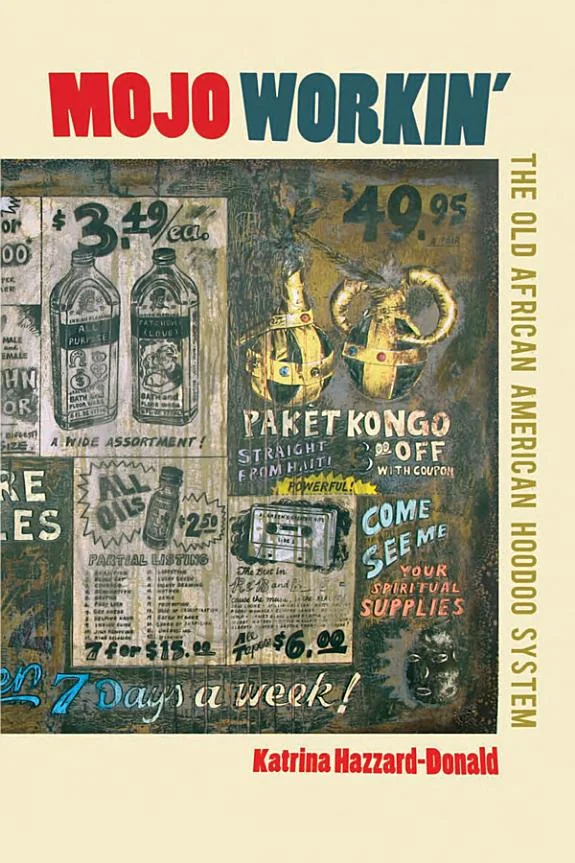
Mojo Workin'
 76
76

Mojo Workin'
Katrina Hazzard-Donald’s *Mojo Workin'* presents a compelling, if sometimes dense, argument for a more nuanced understanding of Hoodoo. Her central thesis, the identification of distinct "regional Hoodoo clusters," provides a valuable framework for appreciating the tradition’s diverse manifestations, a significant departure from prior scholarship that often treated it as a uniform practice. The book’s strength lies in its meticulous tracing of African retentions and their syncretic fusion into a distinct American spiritual system. However, the academic rigor, while admirable, can occasionally obscure the vibrant spirit of the practices it describes. For instance, the detailed discussion of the socio-historical forces shaping Hoodoo in the early 20th century, while crucial, sometimes feels more like an anthropological dissection than an exploration of lived faith. Despite this, the work offers a necessary corrective to simplistic views of African American spirituality. It is a serious scholarly contribution that demands attention from anyone invested in the history of American folk religion.
📝 Description
76
Katrina Hazzard-Donald's 2008 book, Mojo Workin', reconfigures the study of Hoodoo.
In Mojo Workin', Katrina Hazzard-Donald presents Hoodoo as a dynamic system of African American folk magic, healing, and spirituality, challenging older academic views. She argues against seeing Hoodoo as a single entity, instead detailing its specific regional origins and evolution. The book traces Hoodoo's development from West African spiritual traditions and its adaptation within the American context, particularly from the 19th century into the early 20th century. Hazzard-Donald proposes that Hoodoo formed in three distinct regional clusters, a departure from generalized historical accounts. She examines the period around the turn of the 20th century, when Hoodoo practices faced misunderstanding and suppression. The book analyzes how these traditions continued and changed despite societal pressures and the influence of other religious movements. The work covers the herbal, healing, and spiritual aspects of Hoodoo, emphasizing its role as a belief and practice system for marginalized communities. Hazzard-Donald highlights how practitioners actively shaped their spiritual world. It also looks into how knowledge passed through oral traditions and family lines, and how African cosmologies were adapted to the conditions of enslavement and life after emancipation in the Americas.
Mojo Workin' situates Hoodoo within the broader spectrum of African diasporic spiritual systems. It connects the practices to West African cosmologies and examines their transformation under the pressures of enslavement and post-emancipation American society. The book focuses on the practical application of these traditions for healing, spiritual well-being, and community resilience, distinguishing it from purely theological or philosophical explorations of religion. It underscores the agency of practitioners in maintaining and adapting their spiritual heritage.
💡 Why Read This Book?
• Gain a nuanced understanding of Hoodoo's origins by exploring Hazzard-Donald's concept of "regional Hoodoo clusters," appreciating its development across specific geographical and cultural contexts. • Understand the historical suppression and persistence of Hoodoo, particularly through the book's analysis of the period after the turn of the 20th century. • Discover Hoodoo as a complex system of healing and spirituality, examining its roots in African traditions and its adaptation within African American life.
⭐ Reader Reviews
Honest opinions from readers who have explored this book.
❓ Frequently Asked Questions
What is the primary argument of Katrina Hazzard-Donald's 'Mojo Workin''?
The book argues that Hoodoo originated in three distinct "regional Hoodoo clusters" rather than as a single, unified tradition, tracing its evolution from African spiritual practices to its form in the Americas.
What historical period does 'Mojo Workin'' focus on?
While tracing roots back to Africa, the book significantly examines the development and practice of Hoodoo after the turn of the 20th century, a period of significant cultural and social change.
How does 'Mojo Workin'' approach the study of Hoodoo?
It offers a bold reconsideration, working against conventional scholarship by emphasizing Hoodoo's emergence from specific African traditions and its unique historical trajectory within African American communities.
What types of practices are explored in 'Mojo Workin''?
The book explores the herbal, healing, and folk belief aspects of Hoodoo, examining it as a vital spiritual and cultural practice for African Americans.
Who is Katrina Hazzard-Donald?
Katrina Hazzard-Donald was a scholar who significantly contributed to the understanding of African American religious history and folk traditions, with 'Mojo Workin'' being a key publication.
When was 'Mojo Workin'' first published?
'Mojo Workin'' was first published on December 30, 2012, offering a contemporary scholarly perspective on an ancient tradition.
🔮 Key Themes & Symbolism
Regional Hoodoo Clusters
Hazzard-Donald introduces the concept of three distinct "regional Hoodoo clusters" as the origin points for the tradition. This framework challenges monolithic interpretations, suggesting that Hoodoo developed unique characteristics based on geography and the specific cultural syncretisms occurring in areas like the Caribbean, the Deep South, and urban centers. The work meticulously analyzes how these regional variations influenced practices, beliefs, and the transmission of spiritual knowledge, moving beyond a generalized historical overview.
African Retentions and Syncretism
The book traces the lineage of Hoodoo back to West African spiritual and healing traditions. It details how enslaved Africans and their descendants adapted these ancient cosmologies and practices to the new world, blending them with elements of Christianity and other available cultural resources. This process of syncretism is presented not as a dilution, but as a vital act of cultural preservation and innovation, allowing for the creation of a distinct and resilient African American spiritual system.
Hoodoo as Healing and Spiritual Practice
Beyond mere superstition, Hazzard-Donald frames Hoodoo as a sophisticated system of spiritual technology, encompassing herbalism, divination, and spiritual work aimed at healing, protection, and well-being. The text emphasizes the agency of practitioners within these traditions, highlighting how Hoodoo provided tools for reading through the challenges of life, particularly for marginalized communities. It explores the practical application of its beliefs and rituals in everyday life.
Post-20th Century Evolution
A significant portion of the work focuses on the period after the turn of the 20th century. This era saw Hoodoo facing increased scrutiny, misunderstanding, and attempts at suppression, alongside its continued adaptation and evolution. Hazzard-Donald examines how practitioners maintained and transmitted their knowledge despite these pressures, and how the tradition continued to serve its community, adapting to new social and economic conditions.
💬 Memorable Quotes
Direct passages from the work, attributed to the author.
“Hoodoo emerged first in three distinct regions she calls 'regional Hoodoo clusters'.”
— This is the central thesis of Hazzard-Donald's work, proposing a new academic model for understanding the geographical and cultural origins of Hoodoo, moving away from generalized narratives.
“She examines Hoodoo culture and history by tracing its emergence from African traditions to religious practices in the Americas.”
— This highlights the book's methodological approach, connecting ancient African spiritual roots directly to their manifestation and evolution within the African American experience in the Western Hemisphere.
“A bold reconsideration of Hoodoo belief and practice.”
— This phrase signifies the author's intention to challenge existing academic frameworks and offer a fresh, critical perspective on the historical and cultural significance of Hoodoo.
“She argues that Hoodoo emerged first in three distinct regions...”
— This interpretation emphasizes Hazzard-Donald's specific geographical hypothesis, suggesting that Hoodoo's development was not uniform but varied significantly across different American locales.
💡 Key Ideas
Editorial paraphrase of the work's core concepts — not direct quotes.
Katrina Hazzard-Donald explores African Americans' experience and practice of the herbal, healing folk belief tradition known as Hoodoo.
This summarizes the book's focus on Hoodoo as a lived tradition, emphasizing its practical aspects related to herbalism and healing within the context of African American culture and spirituality.
🌙 Esoteric Significance
Tradition
While Hoodoo is not typically categorized within Western Esotericism in the same vein as Hermeticism or Kabbalah, Hazzard-Donald's work bridges the gap by examining its deep roots in African spiritual traditions and its syncretic development. It functions as a crucial text for understanding folk magic and spiritual technology as they manifest outside formal Western esoteric lineages, offering insights into animistic, ancestral, and nature-based spiritual systems that share thematic resonances with esoteric thought.
Symbolism
The book implicitly engages with numerous symbols central to Hoodoo, such as the significance of specific herbs (e.g., for protection or healing), the power attributed to roots and natural elements, and the role of spiritual intermediaries or ancestors. While not always framed in classical esoteric terms, these elements function symbolically within the tradition to mediate spiritual forces, effect change, and maintain balance between the human and spiritual realms.
Modern Relevance
Contemporary practitioners of African diasporic religions, conjure artists, and scholars of folk magic frequently cite Hazzard-Donald's work. Her framework for understanding regional variations and historical development informs modern discussions on Hoodoo's authenticity, its adaptation in urban environments, and its continued relevance as a spiritual technology for community empowerment and personal well-being.
👥 Who Should Read This Book
• Students of African American religious history and folklore: Gain a foundational understanding of Hoodoo's origins and evolution, challenging previous academic assumptions. • Practitioners of Hoodoo and conjure traditions: Deepen your knowledge of the historical roots and diverse regional expressions of your practice, informed by scholarly research. • Comparative religion scholars: Explore the dynamics of syncretism and cultural adaptation through the lens of a vibrant African American spiritual system.
📜 Historical Context
Published in 2012, *Mojo Workin'* arrived at a time when academic interest in African American vernacular religions was robust, yet often still grappling with the legacy of Orientalist scholarship and reductive categorizations. Katrina Hazzard-Donald's work directly confronted conventional scholarship by proposing the "regional Hoodoo clusters" thesis, a significant departure from scholars who viewed Hoodoo more monolithically. Her meticulous research into the period after the turn of the 20th century provided a critical counterpoint to earlier studies that might have focused more on the antebellum South. While not directly engaging in a public debate with a specific contemporary, her work implicitly challenged prevailing narratives and offered a more granular, geographically informed understanding of Hoodoo's complex development and resilience within African American communities.
📔 Journal Prompts
The concept of "regional Hoodoo clusters" and its implications for practice.
Tracing the lineage of specific African traditions within American Hoodoo.
The role of herbalism and healing practices in the context of Hoodoo.
How societal pressures after the turn of the 20th century impacted Hoodoo.
The significance of spiritual agency within the Hoodoo tradition.
🗂️ Glossary
Hoodoo
A spiritual and magical tradition originating from African traditions, practiced by African Americans, incorporating elements of herbalism, divination, and spiritual work for healing and well-being.
Regional Hoodoo Clusters
Katrina Hazzard-Donald's proposed framework identifying three distinct geographical areas where Hoodoo initially developed its unique characteristics and practices.
Syncretism
The blending of different religious, spiritual, or cultural beliefs and practices, particularly the fusion of West African traditions with Christianity in the Americas.
Folk Belief
A system of beliefs and practices held by a community, often passed down through oral tradition, typically distinct from formal religious doctrines.
Herbalism
The practice of using plants and plant extracts for medicinal, spiritual, or magical purposes, a significant component of Hoodoo traditions.
African Retentions
Beliefs, practices, or cultural elements that have been preserved from African ancestral traditions and continue to be expressed in new cultural contexts.
Spiritual Technology
A term used to describe Hoodoo as a system of practical methods and techniques for interacting with and influencing spiritual forces.
This book appears in 1 collection
🔮 Readers Also Liked
Browse all →









From the “Hoodoo” Collection
View all →







More Free Occult Philosophy Books
View all →