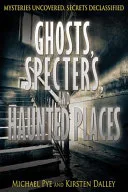
Ghosts, Specters, and Haunted Places
 80
80

Ghosts, Specters, and Haunted Places
The strength of Pye and Dalley's "Ghosts, Specters, and Haunted Places" lies in its commitment to presenting the paranormal not as folklore, but as a subject of active, albeit often fringe, academic investigation. The essay focusing on the historical records of spectral sightings around the turn of the 20th century, for instance, offers a compelling look at how societal anxieties and technological advancements influenced interpretations of the uncanny. However, the book occasionally suffers from a lack of editorial cohesion, with some essays feeling more like personal anecdotes than rigorous research. A significant passage detailing the alleged psychic residue at a specific Victorian manor, while intriguing, lacks the necessary corroborating evidence to satisfy a critical reader. Despite these limitations, the collection provides a valuable snapshot of paranormal research at the time of its publication.
📝 Description
80
Published in 2013, Ghosts, Specters, and Haunted Places examines spectral phenomena and haunted locales.
This 2013 collection gathers essays from researchers active in paranormal investigation. It moves beyond sensationalism to present empirical observations and theoretical frameworks applied to hauntings, apparitions, and poltergeist activity. The authors share their methodologies, challenges, and conclusions, offering a candid look at the practicalities of studying the unexplained. The book's structure accommodates diverse perspectives, from detailed case studies to broader philosophical considerations of belief and evidence in the paranormal field.
The contributors operate on the 'front lines of inquiry,' detailing their firsthand accounts and studies. The collection aims for a balanced approach, blending practical investigation with theoretical analysis. It seeks to understand the nature of spectral experiences and the places associated with them, presenting a scholarly yet accessible overview of the subject.
This work engages with traditions that seek to understand and document phenomena beyond conventional scientific explanation. It touches upon spiritualist inquiries into the nature of consciousness and the afterlife, examining claims of visitation and residual energy. By focusing on empirical observation and scholarly analysis, the book situates itself within a lineage of researchers who have attempted to systematically study reported supernatural occurrences, bridging folk beliefs with critical inquiry.
💡 Why Read This Book?
• Gain practical insights into ghost-hunting methodologies from researchers actively documenting spectral phenomena, distinct from fictional portrayals. • Understand the historical evolution of ghost lore and its connection to specific eras, such as the late 19th-century spiritualist movements, offering a contextualized view. • Explore the varied academic approaches to studying hauntings, as evidenced by the diverse case studies presented, providing a critical lens on paranormal evidence.
⭐ Reader Reviews
Honest opinions from readers who have explored this book.
❓ Frequently Asked Questions
When was 'Ghosts, Specters, and Haunted Places' first published?
The book 'Ghosts, Specters, and Haunted Places' was first published in 2013, bringing together contemporary research on paranormal phenomena.
Who are the primary authors or editors of this collection?
Michael Pye and Kirsten Dalley are credited with editing and compiling the essays in 'Ghosts, Specters, and Haunted Places'.
What kind of research is presented in the book?
The book features research from individuals on the 'front lines of inquiry into the paranormal,' sharing their investigations and findings on ghosts and haunted places.
Does the book focus on a specific type of haunting?
No, the collection covers a range of paranormal subjects, including ghosts, specters, and various haunted places, offering diverse perspectives.
What is the primary aim of the essays in this collection?
The essays aim to share research and personal stories from paranormal investigators, contributing to the ongoing study of unexplained phenomena.
Is this book suitable for skeptics?
The book presents research and case studies from those actively investigating the paranormal, offering a viewpoint for both believers and those seeking to understand the field critically.
🔮 Key Themes & Symbolism
The Nature of Apparitions
The work grapples with the definition and manifestation of ghosts and specters, moving beyond simple folklore to explore documented sightings. It considers how these phenomena are perceived and interpreted by witnesses and researchers alike, often examining the psychological and environmental factors that may contribute to reported experiences. The essays study specific case studies, attempting to categorize different types of apparitions and their potential origins, challenging conventional explanations and inviting a deeper consideration of residual energies or consciousness imprints.
Investigating Haunted Locations
This theme centers on the practical aspects of exploring sites believed to be haunted. The authors detail their methodologies, from historical research and environmental analysis to the use of recording equipment and sensory observation. The book highlights the challenges inherent in such investigations, including the difficulty of replicating conditions, the subjective nature of personal experiences, and the potential for misinterpretation. It presents a candid view of fieldwork, emphasizing the dedication and systematic approach required by those who actively study these environments.
Belief Systems and Evidence
The collection critically examines the interplay between belief in the paranormal and the demand for empirical evidence. It questions what constitutes valid proof in the study of ghosts and hauntings, contrasting anecdotal accounts with more structured research findings. The essays explore the societal and cultural factors that shape our willingness to accept or reject paranormal claims, touching upon the philosophical underpinnings of skepticism and belief. This theme encourages readers to consider the criteria by which we evaluate extraordinary phenomena.
Historical Context of Hauntings
The book situates contemporary paranormal investigations within a broader historical framework, tracing the evolution of ghost stories and beliefs across different eras. It examines how cultural shifts, scientific understanding, and societal anxieties have influenced the way hauntings are perceived and reported. By referencing historical accounts and movements, such as spiritualism in the 19th century, the authors provide context for modern phenomena, suggesting that the understanding and reporting of spectral events are not static but are shaped by their temporal and cultural milieu.
💬 Memorable Quotes
Direct passages from the work, attributed to the author.
“The authors are on the front lines of inquiry into the paranormal.”
— This phrase underscores the book's unique position, highlighting that the contributors are actively engaged in contemporary research and fieldwork, rather than solely theoretical or historical analysis.
“Sharing their research and stories.”
— This emphasizes the dual nature of the content – a blend of structured findings and personal narrative, offering both empirical data and experiential accounts from investigators.
“The work explores spectral phenomena and purportedly haunted locales.”
— This concisely defines the subject matter, indicating a focus on apparitions, ghosts, and specific locations associated with such reported activities.
“Essays by a group of people on the front lines of inquiry.”
— This highlights the collaborative and investigative nature of the book, suggesting a collective effort by individuals actively pursuing knowledge in the paranormal field.
“A collection of essays examining ghosts and hauntings.”
— This straightforward description points to the book's format and core subject, indicating a compilation of distinct pieces focused on spectral and poltergeist phenomena.
🌙 Esoteric Significance
Tradition
While not explicitly aligning with a single esoteric lineage, the book engages with themes resonant in Western Esotericism, particularly those concerning consciousness, residual energies, and the nature of reality beyond the material. It touches upon concepts that parallel ideas found in spiritualism and certain branches of occult philosophy that explore psychic phenomena and the afterlife, offering a contemporary, empirically-focused lens on subjects historically explored through mystical and ritualistic means.
Symbolism
The 'ghost' and 'specter' themselves function as potent symbols, representing unresolved energies, traces of past events, or manifestations of collective or individual consciousness. 'Haunted Places' symbolize locations imbued with these energies, acting as focal points where the veil between worlds is perceived as thin. These symbols often allude to themes of memory, trauma, and the persistence of the past, inviting contemplation on the energetic imprint left by human experience.
Modern Relevance
Contemporary paranormal investigation, often influenced by media portrayals and technological advancements, continues to draw on the empirical, case-study approach exemplified in this book. Thinkers and practitioners exploring consciousness studies, quantum entanglement theories applied to psychic phenomena, and even certain forms of energy healing might find the detailed observations and methodological considerations presented here relevant to their own inquiries into non-material realities.
👥 Who Should Read This Book
• Aspiring paranormal investigators seeking to understand the methodologies and challenges involved in documenting hauntings. • Students of folklore and cultural history interested in the evolution of ghost lore and its societal impact. • Skeptics and critical thinkers looking to engage with contemporary research and case studies in the field of paranormal investigation.
📜 Historical Context
Published in 2013, "Ghosts, Specters, and Haunted Places" emerged during a period where paranormal investigation was increasingly professionalized, albeit still largely outside mainstream academia. The early 21st century saw a proliferation of television programs dedicated to ghost hunting, influencing public perception and the methods employed. This book reflects that trend by featuring researchers actively documenting their findings. It sits in contrast to earlier, more philosophical explorations of the supernatural, such as those by figures like F.W.H. Myers in the late 19th century, who were instrumental in the early Society for Psychical Research. While the book doesn't directly engage with specific contemporaries in its blurb, its existence implies an ongoing discourse with other investigators and authors in the field of parapsychology and cryptozoology, seeking to establish a more empirical footing for the study of hauntings.
📔 Journal Prompts
The concept of 'residual energy' in haunted locations.
Documented spectral sightings versus personal experience.
The role of historical context in interpreting hauntings.
Methodologies employed by paranormal researchers.
The definition of 'ghost' or 'specter' in contemporary inquiry.
🗂️ Glossary
Specter
A visual manifestation, often perceived as a ghost or apparition, typically associated with a specific location or event.
Haunted Places
Locations where paranormal activity, such as the appearance of ghosts or unexplained phenomena, is frequently reported or believed to occur.
Paranormal Inquiry
The systematic investigation of phenomena that are considered outside the scope of normal scientific understanding, including ghosts, ESP, and poltergeists.
Apparition
A ghost or ghostlike image of a person, often appearing unexpectedly and without clear physical cause.
Case Study
A detailed examination of a specific instance or event, in this context, relating to a particular haunting or paranormal phenomenon.
Residual Energy
A theoretical concept suggesting that strong emotions or events can leave an imprint on a location, which may manifest as recurring phenomena.
Poltergeist
A type of ghost or spirit believed to cause physical disturbances, such as noises, moving objects, or physical assaults.