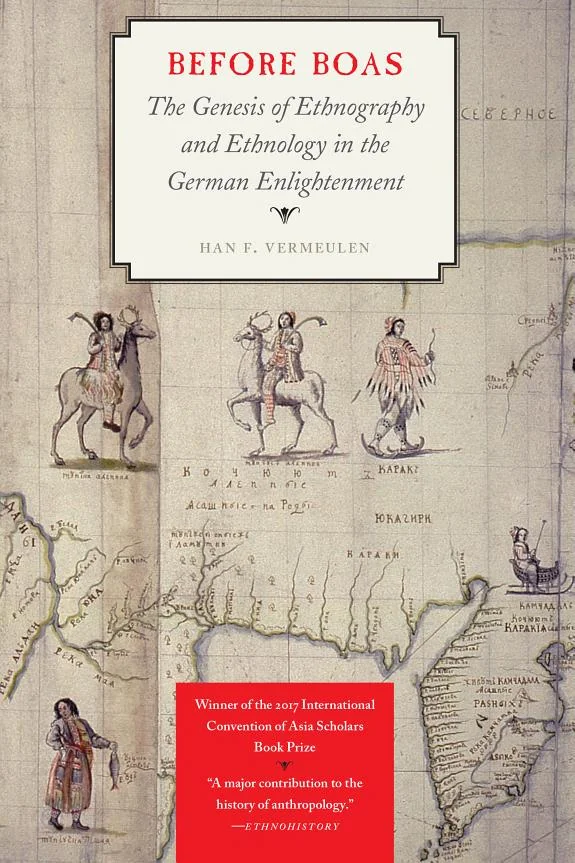
Before Boas
 78
78

Before Boas
Han F. Vermeulen's Before Boas performs a necessary archival excavation, unearthing the eighteenth-century roots of disciplines we typically associate with the late nineteenth. The book’s central thesis—that ethnography and ethnology developed parallel to, rather than solely out of, the “natural history of man”—is persuasively argued through extensive engagement with primary texts. Vermeulen’s examination of early travelogues and scientific correspondence offers a compelling counter-narrative to the established lineage of anthropology. A limitation, however, lies in the density of the academic prose, which may present a barrier to readers less familiar with the historiography of the social sciences. The specific discussion of Johann Georg Forster's contributions, for instance, provides a rich, albeit complex, illustration of eighteenth-century ethnographic practice. This work is a vital corrective for anyone invested in the intellectual genealogy of understanding human diversity.
📝 Description
78
Han F. Vermeulen's Before Boas argues that ethnography and ethnology originated in the eighteenth century.
Before Boas challenges the standard account of anthropology's origins. The book contends that the core disciplines of ethnography, the description of cultures, and ethnology, the comparative study of cultures, took shape in the eighteenth century. This period, marked by Enlightenment thinking and global exploration, saw the development of what was then called the "natural history of man." Vermeulen meticulously sifts through primary and secondary sources to show how this earlier work laid the conceptual and methodological groundwork for later anthropological thought.
The author distinguishes between the independent emergence of ethnographic fieldwork and ethnological comparison. He demonstrates how the systematic observation and classification of human societies and their customs during the eighteenth century provided the essential foundations that were later absorbed into the formal discipline of anthropology. This reevaluation questions the common narrative that traces the field's beginnings primarily to the late nineteenth century and figures like Franz Boas.
While not strictly esoteric in the occult sense, this book engages with the history of human observation and classification, a pursuit that touches upon the esoteric traditions' long interest in understanding humanity's place in the cosmos. The systematic study of diverse peoples and customs, even when framed within Enlightenment science, shares a lineage with earlier attempts to categorize and comprehend the world's peoples and their beliefs. Before Boas situates this intellectual endeavor within a specific historical moment, revealing how seemingly secular scientific pursuits can have roots in older, broader inquiries into human nature and diversity.
💡 Why Read This Book?
• Gain a revised understanding of anthropology's genesis by learning about the eighteenth-century development of ethnography and ethnology, challenging the common attribution of these fields solely to the late 1800s. • Understand the concept of "natural history of man" as a foundational intellectual current, recognizing its role in shaping early comparative studies of human societies before the formalization of anthropology. • Discover the work of lesser-known, yet pivotal, eighteenth-century scholars and travelers whose writings Vermeulen highlights as crucial evidence for the discipline's earlier origins, moving beyond a Boasian-centric view.
⭐ Reader Reviews
Honest opinions from readers who have explored this book.
❓ Frequently Asked Questions
When did ethnography and ethnology truly begin, according to Before Boas?
Before Boas posits that ethnography and ethnology originated and developed concurrently during the eighteenth century, predating the formal establishment of anthropology as a discipline in the nineteenth century.
What was the "natural history of man" discussed in the book?
The "natural history of man" was an eighteenth-century intellectual pursuit focused on the systematic observation, description, and classification of human beings and their societies, acting as a precursor to modern anthropology.
Who is considered a key figure in the book's argument for earlier origins?
While the book examines numerous primary sources, figures like Johann Georg Forster are discussed for their contributions to eighteenth-century ethnographic description and comparative thought, illustrating the discipline's nascent stages.
How does Before Boas differ from traditional accounts of anthropology's history?
It shifts the focus from the late nineteenth century and figures like Franz Boas to the eighteenth century, arguing for the parallel development of key anthropological methods and concepts alongside the study of natural history.
What kind of primary sources does Han F. Vermeulen utilize?
The book draws upon a wide array of primary and secondary sources, including historical travel accounts, scientific correspondence, and early scholarly publications from the eighteenth century.
Does this book present Franz Boas as unimportant?
No, the book does not diminish Boas's significance but rather reframes the historical trajectory of anthropology by highlighting the substantial intellectual and methodological foundations laid in the century prior to his major influence.
🔮 Key Themes & Symbolism
Eighteenth-Century Ethnography
This theme explores the sophisticated descriptive practices and observational methods employed by writers and travelers in the 1700s. Vermeulen argues that these efforts constituted early ethnography, focusing on detailed accounts of customs, social structures, and beliefs of diverse populations encountered during periods of exploration and colonial expansion. It highlights how these empirical observations laid crucial groundwork for later anthropological analysis, challenging the notion that systematic fieldwork began only with figures like Boas.
The "Natural History of Man"
This theme examines the intellectual current known as the "natural history of man," prevalent in the Enlightenment. It encompassed the systematic classification and study of human beings from biological, geographical, and cultural perspectives. Vermeulen positions this pursuit as a direct precursor to anthropology, demonstrating how it fostered comparative thinking and the collection of data about different peoples, which were essential for developing ethnology.
Parallel Development of Disciplines
A central argument is that ethnography and ethnology did not simply evolve into anthropology but developed in parallel with the broader "natural history of man." This perspective suggests a more complex and multi-stranded origin story for the discipline, acknowledging contributions from various scientific and scholarly endeavors of the eighteenth century rather than a single, linear progression.
Historiography of Anthropology
The book critically engages with the established historiography of anthropology, questioning how narratives are constructed and who is credited with originating key ideas. By re-examining primary sources and challenging the conventional timeline, Vermeulen offers a revised understanding of the discipline's intellectual lineage and academic formation.
💬 Memorable Quotes
Direct passages from the work, attributed to the author.
“Ethnography and ethnology developed parallel to anthropology, or the “natural history of man.””
— This core assertion reframes the origins of anthropological study, suggesting that the descriptive (ethnography) and comparative (ethnology) components of the field emerged alongside, rather than solely out of, the broader Enlightenment interest in cataloging human diversity.
“The history of anthropology has been written from multiple viewpoints, often from perspectives of gender, nationality, theory, or politics.”
— This observation highlights the subjective nature of historical accounts. Vermeulen suggests that conventional narratives of anthropology's past may be influenced by biases, prompting a need for re-examination through diverse scholarly lenses.
“Before Boas delves deeper into issues concerning anthropology’s academic origins...”
— This statement signals the book's critical approach to its subject matter. It aims to move beyond surface-level understandings of anthropological history to investigate the deeper, often overlooked, foundational elements and early influences.
“Han F. Vermeulen explores primary and secondary sources...”
— This indicates the methodological approach of the work. By engaging directly with original documents and previous scholarship, the author builds a case based on empirical evidence rather than relying solely on established interpretations.
“ethnography and ethnology originated during the eighteenth rather than the nineteenth century”
— This is the central chronological claim of the book, directly challenging the widely accepted view that these core anthropological methods and fields of study are primarily nineteenth-century developments.
🌙 Esoteric Significance
Tradition
While not strictly esoteric in the vein of Hermeticism or Kabbalah, Before Boas touches upon an early form of occult-adjacent inquiry: the systematic cataloging of human diversity. The "natural history of man" shared with esoteric traditions a drive to uncover universal laws and hidden connections within the cosmos, albeit through empirical observation rather than mystical revelation. It represents a rationalist precursor to later occult movements that sought to map the totality of existence.
Symbolism
The primary 'symbol' explored is the human being itself, viewed not as an individual soul but as a specimen within a grand catalog of creation. Different cultures and peoples are treated as distinct entries, akin to species in natural history. The act of classification and comparison becomes a symbolic representation of humanity's attempt to impose order and understanding upon the perceived chaos of global diversity.
Modern Relevance
Contemporary scholars of critical theory, post-colonial studies, and the history of science draw on the book's critique of disciplinary origins. Its emphasis on the constructed nature of anthropological knowledge appeals to modern debates about representation, power, and the legacy of colonial discourse within academic fields. Thinkers interested in deconstructing established knowledge systems find value in Vermeulen’s archival re-evaluation.
👥 Who Should Read This Book
• Academic historians of anthropology and the social sciences seeking to revise foundational narratives about the discipline's origins. • Researchers in intellectual history interested in the Enlightenment's "natural history of man" and its influence on later scientific thought. • Critical theorists and post-colonial scholars interested in deconstructing the historical power dynamics embedded in the study of human cultures.
📜 Historical Context
Before Boas intervenes in the historiography of anthropology, a field often traced to the late nineteenth century and figures like Franz Boas. The book’s crucial intervention is to push this timeline back to the eighteenth century, an era dominated by Enlightenment thought and global exploration. During this period, the intellectual current known as the "natural history of man" flourished, encompassing systematic efforts to describe and classify human societies. Vermeulen argues that key concepts and methods of ethnography and ethnology were already taking shape within this broader scientific endeavor, concurrent with rather than subsequent to the "natural history of man." While the work doesn't detail specific reception events like bans or prizes, its significance lies in challenging the established disciplinary narrative. It implicitly engages with the work of contemporaries or predecessors who shaped the later anthropological canon, prompting a re-evaluation of earlier scholars whose contributions have been overshadowed.
📔 Journal Prompts
The "natural history of man" as a precursor concept.
Eighteenth-century methods of ethnographic description.
The parallel emergence of ethnography and ethnology.
Revisiting established academic origin stories.
Scholarly perspectives shaping the history of anthropology.
🗂️ Glossary
Ethnography
The descriptive study of individual cultures, involving detailed fieldwork and qualitative data collection on specific societies and their customs.
Ethnology
The comparative study of different cultures, aiming to identify similarities, differences, and general principles of human society through analysis of ethnographic data.
Natural History of Man
An eighteenth-century field of study concerned with the systematic description, classification, and comparison of human beings and their societies, encompassing biological and cultural aspects.
Primary Sources
Original documents or artifacts from the period being studied, such as letters, diaries, original publications, and field notes.
Secondary Sources
Works that analyze, interpret, or discuss primary sources, including later scholarly books and articles about historical events or figures.
Historiography
The study of the writing of history; it examines how historical accounts are constructed, the methods used by historians, and the evolution of historical interpretation.
Academic Origins
Refers to the historical development and establishment of a field of study as a formal academic discipline, including its key figures, theories, methods, and institutions.
This book appears in 1 collection
🔮 Readers Also Liked
Browse all →









From the “Enlightenment” Collection
View all →







More Free Esoteric History & Biography Books
View all →