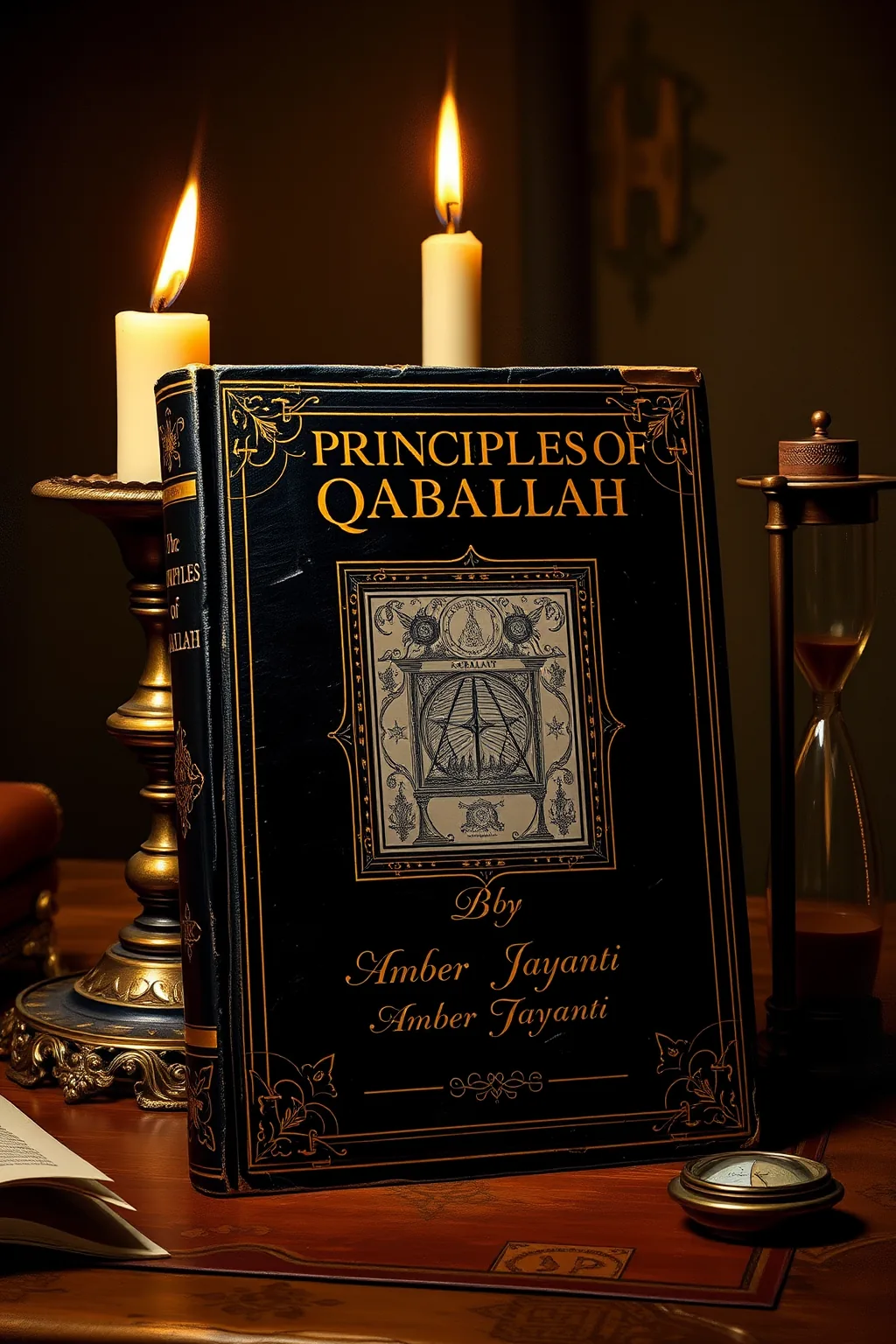
Principles of Qabalah
 80
80

Principles of Qabalah
Amber Jayanti’s Principles of Qabalah offers a commendably straightforward introduction to a subject dense with symbolism and history. The book excels in its clear exposition of the Tree of Life, a complex diagram that Jayanti manages to render comprehensible for the uninitiated. Her inclusion of Qabalah's connections to astrology and Tarot provides immediate practical relevance for practitioners of these arts. However, the work occasionally simplifies intricate philosophical concepts to a degree that may leave seasoned scholars wanting more depth. The passage discussing the concept of Ein Sof, while necessary for an introduction, could benefit from a more nuanced exploration of its paradoxical nature. Despite this, the book remains a valuable primer for anyone beginning their study of Western esotericism, offering a solid foundation for further exploration.
📝 Description
80
Amber Jayanti's Principles of Qabalah first published in 2016 offers an accessible entry into Jewish mysticism.
Principles of Qabalah by Amber Jayanti serves as an introduction to the Qabalah, a system of Jewish mysticism. The book aims to clarify concepts that are often seen as difficult, making them easier for newcomers to grasp. It details the core principles of this tradition, which has influenced many spiritual and esoteric practices.
Readers will find explanations of the spiritual structures that underpin various religious and occult systems. The book is structured as a guide for those interested in what is sometimes called the "yoga of the West." It provides a framework for personal development and a more balanced approach to life. Connections are drawn to magic, astrology, mythology, and the Tarot for those interested in these areas.
The Qabalah, with roots stretching back centuries, has been studied by Jewish mystics, Christian Kabbalists, and Hermetic scholars. Jayanti's work places this tradition within a historical context, noting its lasting appeal and adaptability across cultures. The book follows its lineage through different interpretations and uses, showing how it has been applied in various ways over time.
💡 Why Read This Book?
• Gain a foundational understanding of the Tree of Life, a core Qabalistic diagram, and its symbolic representation of divine emanation as detailed in the early chapters, offering a unique map of consciousness. • Discover how the Qabalah intersects with other esoteric disciplines like astrology and Tarot, providing concrete examples of their shared symbolic language, a perspective not always clearly articulated elsewhere. • Explore practical applications for a more balanced life, learning how principles like the Sephiroth can inform personal growth and spiritual development, as suggested in the latter sections of the book.
⭐ Reader Reviews
Honest opinions from readers who have explored this book.
❓ Frequently Asked Questions
What is the origin of the Qabalah as presented in Amber Jayanti's book?
Principles of Qabalah traces the Qabalah's origins to Jewish mysticism, noting its subsequent adoption and adaptation by Christian Kabbalists and Hermetic scholars, highlighting its long and multifaceted history.
Does the book discuss the Tree of Life?
Yes, the book dedicates significant attention to explaining the Tree of Life, its ten Sephiroth, and the paths connecting them, presenting it as a central organizing principle of Qabalistic thought.
How does Amber Jayanti connect Qabalah to magic and astrology?
Jayanti explores how Qabalistic concepts and symbolism are integrated into magical practices and astrological systems, illustrating the shared esoteric vocabulary and worldview that binds these disciplines.
Is this book suitable for absolute beginners in esoteric studies?
The book is written as an introductory guide, aiming to demystify complex Qabalistic ideas for newcomers to esoteric philosophy and mysticism.
What does the 'yoga of the West' refer to in the context of Qabalah?
This phrase, mentioned in the book's blurb, suggests that Qabalah, like Eastern yoga, offers a path for spiritual discipline, self-understanding, and union with the divine.
When was Principles of Qabalah first published?
Amber Jayanti's Principles of Qabalah was first published in October 1998, making it a relatively modern introduction to an ancient tradition.
🔮 Key Themes & Symbolism
The Tree of Life
The central organizing principle of Qabalah, the Tree of Life is presented as a divine map of creation and consciousness. Jayanti explains its ten Sephiroth (emanations or attributes of God) and the 22 paths that link them, detailing how each Sephirah corresponds to specific divine names, archangels, planetary influences, and symbolic imagery. The work emphasizes its role as a framework for understanding both the macrocosm (universe) and the microcosm (human soul).
Esoteric Connections
Principles of Qabalah highlights the interwoven nature of Qabalistic thought with other esoteric traditions. It details how Qabalistic symbolism informs Western magical practices, astrological interpretations, and the archetypal imagery found in Tarot cards. The book explores these connections to demonstrate the universality of certain spiritual truths and the common symbolic language employed across different mystical systems.
Spiritual Development
Beyond its theoretical aspects, the book frames Qabalah as a practical path for personal transformation. Jayanti suggests that by understanding and applying the principles of the Tree of Life, individuals can achieve greater self-awareness, emotional balance, and spiritual insight. The work encourages readers to use Qabalistic concepts as tools for inner work and aligning oneself with divine principles.
Historical Lineage
The text provides a historical overview of the Qabalah, tracing its development from its roots in Jewish mysticism. It acknowledges the contributions of various scholars and traditions, including Hermetic Kabbalists and Christian interpretations, positioning the Qabalah as a resilient and adaptable system that has resonated across different religious and philosophical landscapes for centuries.
💬 Memorable Quotes
Direct passages from the work, attributed to the author.
“The Qabalah is the yoga of the West.”
— This analogy suggests that, much like Eastern yoga disciplines, Qabalistic study and practice offer a systematic method for spiritual development, self-mastery, and achieving a higher state of consciousness.
“The Tree of Life is a map of the soul.”
— This interpretation posits that the intricate structure of the Tree of Life, with its Sephiroth and paths, serves as a symbolic representation of the human psyche and its journey towards spiritual realization.
“Spiritual truths are behind all religious traditions.”
— This reflects a perennialist or syncretic view, suggesting that various religions, despite their external differences, share a common underlying mystical or spiritual essence that the Qabalah aims to reveal.
“Qabalah connects magic, astrology, and mythology.”
— This highlights the interdisciplinary nature of Qabalistic study, emphasizing how its principles and symbols provide a unifying framework for understanding the correspondences and symbolic language found across these diverse esoteric fields.
“Understanding Qabalah can lead to a healthier, more balanced life.”
— This points to the practical, psychospiritual benefits of engaging with Qabalistic concepts, suggesting that its insights can foster personal well-being and a greater sense of equilibrium.
🌙 Esoteric Significance
Tradition
This work is firmly situated within the Western Esoteric tradition, specifically drawing from the Hermetic Kabbalah lineage. It adapts and presents Qabalistic concepts, originally from Jewish mysticism, in a manner accessible to a broader audience interested in occult philosophy, magic, and comparative religion, bridging the gap between ancient wisdom and modern seekers.
Symbolism
Key symbols include the Tree of Life, representing the divine emanations and the structure of reality, and the Sephiroth, each an aspect of the divine and a stage of consciousness. The work also touches upon the Hebrew alphabet's mystical significance and the archetypal imagery associated with the Tarot, interpreting these as facets of a unified esoteric cosmology.
Modern Relevance
Principles of Qabalah continues to be relevant for contemporary practitioners of Western esotericism, including ceremonial magicians, Tarot readers, and astrological counselors. Its clear exposition of Qabalistic fundamentals provides a bedrock for understanding more advanced texts and practices within these fields, influencing spiritual seekers interested in self-knowledge and cosmic order.
👥 Who Should Read This Book
• Beginning students of Western Esotericism seeking a clear introduction to Qabalistic principles and terminology. • Individuals interested in comparative religion and mysticism who want to understand the spiritual architecture underlying various traditions. • Practitioners of magic, astrology, or Tarot looking to deepen their understanding of the symbolic systems and correspondences informing their craft.
📜 Historical Context
Published in 1998, Amber Jayanti's Principles of Qabalah emerged during a period of renewed popular interest in Western esotericism, following the foundational works of scholars like Gershom Scholem in the mid-20th century. The Qabalah itself has a long history, originating in medieval Jewish mysticism and later influencing Christian Kabbalah and Hermeticism. While its roots are deeply embedded in Jewish tradition, its universal symbolism has attracted thinkers across various faiths. During the Renaissance, figures like Pico della Mirandola championed Christian Kabbalah, demonstrating an early cross-pollination of ideas. By the late 20th century, when Jayanti's book appeared, Qabalistic concepts were being integrated into diverse New Age and occult circles, often presented alongside practices like Tarot and astrology, a trend also explored by authors like Lon Milo DuQuette. Jayanti's work aimed to synthesize these elements for a contemporary audience seeking accessible spiritual knowledge.
📔 Journal Prompts
The ten Sephiroth as aspects of consciousness: how do they manifest in your daily life?
Reflect on the paths connecting the Sephiroth and their symbolic meaning for your personal journey.
How does the Qabalah's concept of Ein Sof inform your understanding of the divine?
Consider the interplay between Qabalah and Tarot as described in the text.
Map your current life challenges onto the structure of the Tree of Life.
🗂️ Glossary
Qabalah
A mystical tradition, originating in Jewish mysticism, that explores the divine nature and the structure of the universe through symbolic interpretation, often centered on the Tree of Life.
Tree of Life
The central diagram in Qabalah, consisting of ten interconnected spheres (Sephiroth) and 22 paths, representing the divine emanations and a map of creation and consciousness.
Sephiroth
The ten divine emanations or attributes of God, forming the components of the Tree of Life. Each Sephirah represents a specific aspect of divinity and consciousness.
Ein Sof
A Kabbalistic term meaning 'Without End' or 'Infinite,' referring to God in His absolute, unknowable, and unmanifest aspect prior to any creation or emanation.
Hermetic Kabbalah
A form of Qabalah developed by non-Jewish mystics, particularly during the Renaissance, that integrates Kabbalistic concepts with Hermeticism, Neoplatonism, and Christian theology.
Gematria
A Kabbalistic practice of assigning numerical values to Hebrew letters and words to interpret hidden meanings and relationships between concepts.
Paths
The 22 connections or channels linking the ten Sephiroth on the Tree of Life, often associated with the letters of the Hebrew alphabet and representing stages of spiritual ascent or descent.
This book appears in 2 collections
🔮 Readers Also Liked
Browse all →









From the “Qabalah” Collection
View all →








More Free Kabbalah & Jewish Mysticism Books
View all →