Prayers of the Cosmos
 73
73

Prayers of the Cosmos
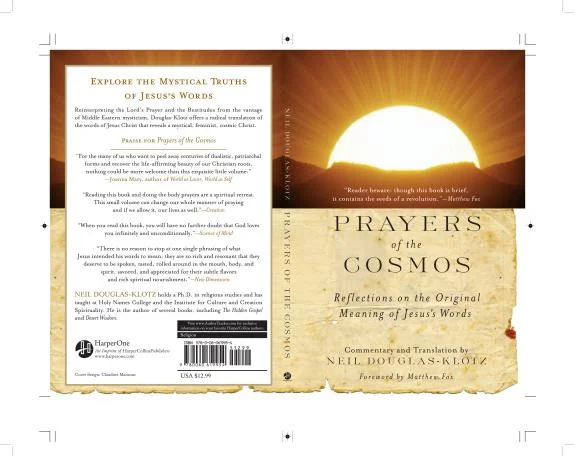
Neil Douglas-Klotz's *Prayers of the Cosmos* is a compelling re-examination of the Jesus tradition, moving away from the Hellenistic biases that have long shaped its interpretation. Douglas-Klotz, drawing on his expertise in Aramaic, argues convincingly that the language of Jesus's day fundamentally alters our understanding of his message. He illustrates this with specific Aramaic terms, showing how their inherent worldview, emphasizing interconnectedness and immanence, contrasts with later interpretations. A particularly striking aspect is his explication of 'Abwoon,' the Lord's Prayer, revealing its mystical depth when approached through its original linguistic and cultural matrix. While the scholarly rigor is commendable, the book occasionally risks becoming dense for the general reader, requiring careful attention to the linguistic arguments. Despite this, it offers a vital perspective for anyone seeking a more authentic connection to the historical Jesus and his original spiritual vision. It serves as a significant corrective to centuries of translation and interpretation.
📝 Description
73
Published in 2010, Neil Douglas-Klotz re-examines Jesus's sayings through their Aramaic roots.
Neil Douglas-Klotz's *Prayers of the Cosmos* argues that a deep understanding of Aramaic, the language Jesus likely spoke, fundamentally changes how his teachings are understood. Douglas-Klotz, who specializes in Middle Eastern mysticism, shows how the worldview embedded in Aramaic, which differs from later Greek and Latin translations, unlocks new meanings in Christian scripture. This is not a devotional book, but rather an academic study focused on the linguistic origins of these spiritual texts.
The book is for those interested in the historical Jesus, comparative religion, and the language behind spiritual writings. It will appeal to scholars, theologians, and dedicated students of esoteric traditions looking for interpretations beyond common understandings. Readers who value careful scholarship applied to religious origins, especially concerning Middle Eastern traditions, will find this work valuable. It is particularly suited for individuals who question existing translations and seek a more authentic grasp of ancient religious concepts.
This work situates itself within a tradition of scholarly inquiry into the historical and linguistic foundations of major world religions. It specifically engages with the study of early Christianity from a perspective that prioritizes original language sources, moving beyond interpretations shaped by centuries of translation and cultural assimilation. By focusing on Aramaic, the book taps into a lineage of mystical and contemplative traditions that seek direct access to spiritual truths through linguistic precision and a return to original contexts.
💡 Why Read This Book?
• Gain a radically different understanding of Jesus's core teachings by exploring their Aramaic linguistic roots, revealing concepts of immanence and interconnectedness previously obscured by translation. • Comprehend the profound impact of Aramaic's worldview on the interpretation of spiritual texts, moving beyond Greek and Latin frameworks to access deeper layers of meaning. • Discover the mystical dimensions of familiar prayers, such as the 'Abwoon' (Lord's Prayer), as Douglas-Klotz unpacks their original Aramaic significance and spiritual implications.
⭐ Reader Reviews
Honest opinions from readers who have explored this book.
❓ Frequently Asked Questions
What is the main argument of Prayers of the Cosmos?
The book argues that Jesus spoke Aramaic, and understanding this language reveals a different worldview and interpretation of his teachings than those derived from Greek or Latin translations.
Who is Neil Douglas-Klotz?
Neil Douglas-Klotz is an author and scholar known for his work on Middle Eastern mysticism and the Aramaic language, particularly its connection to early Christian texts and prayers.
How does the Aramaic language change the interpretation of Jesus's teachings?
Aramaic implies a worldview emphasizing interconnectedness and immanence, which Douglas-Klotz argues alters the meaning of concepts like the Kingdom of God compared to interpretations based on Greek or Latin.
Is this book a devotional or academic text?
It is primarily an academic exploration of linguistics and religious history, though it can certainly inform devotional practice by offering a new perspective on familiar prayers and sayings.
When was Prayers of the Cosmos first published?
The book was first published on December 14, 2010, though the author had been exploring these ideas for some time prior.
What is the significance of the 'Abwoon' in the book?
Douglas-Klotz uses the Aramaic Lord's Prayer, 'Abwoon,' to demonstrate how its original linguistic and cultural context reveals profound mystical meanings lost in conventional translations.
🔮 Key Themes & Symbolism
Aramaic Linguistic Lens
The central thesis revolves around the wide impact of Aramaic, the likely spoken language of Jesus, on his worldview and teachings. Douglas-Klotz argues that translations into Greek and Latin have fundamentally altered the original intent, obscuring a message rooted in immanence and interconnectedness. The work meticulously examines specific Aramaic terms and phrases, demonstrating how their inherent semantic fields and cultural connotations offer a richer, more mystical understanding of Jesus's spiritual insights, moving beyond dualistic interpretations.
Reclaiming Mystical Prayer
The book offers a re-examination of core Christian prayers, most notably the Lord's Prayer, through the 'Abwoon' (Aramaic) version. Douglas-Klotz unpacks the original Aramaic text, revealing layers of meaning related to the divine presence within, the interconnectedness of all beings, and the immanent nature of the divine. This approach aims to restore the prayer's original mystical potency, presenting it not as a petition to an external deity but as a vibrational attunement to the divine within oneself and the cosmos.
Jesus's Worldview
Douglas-Klotz reconstructs a potential worldview of Jesus as understood through his Aramaic linguistic context. This perspective emphasizes a non-dualistic understanding of reality, where the divine is not separate from creation but is immanent within it. The teachings are presented as guidance for spiritual awakening and realizing this inherent divinity, aligning with mystical traditions that emphasize inner transformation and direct experience of the sacred, rather than solely adherence to external dogma or future eschatological events.
Comparative Spirituality
By grounding Jesus's teachings in Aramaic, the book implicitly engages in comparative spirituality, highlighting parallels with other mystical traditions that emphasize inner experience and interconnectedness. The Aramaic perspective offers a bridge to understanding esoteric concepts found in Sufism, Kabbalah, and other wisdom traditions, suggesting a universality in the mystical quest for divine realization. It positions the Jesus tradition within a broader spectrum of spiritual exploration, emphasizing shared human experiences of the sacred.
💬 Memorable Quotes
Direct passages from the work, attributed to the author.
“Whatever Jesus said was said in Aramaic.”
— This foundational statement underscores the book's core argument: that linguistic context is paramount for accurate interpretation. It challenges the dominance of Greek and Latin texts and suggests that a different worldview is embedded within Aramaic.
“The Aramaic worldview implies a different relationship between God and humanity.”
— This highlights the shift from a potentially transcendent, external God to one that is immanent and intimately connected with creation and human consciousness, as suggested by the Aramaic linguistic framework.
“Understanding 'Abwoon' reveals the prayer's mystical depth.”
— This points to the re-evaluation of the Lord's Prayer, suggesting that its original Aramaic form carries spiritual significance related to inner divinity and cosmic unity that is lost in common translations.
“The impact of translation on religious texts is profound.”
— This emphasizes the critical role of language and translation in shaping religious understanding, arguing that literal or culturally biased translations can obscure or alter the original spiritual message.
“Jesus's message was about immanent spiritual awakening.”
— This interpretation suggests that Jesus's teachings were focused on realizing the divine within one's own being and the present moment, rather than solely on future salvation or external divine intervention.
🌙 Esoteric Significance
Tradition
This work significantly engages with the esoteric Christian tradition, particularly Gnostic and mystical interpretations that seek direct experience of the divine. It aligns with traditions that view Jesus as a spiritual teacher embodying divine wisdom, rather than solely as a figure of salvation. By emphasizing Aramaic, it connects to a lineage of spiritual seekers who look to original languages and cultural contexts for deeper meaning, echoing Hermetic principles of seeking hidden knowledge through diligent study and inner contemplation.
Symbolism
A key symbolic element is the concept of 'Abwoon,' the Aramaic rendition of the Lord's Prayer. Its reinterpretation symbolizes the potential for accessing divine presence within. Another motif is the 'Kingdom of Heaven' (Malkutha d'Shmaya), which Douglas-Klotz's Aramaic lens reframes from a future, external state to an immanent, internal reality – a state of divine consciousness accessible in the present moment.
Modern Relevance
Contemporary spiritual seekers and scholars interested in the historical Jesus and comparative mysticism find Douglas-Klotz's work highly relevant. It informs modern contemplative practices that emphasize immanence and interconnectedness, aligning with movements like the Jesus Seminar or New Age interpretations focusing on inner divinity. Thinkers exploring the intersection of language, consciousness, and spirituality often cite his work as a foundational text for re-examining Abrahamic traditions through a more mystical and less dogmatic lens.
👥 Who Should Read This Book
• Students of comparative religion and early Christianity seeking to understand the impact of Aramaic on Jesus's teachings, moving beyond standard translations. • Practitioners of contemplative prayer and mysticism interested in accessing the deeper, original meanings of familiar prayers like the Lord's Prayer. • Scholars and enthusiasts of Middle Eastern mysticism looking to connect Aramaic spiritual traditions with the historical Jesus and early Christian thought.
📜 Historical Context
Published in 2010, *Prayers of the Cosmos* emerged during a period of intensified scholarly interest in the historical Jesus and the Aramaic language. Neil Douglas-Klotz's work built upon earlier scholarship, such as that of scholars like Matthew Black and Joseph Fitzmyer, who had highlighted the importance of Aramaic for understanding the Gospels. This era saw a broader academic and popular re-engagement with non-canonical texts and a questioning of traditional interpretations derived solely from the King James Version or its successors. The book offered an alternative to the dominant Greek/Latin-centric interpretations of early Christianity, providing a lens through which to view Jesus's teachings through the specific cultural and linguistic framework of first-century Galilee. It contributed to the ongoing scholarly conversation about the linguistic and theological diversity within early Christian movements, often positioned against more Hellenistic philosophical influences.
📔 Journal Prompts
The Aramaic concept of 'Abwoon' and its implications for personal prayer.
Reflecting on the difference between immanent and transcendent understandings of the divine in Jesus's sayings.
How does the Aramaic worldview, emphasizing interconnectedness, challenge conventional interpretations of scripture?
The linguistic shift from Aramaic to Greek/Latin: what might have been lost?
Exploring the idea of the 'Kingdom of Heaven' as an internal state rather than a future event.
🗂️ Glossary
Aramaic
An ancient Semitic language spoken in the Middle East from the early 1st millennium BCE. It was the likely common language of Jesus and his disciples in Galilee and Judea.
Abwoon
The Aramaic word for 'Father' or 'Source,' used in Douglas-Klotz's reconstruction of the Lord's Prayer, emphasizing a more profound, encompassing relationship with the divine.
Malkutha d'Shmaya
Aramaic for 'Kingdom of Heaven' or 'Reign of the Heavens.' Douglas-Klotz interprets this as an inner, immanent state of consciousness rather than an external, future kingdom.
Immanence
The philosophical or theological concept that the divine is present within the material world and human consciousness, as opposed to transcendence, where the divine is entirely separate.
Worldview
The fundamental cognitive orientation of an individual or society encompassing the whole of the individual's or society's knowledge and point of view, deeply influenced by language.
Hellenistic
Pertaining to the period of ancient Greek history and culture following the death of Alexander the Great (323 BCE) and lasting until the Roman conquest of Egypt (30 BCE), characterized by the spread of Greek language and culture.
Esoteric
Intended for or likely to be understood by only a small number of people with a specialized knowledge or interest; inner, secret, or hidden teachings.
This book appears in 1 collection
🔮 Readers Also Liked
Browse all →





From the “Eastern Mysticism” Collection
View all →








More Free Mysticism & Contemplation Books
View all →