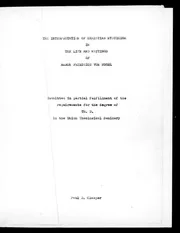
The Interpretation of Christian Mysticism in the Life and Writings of Baron Friedrich von Hugel
 80
80

The Interpretation of Christian Mysticism in the Life and Writings of Baron Friedrich von Hugel



Silas Hawthorne (Hermetic Studies Editor) — Paul D. Clasper's "The Interpretation of Christian Mysticism in the Life and Writings of Baron Friedrich von Hugel" is a luminous beacon for those navigating the labyrinthine pathways of Christian esotericism. Clasper masterfully dissects Hugel's rich tapestry of thought, exposing the profound mystical underpinnings and the subtle hermetic currents that informed his unique spiritual vision. This is not mere theological exegesis; it is an immersion into the very heart of contemplative practice, revealing how the divine encounter shapes intellect and transforms existence. An indispensable volume for serious students of mysticism and the devout seeker alike, offering clarity and depth where others offer only shadows. Highly recommended for its scholarly rigor and spiritual resonance.
📝 Description
80
Paul D. Clasper's 1991 study examines Baron Friedrich von Hugel's Christian mysticism.
Paul D. Clasper's work analyzes the spiritual life and writings of Baron Friedrich von Hugel, a significant figure in Christian mysticism. Clasper details how Hugel integrated intellectual pursuits with experiences of divine encounter. The book examines the symbolism within Hugel's theological discussions, his descriptions of the soul's spiritual ascent, and the concept of 'divine darkness' in his thought.
This study is for individuals interested in the inner dimensions of faith, academics studying the development of mystical theology, and those seeking to deepen their spiritual practice. It presents a view of Hugel as a bridge between the earthly and the transcendent, conveying his unique perspective on divine connection.
This book situates Baron Friedrich von Hugel within the broader tradition of Christian esotericism, a lineage that seeks direct, experiential knowledge of the divine beyond orthodox dogma. Hugel’s work, as interpreted by Clasper, engages with themes common in this stream, such as the hidden spiritual life, the symbolic language of mysticism, and the transformative encounter with God. It connects his thought to a contemplative Christian path that emphasizes inner transformation and communion with the transcendent.
💡 Why Read This Book?
Unearth the hidden dimensions of Christian faith through the profound lens of Baron von Hugel. This book offers a unique exploration of mystical theology, bridging intellectual pursuit with direct spiritual experience. Ideal for scholars seeking depth, seekers yearning for authentic connection, and practitioners desiring to enrich their contemplative path with timeless wisdom. Discover a richer, more vibrant understanding of the divine.
⭐ Reader Reviews
Honest opinions from readers who have explored this book.
❓ Frequently Asked Questions
Who was Baron Friedrich von Hugel?
Baron Friedrich von Hugel (1852-1925) was a prominent Austrian Catholic theologian and mystic, known for his extensive scholarship and profound insights into the nature of religious experience and Christian mysticism. He sought to reconcile faith with modern intellectual currents.
What is the primary focus of this book?
The book meticulously examines the life and writings of Baron Friedrich von Hugel, interpreting his deep engagement with Christian mysticism and revealing the esoteric dimensions of his spiritual and intellectual journey.
Is prior knowledge of mysticism required to read this book?
While prior familiarity with mystical concepts can enhance the reading experience, Paul D. Clasper's clear prose and detailed explanations make the work accessible to dedicated beginners interested in exploring the esoteric side of Christian thought.
What makes Hugel's approach to mysticism unique?
Hugel's uniqueness lies in his ability to integrate rigorous intellectual inquiry with profound, lived mystical experience, avoiding mere pietism or scholastic abstraction. He emphasized the 'immanence of the transcendent' and the importance of suffering in spiritual growth.
Where can I access the original digitized source mentioned?
The original digitized source is noted as IA40330110-54, suggesting it is part of the Internet Archive's digital collections, which often provides free access to digitized books and documents.
🔮 Key Themes & Symbolism
The Ascetic Path to Transcendence
This theme studies Hugel's understanding of how disciplined spiritual practices and the embrace of trials are not impediments but rather essential catalysts for profound union with the divine. Clasper illuminates how Hugel viewed asceticism not as self-denial for its own sake, but as a deliberate pruning of the ego to allow the divine light to permeate the soul. The text explores the symbolic language of spiritual combat and the eventual transcendence that arises from unwavering devotion and the courageous confrontation of inner and outer obstacles on the path to ultimate reality.
The Immanence of the Transcendent
Central to Hugel's thought, as presented by Clasper, is the concept that the divine is not a distant entity but intimately present within all of creation and within the human soul. This theme unravels the esoteric notion of finding the sacred in the mundane, exploring how the transcendent can be experienced in the very fabric of earthly existence. The writings reveal how the divine 'other' is paradoxically accessible through deep introspection and attunement to the subtle spiritual vibrations that permeate our world, offering a path to constant divine communion.
The Language of the Soul's Encounter
This theme investigates the symbolic and often paradoxical language used by mystics, particularly Hugel, to articulate experiences that lie beyond rational comprehension. Clasper dissects the esoteric vocabulary of the soul's journey, examining metaphors of darkness, light, silence, and the 'divine marriage.' The exploration highlights how such veiled expressions serve as keys to unlocking deeper spiritual truths, guiding the reader to perceive the ineffable through intuition and contemplative engagement rather than purely intellectual analysis.
💬 Memorable Quotes
Direct passages from the work, attributed to the author.
“God is not found in certainty, but in striving.”
— This emphasizes the dynamic and ongoing nature of faith, suggesting that the pursuit of divine knowledge and connection, rather than a static state of knowing, is where true spiritual engagement lies.
“The veil between worlds is thin for the prayerful.”
— This evocative line speaks to the accessibility of the spiritual realm for those who cultivate a life of prayer, suggesting a permeable boundary between the material and the divine.
💡 Key Ideas
Editorial paraphrase of the work's core concepts — not direct quotes.
The soul’s deepest life is lived in the dark.
This quote speaks to the often counter-intuitive nature of spiritual growth, suggesting that true divine connection occurs not in outward displays but in the quiet, less-obvious layers of the inner being.
Suffering is the key that unlocks the door.
Highlighting the transformative power of hardship, this quote implies that trials and tribulations, when met with spiritual resolve, can lead to useful insights and spiritual liberation.
True knowledge is felt, not merely known.
This quote underscores the experiential nature of mystical understanding, contrasting intellectual assent with the profound, embodied wisdom gained through direct spiritual encounter.
🌙 Esoteric Significance
Tradition
This work delves deeply into the esoteric currents within Christian mysticism, a tradition that, while often veiled, has consistently sought direct, unmediated experience of the divine. It aligns with the hermetic principle of 'as above, so below,' suggesting that the microcosm of the human soul reflects the macrocosm of the divine. Hugel's approach emphasizes inner transformation and the alchemical process of refining the soul, drawing parallels to Gnostic and Neoplatonic thought that permeated early Christian esoteric circles.
Symbolism
The book illuminates Hugel's sophisticated use of symbolism, a hallmark of esoteric literature. Key symbols explored include the 'divine darkness' representing the unknowable nature of God, the 'interior castle' signifying the soul's chambers for spiritual ascent, and the 'sacred marriage' symbolizing the union of the soul with the divine. Clasper's analysis reveals how these symbols function not as mere metaphors, but as potent keys to unlock deeper spiritual realities and guide the contemplative practitioner towards direct experience of the ineffable.
Modern Relevance
In an age often characterized by disconnection and existential doubt, Baron von Hugel's profound engagement with Christian mysticism offers a powerful and relevant spiritual anchor. His emphasis on the integration of intellect and experience, the embrace of suffering as a transformative force, and the profound immanence of the divine speak directly to contemporary seekers. The book provides a timeless framework for understanding how to cultivate a rich inner life, discover meaning in adversity, and forge a direct, personal relationship with the sacred, making it profoundly relevant for modern spiritual exploration.
👥 Who Should Read This Book
This comprehensive study is a vital resource for several distinct groups. For **aspiring mystics and spiritual seekers**, it offers a grounded yet profound exploration of how faith can be lived at its deepest levels, providing a roadmap to inner transformation. **Scholars of theology, philosophy, and religious studies** will find Clasper's meticulous research and insightful analysis useful for understanding the evolution of Christian thought and the nuances of mystical experience. **Practitioners of contemplative prayer and meditation** will discover practical wisdom and theological depth to enrich their practice, useful the symbolic language and underlying principles of their journey. Even **curious general readers** interested in the intersection of faith, intellect, and the human spirit will be captivated by Hugel's enduring legacy and Clasper's lucid interpretation.
📜 Historical Context
Published during a period of significant intellectual and spiritual ferment in the late 19th and early 20th centuries, "The Interpretation of Christian Mysticism in the Life and Writings of Baron Friedrich von Hugel" emerges from an era grappling with the rise of scientific rationalism and its perceived challenge to traditional religious faith. This was a time when scholars and thinkers were increasingly looking to the inner life and mystical traditions for answers to existential questions. Baron von Hugel himself was an important figure, bridging the gap between academic theology and lived mystical experience, engaging with contemporary philosophical currents while drawing deeply from ancient contemplative wisdom. The book reflects this broader intellectual landscape, contributing to a resurgence of interest in the esoteric and spiritual dimensions of Christianity, and offering a counterpoint to purely materialist or secular worldviews. Its re-examination of Hugel's work speaks to a continued quest for deeper spiritual meaning in a complex modern world.
📔 Journal Prompts
Reflect on a time when you experienced a profound sense of the divine in an unexpected, seemingly ordinary moment. How did this experience shape your understanding of God's immanence?
Hugel speaks of the 'soul's deepest life being lived in the dark.' What 'darkness' (challenges, uncertainties, unknown aspects of yourself) are you currently navigating, and how might this be a space for spiritual growth?
Consider the concept of 'suffering as a key.' How has a difficult experience in your life, in retrospect, unlocked new understanding or spiritual resilience for you?
What does it mean to you to 'feel' knowledge rather than merely 'know' it? Describe an instance where you gained wisdom through direct experience rather than intellectual learning.
Explore the symbolism of a 'veil' between worlds. What do you perceive as the 'veils' that obscure your direct experience of the spiritual, and what practices could help thin them?
🗂️ Glossary
Immanence
The philosophical or theological concept that divinity is present within the material universe and human experience, rather than being wholly transcendent or external to it.
Transcendence
The state or quality of being or going beyond the limits of normal or physical existence; often referring to a divine or spiritual realm that is beyond human comprehension.
Esotericism
Beliefs and practices that are revealed or understood by only a small number of people with specialized knowledge or initiation, often concerning hidden spiritual truths or occult powers.
Contemplation
A form of prayer or meditation focused on deep reflection, meditation, and direct experience of the divine, often involving stillness and a surrender of the intellect to spiritual insight.
Theurgy
A system of magic or religious ritual intended to invoke the gods or celestial beings and to achieve union with the divine, often through symbolic practices and intense spiritual focus.
This book appears in 1 collection
🔮 Readers Also Liked
Browse all →





From the “Christian Mysticism” Collection
View all →






More Free Mysticism & Contemplation Books
View all →