Poltergeists

 75
75

Poltergeists
Clarkson's "Poltergeists" presents a refreshingly sober approach to a topic often mired in sensationalism. The author's strength lies in his meticulous cataloging of reported incidents and his even-handed presentation of diverse theoretical explanations, drawing from parapsychological research and psychological studies. A particularly insightful section details the recurring patterns in agent-focused poltergeist cases, highlighting the correlation with adolescent stress. However, the work occasionally suffers from a lack of definitive conclusions, a common pitfall in parapsychological literature. While the exploration of environmental factors is thorough, the book could benefit from deeper engagement with contemporary scientific skepticism regarding the very existence of such phenomena. Despite this, Clarkson's "Poltergeists" serves as a valuable compendium for serious students of the unexplained.
📝 Description
75
Michael Clarkson's "Poltergeists" (2006) examines phenomena often dismissed as folklore.
Published in 2006, Michael Clarkson's "Poltergeists" analyzes events frequently relegated to folklore and sensationalism. The book moves beyond simple anecdotes to consider psychological, environmental, and energetic factors that might explain reported poltergeist activity. Clarkson synthesizes various theories, including psychokinetic energy and environmental disturbances, offering a structured understanding of an elusive subject. This work is suited for researchers of parapsychology, occult history enthusiasts, and anyone curious about the fringes of physical phenomena who prefers a systematic approach over pure speculation.
The study of poltergeists has a long, contentious history, with early cases like the "Drummer of Tedworth" (1662) sparking debate. Clarkson's book appears in an era where parapsychology held a more established academic presence than in earlier centuries. This period saw continued investigation into mediums and hauntings, influenced by figures and organizations like J.W. Dunne and the Society for Psychical Research (founded 1882). Clarkson engages with this lineage, building upon decades of documented cases and theoretical frameworks.
Clarkson's "Poltergeists" engages with the long tradition of investigating anomalous physical phenomena, a subject often explored within spiritualist and parapsychological circles. The book situates itself within a lineage that includes early documented cases and the formal academic inquiries of societies dedicated to psychical research. It grapples with concepts like psychokinesis and the potential influence of human agents or environments on physical events, placing it within a broader esoteric interest in the mind's interaction with the material world.
💡 Why Read This Book?
• Gain a structured understanding of reported poltergeist phenomena, moving beyond folklore by examining specific case studies and theories presented in the book's 2006 publication. • Explore the psychological underpinnings of hauntings, specifically the "agent-focused" theory and its documented links to adolescent individuals, a concept detailed within Clarkson's research. • Differentiate between various explanations for paranormal disturbances, including psychokinesis and environmental imprints, as discussed in the book's analysis of historical and contemporary accounts.
⭐ Reader Reviews
Honest opinions from readers who have explored this book.
❓ Frequently Asked Questions
What is the primary focus of Michael Clarkson's "Poltergeists"?
The book primarily focuses on examining reported poltergeist phenomena through a systematic lens, exploring psychological, environmental, and energetic factors rather than solely relying on anecdotal evidence.
When was Michael Clarkson's "Poltergeists" first published?
Michael Clarkson's "Poltergeists" was first published in 2006, placing its research and analysis within the context of early 21st-century parapsychological inquiry.
Does the book present definitive proof of poltergeist activity?
No, the book presents various theories and documented cases but does not claim to offer definitive proof, reflecting the ongoing debate and challenges in parapsychological research.
What different types of poltergeist activity does the book discuss?
It discusses agent-focused activity, often linked to individuals, and environment-focused activity, attributed to specific locations, exploring theories like psychokinesis and residual energy.
Who would benefit most from reading "Poltergeists"?
Researchers of parapsychology, occult history enthusiasts, students of psychology and sociology, and anyone seeking a structured, analytical approach to unexplained phenomena would benefit.
Are there any specific historical cases mentioned in the book?
While not explicitly detailed in summaries, the book likely references historical accounts to contextualize the study of poltergeists, building upon a tradition of inquiry dating back centuries.
🔮 Key Themes & Symbolism
Psychokinesis and Mind-Matter Interaction
The work extensively probes the concept of psychokinesis (PK), the alleged ability of the human mind to influence physical reality. Clarkson examines how this theoretical force might manifest in poltergeist events, from moving objects to unexplained noises. The book critically assesses evidence for PK, considering both anecdotal reports and experimental attempts to quantify such effects. It positions PK as a central, albeit controversial, hypothesis within the study of unexplained phenomena, inviting readers to consider the potential power of consciousness over matter. The implications for understanding reality are significant.
Agent-Focused vs. Environment-Focused Phenomena
A key distinction drawn in "Poltergeists" is between phenomena seemingly tied to a specific person (agent-focused) and those attributed to a location (environment-focused). The book dedicates considerable attention to agent-focused cases, often noting correlations with periods of stress or psychological upheaval in adolescents. Conversely, environment-focused activity is explored through concepts like "imprints" or "residual energy," suggesting that a location might retain energetic traces of past events. This dichotomy provides a framework for analyzing diverse hauntings and disturbances.
The Role of Belief and Perception
Clarkson acknowledges the significant influence of belief systems and individual perception on how paranormal events are interpreted. The work touches upon how pre-existing notions about ghosts or hauntings can shape an observer's experience and reporting of an event. It suggests that understanding the subjective element is crucial for any objective study of poltergeists. This theme highlights the interplay between the external event and the internal framework through which it is processed, a vital consideration in parapsychological research.
Historical Documentation and Parapsychology
The book anchors its discussion within the broader history of parapsychology and the study of the unexplained. By referencing documented cases and the evolution of theoretical models since the late 19th century, Clarkson situates his work within an ongoing academic and investigative tradition. This grounding emphasizes that the study of phenomena like poltergeists is not new but has a lineage of inquiry. It highlights the efforts to apply systematic methods to subjects often dismissed by mainstream science, underscoring the persistence of these investigations.
💬 Memorable Quotes
Direct passages from the work, attributed to the author.
“Poltergeist activity is often characterized by its apparent spontaneity and localized nature.”
— This highlights the core challenge in studying poltergeists: their unpredictable appearance and their tendency to manifest in specific, often confined, areas, making them difficult to observe and record systematically.
“The link between adolescent stress and agent-focused phenomena is a recurring pattern.”
— This interpretation points to a significant correlation observed in many cases, suggesting that psychological factors, particularly during developmental stages like adolescence, may play a central role in the manifestation of certain types of poltergeist activity.
“Environmental imprints are theorized as residual energies from past events.”
— This defines a specific concept where the 'haunting' is not caused by a conscious entity but by lingering energetic traces or elements of significant occurrences that have imprinted themselves onto a location.
“Distinguishing between psychological projection and genuine physical disturbance is paramount.”
— This emphasizes the critical analytical task for researchers: to carefully evaluate whether reported phenomena are caused by external physical forces or by the mind's own processes of perception and interpretation.
“The study of poltergeists requires a synthesis of anecdotal evidence and scientific methodology.”
— This underscores the book's approach, suggesting that while personal accounts are vital for identifying potential cases, rigorous investigation and theoretical frameworks are necessary to move towards a scientific understanding.
🌙 Esoteric Significance
Tradition
While not strictly tied to a single esoteric lineage, "Poltergeists" engages with themes relevant to Western esotericism, particularly its interest in the subtle energies and the power of consciousness. It touches upon concepts that resonate with psychical research traditions influenced by Theosophy and later New Age thought, which explored non-physical causation. The book's systematic approach differentiates it from purely mystical or occult texts, aiming for a more empirical (though still fringe) understanding of phenomena that have long been subjects of occult speculation.
Symbolism
The phenomena themselves can be seen as symbolic. The uncontrolled physical manifestations, often linked to psychokinesis, can symbolize the subconscious mind's power breaking through into the material world. Objects moving or breaking might represent internal turmoil or suppressed emotions finding an external outlet. The recurring association with adolescents can symbolize the tumultuous transition from childhood to adulthood, a period of intense psychic and emotional flux where boundaries between the inner and outer self become blurred.
Modern Relevance
Clarkson's work remains relevant to contemporary discussions in parapsychology and the study of anomalous experiences. It provides a foundational text for understanding the historical and theoretical range of poltergeist research. Modern practitioners and researchers in fields like consciousness studies, subtle energy research, and even certain branches of psychology, may draw upon its analysis of case studies and its exploration of mind-matter interaction, particularly as the understanding of consciousness continues to evolve.
👥 Who Should Read This Book
• Students of parapsychology and anomalous phenomena seeking a comprehensive overview of poltergeist research, including historical cases and theoretical frameworks. • Individuals interested in the psychological aspects of unexplained events, particularly the connection between mental states and reported physical disturbances. • Skeptics and researchers who wish to understand the arguments and evidence presented by those who investigate phenomena like psychokinesis and hauntings.
📜 Historical Context
Michael Clarkson's "Poltergeists" (2006) emerged from a field with a rich, albeit controversial, history. The Society for Psychical Research, founded in 1882, had already established a precedent for systematic investigation into paranormal claims, including hauntings and poltergeist phenomena. Clarkson's work builds upon decades of case documentation and theoretical development, influenced by earlier parapsychologists who attempted to classify and understand these events. The early 20th century saw continued interest, particularly with the rise of spiritualism and mediumship, though skepticism remained a dominant counterpoint. By 2006, parapsychology occupied a fringe but persistent niche, with ongoing debates concerning methodology and the very existence of phenomena like psychokinesis. Clarkson’s book arrived in an era where digital recording and advanced psychological profiling offered new tools for analysis, differentiating it from earlier, more anecdotal approaches.
📔 Journal Prompts
Analyze the "agent-focused" poltergeist cases discussed, considering the role of adolescent stress.
Reflect on the concept of "environmental imprints" and its potential implications for understanding places with historical significance.
Compare the theories of psychokinesis and residual energy as presented in the book.
Consider how belief systems might influence the interpretation of unexplained events like those described.
Examine the challenges inherent in applying scientific methodology to phenomena like poltergeists, as detailed by Clarkson.
🗂️ Glossary
Poltergeist
A type of ghost or entity in folklore that is responsible for physical disturbances such as loud noises and objects being moved or destroyed.
Psychokinesis (PK)
The alleged ability of the mind to influence physical systems or matter without the use of conventional physical means; a key concept in poltergeist research.
Agent-Focused Phenomena
Poltergeist activity that appears to be directly associated with a specific living person, often referred to as the 'agent'.
Environment-Focused Phenomena
Haunting or disturbance activity attributed to the location itself, rather than a specific living individual, often explained by residual energy or imprints.
Residual Energy
A theoretical concept suggesting that strong emotional or energetic events can leave an 'imprint' on a location, which may manifest as unexplained phenomena.
Parapsychology
The study of alleged psychic phenomena and other paranormal claims, including extrasensory perception (ESP) and psychokinesis.
Anecdotal Evidence
Evidence based on personal accounts rather than on measurable, repeatable, scientific data; often a starting point in poltergeist investigations.
🔮 Readers Also Liked
Browse all →







More by Michael Clarkson
All books →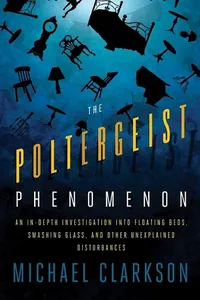




More Free Occult Philosophy Books
View all →