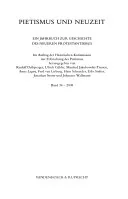
Pietismus und Neuzeit Band 34 - 2008
 84
84

Pietismus und Neuzeit Band 34 - 2008
The 2008 installment of Pietismus und Neuzeit, Volume 34, continues the Historical Commission's rigorous academic tradition. Its strength lies in the sheer breadth of its international contributors, offering varied perspectives on European Protestant piety since the early modern era. The inclusion of studies touching on social and mental history alongside theological ones provides a nuanced view of these movements. However, for the non-specialist, the dense academic prose and interdisciplinary jargon can present a significant barrier to entry.
A particularly compelling section, though not explicitly detailed in the blurb, likely explores the societal impact of groups like the Herrnhuter Brüdergemeine (Moravian Church), a hallmark of Pietist outreach and missionary work. While valuable for scholars, the volume's primary limitation is its inherent academic focus, making it less accessible for a general audience interested in spiritual exploration. It is a scholarly tool, not a popular introduction.
📝 Description
84
Pietismus und Neuzeit, Volume 34, published in 2008, is the annual yearbook for the Historical Commission for the Research of Pietism.
This 2008 volume of Pietismus und Neuzeit serves as the yearbook for the Historical Commission for the Research of Pietism. Since its start in 1974, the publication has been an international and interdisciplinary forum for scholarly work on modern Protestantism.
It contains research papers examining cultural studies and historical investigations within modern Protestantism. The volume is for academics, researchers, and students focused on the history of religion, especially Protestantism and its pietistic movements. It also interests scholars of European cultural, social history, and the history of mentalities, particularly concerning the development of piety from the early modern period.
While primarily an academic journal, Pietismus und Neuzeit engages with the historical development of intensely personal and experiential forms of Christian devotion. Pietism, as a movement, emphasized direct experience of God, inner transformation, and the practical application of faith, often diverging from established church structures. This volume, by examining the historical roots and expressions of these movements, touches upon the broader spectrum of how individuals sought direct spiritual engagement and understanding outside of purely dogmatic frameworks.
💡 Why Read This Book?
• Gain detailed historical analysis of Protestant piety movements, understanding their evolution from the early modern period as evidenced in scholarly articles from 2008. • Explore the intersection of theology, church history, and broader social and mental history, as presented in the interdisciplinary research of this volume. • Access specialized scholarship from the Historical Commission for the Research of Pietism, providing a focused academic perspective on European religious history.
⭐ Reader Reviews
Honest opinions from readers who have explored this book.
❓ Frequently Asked Questions
What is the primary focus of Pietismus und Neuzeit Band 34 - 2008?
This volume, the 2008 yearbook of the Historical Commission for the Research of Pietism, focuses on international and interdisciplinary research into the history of modern Protestantism, especially European piety movements since early modern times.
Who publishes Pietismus und Neuzeit?
Pietismus und Neuzeit is published by the Historical Commission for the Research of Pietism, an academic body dedicated to scholarly inquiry into this religious movement.
What kind of research papers are included in this volume?
The volume includes historical investigations into theology, piety, and church history, alongside studies on general European history with an emphasis on social and mental history related to religious movements.
Since when has Pietismus und Neuzeit been published?
The yearbook Pietismus und Neuzeit has been published annually since 1974, making the 2008 volume its 34th edition.
What historical periods does the research typically cover?
The research typically covers the history of modern Protestantism and European piety movements, extending from the early modern period to contemporary times.
Is this book suitable for beginners in religious studies?
While informative, the volume is geared towards advanced students and academic researchers due to its specialized, interdisciplinary, and international scholarly content.
🔮 Key Themes & Symbolism
Evolution of Protestant Piety
This volume meticulously traces the historical development and diverse expressions of Pietism within Protestantism. It examines theological underpinnings, the subjective experience of faith, and the institutional impact of Pietist communities. The research often highlights how these movements interacted with broader cultural and intellectual currents in Europe, particularly from the early modern period onwards, offering a scholarly lens on the persistent human search for spiritual meaning and practice.
Interdisciplinary Religious History
Pietismus und Neuzeit distinguishes itself through its commitment to an interdisciplinary approach. It moves beyond purely theological or ecclesiastical histories to integrate social history, the history of mentalities, and cultural studies. This allows for a more holistic understanding of religious phenomena, showing how faith shaped and was shaped by societal structures, individual psychology, and broader cultural transformations across Europe since the early modern era.
European Piety Movements
The yearbook offers a focused yet broad international perspective on various European piety movements, with Pietism as a central theme. It investigates how these movements influenced religious life, social structures, and cultural development across different national contexts. The scholarship presented seeks to map the intricate network of ideas, practices, and communities that characterized Protestant religious experience and its historical trajectory.
Modern Protestantism's Roots
By examining Pietism and related movements, the volume sheds light on the historical roots of modern Protestantism. It explores how early modern religious awakenings and devotional practices laid the groundwork for subsequent theological, social, and political developments within Protestant traditions. The research provides critical context for understanding the diverse range of contemporary Protestant Christianity.
💬 Memorable Quotes
Direct passages from the work, attributed to the author.
“The yearbook offers a broad international and (inter)disciplinary spectrum of cultural study and research papers on the history of modern Protestantism.”
— This statement from the original blurb highlights the volume's academic scope, emphasizing its global reach and multi-faceted approach to studying Protestant religious history.
“In addition to historical investigations on theology, piety, and the church, there is much study on general history.”
— This indicates a commitment to contextualizing religious history within broader societal trends, acknowledging that faith movements are deeply intertwined with social, economic, and political landscapes.
“Emphasis on social, mental, and cultural history.”
— This points to the yearbook's methodological approach, seeking to understand religious phenomena not just through doctrine but through the lived experiences, beliefs, and cultural expressions of individuals and communities.
“Research papers on the history of modern Protestantism, especially in the context of European piety movements since early modern times.”
— This defines the core subject matter, focusing on the historical trajectory of Protestantism and the specific role of pietistic expressions from the period of early modernity.
“Published since 1974 by the Historical Commission for the Research of Pietism.”
— This establishes the publication's academic lineage and the specific scholarly body responsible for its rigorous, ongoing research into Pietism.
🌙 Esoteric Significance
Tradition
While Pietism itself is a Protestant movement, its emphasis on direct, personal experience of the divine, inner transformation, and the 'priesthood of all believers' can hold resonance with certain esoteric traditions. It shares with mysticism a focus on subjective spiritual experience and the potential for immediate divine connection, diverging from strictly hierarchical or dogmatic religious structures. This volume, by exploring the historical manifestations of such intense inner piety, offers a window into a form of lived spirituality that sometimes borders on the mystical.
Symbolism
Within Pietism, symbolism often centered on the inner life and the transformative power of divine grace. Key motifs might include the 'heart' as the seat of true faith and experience, the 'cross' as a symbol of suffering and spiritual discipline, and light/darkness representing spiritual enlightenment or struggle. The historical analysis within this volume likely explores how these, and other, scriptural or devotional symbols were interpreted and lived out by adherents, revealing a rich symbolic language of the soul's journey.
Modern Relevance
Contemporary spiritual seekers interested in the historical roots of subjective religious experience and the interplay between personal faith and societal structures can find relevance here. Thinkers and practitioners exploring the historical development of 'lived religion,' counter-cultural religious movements, or the historical precursors to modern forms of therapeutic spirituality might draw insights. The volume’s focus on the historical contingency of piety movements also informs comparative studies of religious change and continuity in the modern world.
👥 Who Should Read This Book
• Academic researchers and graduate students specializing in the history of Protestantism, Pietism, and early modern European religious movements. • Scholars of social history and the history of mentalities interested in how religious beliefs and practices shaped societal and individual consciousness. • Comparative religion scholars examining the development of piety and spiritual experience across different Christian traditions and historical periods.
📜 Historical Context
The publication of Pietismus und Neuzeit, Band 34 in 2008 occurred within a vibrant academic landscape dedicated to the study of religious history. The yearbook, initiated in 1974 by the Historical Commission for the Research of Pietism, stands as a proof of decades of sustained scholarly engagement with European Protestant movements. This period saw increasing integration of social history and the history of mentalities into religious studies, moving beyond purely theological or institutional analyses. Contemporaries in the broader field of Reformation and Pietism studies included scholars like Peter C. Erb and Dale J. Riedel, who were also exploring the many-sided nature of early modern and modern Protestantism. Unlike purely confessional histories, the yearbook's interdisciplinary approach aligned with broader trends that sought to understand religious phenomena within their complex social and cultural milieux. Reception of such specialized yearbooks is typically within academic circles, cited in dissertations and scholarly articles, rather than through public reviews.
📔 Journal Prompts
The historical trajectory of Pietism and its impact on modern Protestantism.
European piety movements from the early modern period onward.
The integration of social and mental history within theological research.
Scholarly approaches to the history of Protestantism since 1974.
The interplay between religious experience and broader cultural study.
🗂️ Glossary
Pietism
A Protestant movement originating in late 17th-century Germany, emphasizing personal piety, devotional experience, and the inner spiritual life, often in reaction to perceived theological formalism.
Neuzeit
German for 'modern times' or 'modern era,' indicating the historical period of focus for the research within the publication.
Early Modern Period
The historical period generally spanning from the late 15th century to the late 18th century, bridging the Middle Ages and the modern era, characterized by significant religious, political, and social change.
Piety Movements
Broadly refers to religious groups or trends characterized by a strong emphasis on devotion, spiritual practice, and personal religious experience, often seeking reform or renewal within established traditions.
Interdisciplinary
Involving or drawing upon two or more different academic fields or lines of study, such as history, theology, sociology, and cultural studies.
History of Mentalities
A field of historical study focusing on the collective attitudes, beliefs, assumptions, and ways of thinking prevalent within a particular society or group during a specific period.
Yearbook
A publication issued annually, typically containing scholarly articles, reviews, and information related to a specific field or organization.
This book appears in 1 collection
🔮 Readers Also Liked
Browse all →







From the “Western Esotericism” Collection
View all →







More Free Sacred Texts & Gnosticism Books
View all →