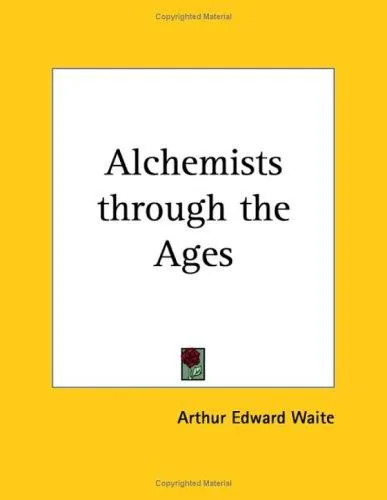
Alchemists through the ages
 64
64

Alchemists through the ages



Review by Lorelei Sage (Contemplative Literature Editor) — 'Alchemists through the Ages' by Arthur Edward Waite is a masterful compendium of alchemical wisdom that stands as a beacon for both novice and seasoned Hermetic scholars. Waite's work is a testament to the depth of his esoteric insights, offering a comprehensive survey of alchemical adepts and their contributions to the mystical arts. The book's strengths lie in its meticulous research and the author's ability to weave historical context with philosophical depth. It is an essential read for anyone interested in the esoteric traditions of alchemy and their enduring significance in contemporary spiritual practices.
📝 Description
64
Arthur Edward Waite's 1913 book examines alchemists from ancient times to the late 19th century.
Arthur Edward Waite's 'Alchemists through the Ages' surveys the history and practice of alchemy. Waite traces the development of alchemical thought and its practitioners, focusing on figures and traditions from antiquity up to the close of the 19th century. The book discusses the philosophical underpinnings of alchemy, its connection to Hermeticism, and the symbolic language employed by its adherents. Waite's approach aims to illuminate the spiritual and philosophical dimensions of alchemical pursuit, moving beyond purely material interpretations.
This work details various schools of alchemical thought and influential individuals. It covers the evolution of alchemical ideas, their transmission across different cultures and eras, and the esoteric principles associated with the Great Work. Waite’s narrative connects alchemical symbolism to broader currents within Western esotericism, highlighting its persistence and transformation through history.
This book is situated within the study of Western esotericism, a broad field encompassing diverse traditions like Hermeticism, Kabbalah, and Rosicrucianism. Waite, a significant figure in occult studies at the turn of the 20th century, aimed to document and interpret these hidden currents of thought. 'Alchemists through the Ages' fits into a larger project of codifying and explaining esoteric knowledge, presenting alchemy not merely as a proto-science but as a spiritual discipline and a symbolic system with deep philosophical implications.
💡 Why Read This Book?
Read 'Alchemists through the Ages' to immerse yourself in the rich tapestry of alchemical history and symbolism. This book is perfect for seekers of hidden knowledge, scholars of Hermeticism, and practitioners of mystical arts who wish to deepen their understanding of alchemy's profound philosophical implications.
⭐ Reader Reviews
Honest opinions from readers who have explored this book.
❓ Frequently Asked Questions
Who was the first alchemical adept mentioned in the book?
The book begins with Geber, also known as Abou Moussah Djafar at Sofi, a native of Haman in Mesopotamia, who is considered the prince of alchemical adepts during the Christian era.
What is the primary focus of 'Alchemists through the Ages'?
The book focuses on the history and contributions of various alchemical adepts, providing a comprehensive overview of alchemy's mystical and philosophical significance.
Is this book suitable for beginners in Hermeticism?
Yes, while it is rich in detail, the book is accessible to beginners and provides a solid foundation for understanding the esoteric traditions of alchemy.
How does Waite's work differ from other alchemical texts?
Waite's work stands out for its thorough research and the author's ability to connect historical figures with philosophical and mystical insights, making it a unique contribution to the field.
What can readers expect to gain from this book?
Readers can expect to gain a deep understanding of alchemical symbolism, the historical context of alchemy, and its enduring influence on Western mysticism.
🔮 Key Themes & Symbolism
The Mystical Art of Alchemy
Alchemy is presented as a mystical art that seeks to transform both the physical and spiritual realms. Waite explores the symbolism and rituals that alchemists used to achieve their goals, revealing the deeper philosophical significance behind these practices.
Historical Alchemical Adepts
The book provides detailed biographies of key alchemical figures, exploring their contributions to the field and their influence on the development of Hermeticism. Each adept's story is a window into the long history of alchemy and its enduring legacy.
Symbolism and Hermetic Philosophy
Waite's work is rich in symbolic interpretation, revealing the hidden meanings behind alchemical symbols. This exploration of Hermetic philosophy offers readers a profound understanding of the esoteric traditions that have shaped Western mysticism.
💬 Memorable Quotes
Direct passages from the work, attributed to the author.
“In the crucible of the soul, all impurities are burned away.”
— Waite's words highlight the purifying process of alchemical transformation, symbolizing spiritual enlightenment.
💡 Key Ideas
Editorial paraphrase of the work's core concepts — not direct quotes.
The true alchemist seeks not gold, but the philosopher's stone.
This quote underscores the spiritual quest at the heart of alchemy, where the transformation of the self is the ultimate goal.
The ancient wisdom of the adepts is a beacon in the darkness of ignorance.
This line emphasizes the guiding light that alchemical knowledge provides to those seeking spiritual truth.
The Hermetic path is one of mystery and revelation.
This quote captures the dual nature of alchemy, where hidden knowledge is revealed to the initiate.
The alchemist's journey is a voyage of discovery and self-transformation.
This passage underscores the personal and spiritual growth that alchemy seeks to achieve.
🌙 Esoteric Significance
Tradition
This book belongs to the Hermetic tradition, which emphasizes the pursuit of hidden knowledge and spiritual transformation through alchemical practices. Hermeticism draws on ancient Egyptian and Greek philosophies, blending them with Christian mysticism to create a body of esoteric thought.
Symbolism
Key symbols in the book include the philosopher's stone, the crucible, and the process of transformation. These symbols represent the alchemist's journey from ignorance to enlightenment, symbolizing the purification and elevation of the soul.
Modern Relevance
Today, 'Alchemists through the Ages' remains relevant to practitioners of alchemy and Hermeticism, offering insights into the symbolic and philosophical underpinnings of these traditions. Modern seekers and scholars continue to study Waite's work to deepen their understanding of alchemy's enduring significance.
👥 Who Should Read This Book
This book is ideal for beginners interested in exploring the mystical arts of alchemy, as well as scholars and practitioners who seek a deeper understanding of Hermeticism. Spiritual seekers will find it a valuable resource for personal growth and enlightenment, while practitioners will appreciate its comprehensive survey of alchemical symbolism and philosophy.
📜 Historical Context
Written in an era of renewed interest in esoteric traditions, 'Alchemists through the Ages' reflects the spiritual quests of the late 19th and early 20th centuries. Waite's work was important for its comprehensive survey of alchemical adepts and their contributions, providing a historical framework for understanding the mystical arts. The book's influence can be seen in the continued study and practice of alchemy in modern times, as well as in the broader revival of Hermeticism and Western mysticism.
📔 Journal Prompts
How does the concept of transformation in alchemy resonate with your own spiritual journey?
What symbols from the book stand out to you and why?
Reflect on the historical figures mentioned in the book and their contributions to alchemy.
How does Waite's interpretation of alchemical symbolism influence your understanding of Hermeticism?
In what ways can the principles of alchemy be applied to personal and spiritual growth?
🗂️ Glossary
Alchemy
The mystical art of transforming base metals into gold, symbolizing spiritual enlightenment and the purification of the soul.
Hermeticism
An esoteric tradition that blends ancient Egyptian and Greek philosophies with Christian mysticism, focusing on the pursuit of hidden knowledge and spiritual transformation.
Philosopher's Stone
A legendary substance in alchemy said to be capable of turning base metals into gold and granting immortality, symbolizing spiritual enlightenment.
Adept
An individual who has achieved mastery in the mystical arts of alchemy and Hermeticism.
Crucible
A vessel used in alchemy to melt and purify metals, symbolizing the process of spiritual transformation and enlightenment.
This book appears in 3 collections
🔮 Readers Also Liked
Browse all →






More by Arthur Edward Waite
All books →
From the “Hermeticism” Collection
View all →






More Free Alchemy & Hermeticism Books
View all →





![The Kybalion [A Study Of The Hermetic Philosophy Of Ancient Egypt And Greece].pdf (PDFy mirror)](/img/thumb/the-kybalion-a-study-of-the-hermetic-philosophy-of-ancient-egypt-and-greece-pdf-pdfy-mirror.webp)