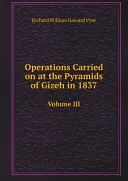
Appendix to Operations Carried on at the Pyramids of Gizeh in 1837
 80
80

Appendix to Operations Carried on at the Pyramids of Gizeh in 1837
Vyse's appendix to his 1837 Gizeh operations is a valuable, if dry, document for those deeply invested in the minutiae of early Egyptological fieldwork. The strength lies in its direct reporting of survey data for sites beyond the main Giza complex, particularly the inclusion of Abou Roash and Faiyum structures, which were less commonly detailed in popular accounts of the time. However, the prose lacks interpretative flair, presenting raw observational data that requires significant contextualization for the modern reader. A specific passage detailing the differing construction methods observed at various Faiyum pyramids, while factually important, is presented in a manner that demands considerable prior knowledge to appreciate fully. The work is an important primary source, but not an accessible introduction to the subject. It serves best as a supplement to more comprehensive historical analyses.
📝 Description
80
Published in 1840, R.W.H. Vyse's Appendix details pyramid surveys beyond Giza.
This volume serves as an addendum to R.W.H. Vyse's 1837 Giza pyramid operations. It expands the record by detailing investigations at other significant pyramid sites, moving beyond the Giza plateau. The text documents surveying and examination work conducted at locations including Abou Roash and structures within the Faiyum region.
Vyse's appendix situates his work within the mid-19th century's burgeoning field of Egyptology. This period saw significant European interest in Egyptian antiquities. Vyse's methodical approach to recording pyramid dimensions and locations contributed to the systematic documentation of these ancient structures. His work is comparable to that of contemporaries like Jean-François Champollion, who deciphered hieroglyphs, and stands apart from purely antiquarian pursuits.
The book centers on the empirical documentation of architectural remains. It provides specific measurements and observations from sites such as Abou Roash and the Faiyum. The core idea is the careful cataloging of physical evidence related to ancient Egyptian construction, prioritizing accuracy in its records.
While primarily a work of empirical surveying, Vyse's appendix engages with the mystique surrounding Egyptian antiquities that fueled esoteric interests in the 19th century. The detailed recording of pyramid dimensions and locations, though presented as scientific, contributed to the broader fascination with these structures as sites of ancient knowledge and power. Such meticulous documentation, even if dated by modern standards, fed into the speculative traditions that sought hidden meanings within Egyptian monumental architecture. This appendix, therefore, sits at the intersection of early systematic archaeology and the enduring esoteric interpretations of ancient Egypt.
💡 Why Read This Book?
• Gain direct access to Vyse's 1837 survey data for lesser-documented pyramids, including those at Abou Roash and the Faiyum region, offering a factual baseline for comparative architectural study. • Understand the empirical methods employed in mid-19th century Egyptology by examining the detailed recording of measurements and site locations, providing insight into the evolution of archaeological practice. • Appreciate the historical context of Egyptian exploration by engaging with a text that supplements foundational Giza research, placing Vyse's efforts within the broader intellectual currents of Victorian antiquarianism.
⭐ Reader Reviews
Honest opinions from readers who have explored this book.
❓ Frequently Asked Questions
What is the primary focus of the "Appendix to Operations Carried on at the Pyramids of Gizeh in 1837"?
The appendix primarily details R.W.H. Vyse's survey and examination operations conducted on pyramid sites beyond the main Giza plateau, specifically mentioning Abou Roash and pyramids in the Faiyum region.
When were the operations described in this appendix conducted?
The operations detailed in this appendix are supplementary to the main work conducted at the Pyramids of Gizeh in 1837, indicating the survey work for these additional sites also occurred around that period.
What distinguishes this appendix from the main volume of Vyse's work?
This appendix expands the scope of Vyse's research beyond the Giza pyramids to include investigations of other significant pyramid sites, offering a broader survey of ancient Egyptian monumental architecture.
Who would find the detailed site information in this appendix most useful?
Egyptologists, archaeologists, historians of ancient architecture, and researchers of early modern exploration and documentation of Egyptian antiquities would find the specific survey data and site descriptions particularly valuable.
Does this appendix contain interpretative theories about pyramid construction or purpose?
While it records observations and measurements, the appendix's main contribution is factual documentation rather than speculative interpretation of the pyramids' original purpose or advanced construction theories.
Besides Giza, what specific locations are covered in this appendix?
The appendix explicitly mentions extending the investigations to the pyramids at Abou Roash and those situated further south, including structures located within the Faiyum region.
🔮 Key Themes & Symbolism
Beyond Giza Survey
This work moves past the iconic Giza plateau to detail Vyse's meticulous survey efforts at other pyramid sites. By focusing on Abou Roash and structures in the Faiyum, it provides crucial, often overlooked, empirical data. This expansion offers comparative architectural insights, allowing scholars to analyze variations in construction and scale across different royal necropolises during Egypt's Old Kingdom and subsequent periods. The appendix underscores that understanding ancient Egypt requires a comprehensive survey of its monumental legacy, not just its most famous examples.
Empirical Documentation Methods
The core of this appendix lies in its commitment to factual recording. Vyse's operations, though from 1837, represent an early attempt at systematic archaeological documentation. The text emphasizes precise measurements, site descriptions, and geographical positioning of pyramid remnants. This focus on observable data, rather than pure speculation, established a precedent for scientific inquiry in Egyptology, distinguishing it from earlier, more haphazard antiquarian pursuits. It offers a window into the developing methodologies of field archaeology.
The Faiyum's Ancient Structures
A significant portion of this appendix is dedicated to the pyramids located within the Faiyum region. This inclusion highlights the importance of this area in ancient Egyptian history and monumental construction. The detailed observations of these structures provide valuable information for understanding regional variations in pyramid building and the extent of royal funerary complexes across different nomes. It challenges a monolithic view of pyramid construction, revealing diversity in scale and design.
Abou Roash Investigations
The appendix specifically addresses the pyramid complex at Abou Roash, a site often overshadowed by its southern neighbors. Vyse's records contribute essential survey information for this northernmost pyramid of the Giza plateau. By detailing its physical state and dimensions as observed in the mid-19th century, the work provides a historical record that is useful for understanding the site's past condition and for ongoing archaeological analysis and preservation efforts.
💬 Memorable Quotes
Direct passages from the work, attributed to the author.
“The pyramids at abou roash, and to the southward, including those in the faiyoum.”
— This direct statement from the blurb clearly delineates the expanded scope of Vyse's investigations beyond the primary Giza site, signaling the appendix's function as a record of broader archaeological surveying.
“Appendix to Operations Carried on at the Pyramids of Gizeh in 1837.”
— This title itself functions as a factual anchor, immediately establishing the document's nature as a supplementary report to Vyse's more extensive primary work from that specific year.
“This work presents records of surveying and examination.”
— An interpretation of the appendix's content, emphasizing its function as a repository of empirical data and observational findings rather than theoretical discourse.
“The text includes structures in the Faiyum region.”
— This highlights a specific geographical focus within the appendix, indicating the inclusion of data from a significant ancient Egyptian region beyond the immediate vicinity of Giza.
💡 Key Ideas
Editorial paraphrase of the work's core concepts — not direct quotes.
The operations extend beyond the main Giza plateau.
This paraphrased concept highlights the critical function of the appendix: to document investigations at pyramid sites that are geographically distinct from the famous Giza complex.
🌙 Esoteric Significance
Tradition
While primarily an archaeological document, this appendix can be viewed through a Hermetic lens as a foundational text for understanding the physical manifestations of ancient Egyptian cosmology. The pyramids themselves are seen in Hermetic traditions as potent symbols of cosmic order, spiritual ascent, and enduring knowledge. Vyse's meticulous recording of these structures, even without explicit esoteric interpretation, provides the raw material that later esotericists would analyze for geometric, astronomical, and symbolic meaning, connecting the physical world to higher principles.
Symbolism
The pyramids, as the central subject, are potent symbols in esoteric traditions. They represent the primeval mound (Benben), the point of creation, and the ascent to the heavens. Their precise geometric form and alignment with celestial bodies are interpreted as embodying universal laws and divine intelligence. The act of surveying and documenting these structures, as Vyse undertook, can be seen as an attempt to map the tangible evidence of this ancient, divinely inspired knowledge, treating the physical monument as a key to unlocking spiritual understanding.
Modern Relevance
Contemporary esotericists and researchers of ancient mysteries frequently reference the foundational surveys and documentation produced by figures like Vyse. His work provides essential baseline data for modern analyses of pyramid construction, alignment, and potential hidden chambers, often used in conjunction with advanced technologies. Thinkers and practitioners in fields ranging from sacred geometry to ancient astronaut theories draw upon these historical records to support their interpretations of the pyramids' origins and purposes, integrating empirical findings with speculative frameworks.
👥 Who Should Read This Book
• Early 20th-century archaeology students: Those studying the historical development of archaeological methods will benefit from examining Vyse's 1837 survey techniques for sites like Abou Roash. • Comparative Egyptology researchers: Scholars interested in analyzing variations in pyramid construction and scale across different regions will find the Faiyum and Abou Roash data useful for comparative studies. • Historians of science and technology: Readers interested in how empirical data collection evolved in the study of ancient monuments will appreciate the factual reporting style of this appendix.
📜 Historical Context
R.W.H. Vyse's "Appendix to Operations Carried on at the Pyramids of Gizeh in 1837" emerged during an important era for Egyptology. The mid-19th century was characterized by intense European colonial and scientific interest in Egyptian antiquities, following Napoleon's campaigns and the subsequent decipherment of hieroglyphs by Jean-François Champollion. Vyse's work contributed to the systematic, albeit nascent, archaeological documentation of Egypt's monumental heritage. This period also saw the rise of comparative studies and the formation of national collections, such as the British Museum's Egyptian galleries. While Vyse focused on empirical recording, other contemporary scholars like Giovanni Battista Belzoni engaged in more sensationalized discoveries, and the field was grappling with establishing rigorous methodologies. The reception of such works often involved scholarly debate over interpretations and the ethical acquisition of artifacts.
📔 Journal Prompts
The specific dimensions recorded for the Abou Roash pyramid complex.
Vyse's observations regarding pyramid construction in the Faiyum region.
The contrast between the Giza operations and the work described in this appendix.
The significance of documenting sites beyond the most famous Egyptian pyramids.
The empirical approach taken in the 1837 operations at Gizeh and its extensions.
🗂️ Glossary
Operations Carried On
Refers to the systematic investigative activities, including surveying, excavation, and recording, undertaken by R.W.H. Vyse during his archaeological work in Egypt.
Pyramids of Gizeh
The famous complex of ancient Egyptian pyramids located on the Giza Plateau near modern Cairo, including the Great Pyramid of Giza, the Pyramid of Khafre, and the Pyramid of Menkaure.
Abou Roash
A location north of Giza, site of the ruins of a pyramid attributed to the Pharaoh Djedefre, considered the northernmost pyramid of the Giza Necropolis.
Faiyum
A depression in the desert west of the Nile, known for its ancient history, agricultural productivity, and numerous archaeological sites, including several pyramids from various dynasties.
Surveying
The process of carefully measuring and mapping land features, dimensions, and locations, as conducted by Vyse to document the physical state of the pyramids.
Appendix
A supplementary section added to a book or document, containing additional material that is relevant but not essential to the main text.
1837
The specific year cited for the primary archaeological operations at the Pyramids of Gizeh, to which this document serves as an addendum.