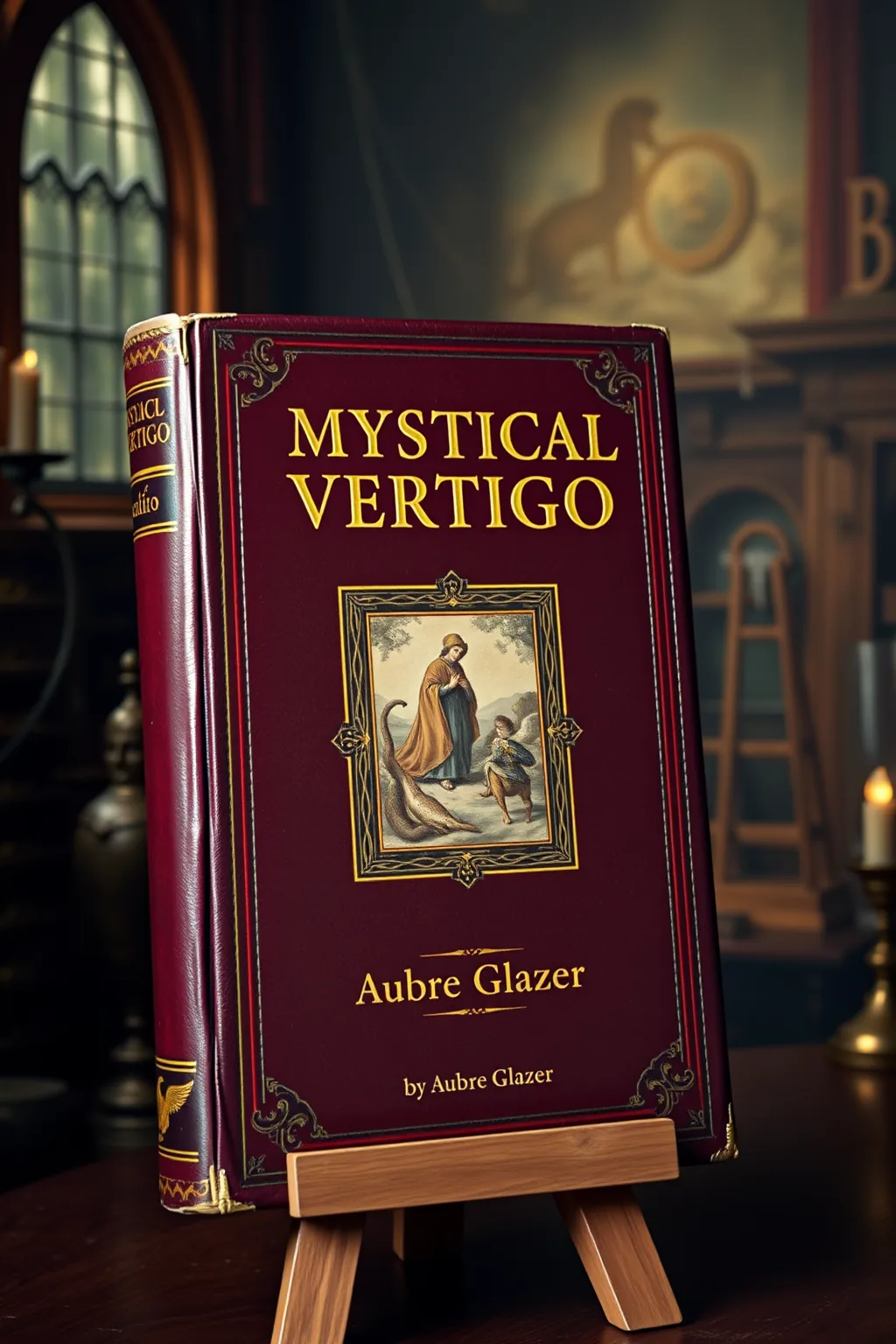
Mystical Vertigo
 79
79

Mystical Vertigo
Aubrey Glazer's Mystical Vertigo presents a challenging, yet rewarding, engagement with the phenomenology of altered states. The strength of the book lies in its unflinching depiction of the subjective disorientation that often accompanies mystical experiences, avoiding the common pitfall of sanitizing these often chaotic encounters. Glazer’s refusal to offer easy answers or prescriptive methods is a significant asset. A point of contention, however, might be the dense prose, which at times demands considerable reader investment, potentially alienating those seeking a more accessible entry into these topics. The exploration of the 'vertigo' inherent in ego dissolution, particularly as it relates to the destabilization of sensory input, is handled with a rare, visceral honesty. Ultimately, Mystical Vertigo is a potent, if demanding, examination of consciousness's outer limits.
📝 Description
79
Mystical Vertigo, published in 2013, examines subjective terrains that blur internal and external perception.
Aubrey Glazer's 2013 book is not a guide to achieving altered states but a text that maps the experience of them. It charts subjective experiences where the lines between the inner world and outer reality, and between the ordinary and the transcendent, become indistinct. Glazer engages with these states not as phenomena to be managed, but as windows into the fluid nature of existence itself. The work is suited for readers who question standard ways of knowing and are interested in the lived experience of mystical awareness. It will appeal to those seeking texts that reflect the often inexpressible quality of deep inner transformations, rather than clear doctrines or historical surveys. Individuals drawn to philosophical questions about self and reality will find considerable material here.
Published in 2013, Mystical Vertigo appeared during a period of renewed interest in consciousness and contemplation, often in dialogue with critiques of materialism. Glazer's work aligns with contemporary discussions that question the human-centered view of reality, similar to Graham Harman's Object-Oriented Ontology, though Glazer focuses on internal experience. The book's arrival coincided with digital culture's influence on concepts of presence and virtuality, offering a distinct perspective on altered states of consciousness.
💡 Why Read This Book?
• Gain a unique vocabulary for describing the disorienting yet revelatory aspects of altered consciousness, as explored through Glazer’s concept of ‘mystical vertigo’. • Understand how subjective experiences of distorted time and ego dissolution, as detailed in the text, can lead to novel apprehensions of reality. • Engage with a philosophical approach to consciousness that parallels contemporary discussions in fields like Object-Oriented Ontology, particularly regarding the limits of anthropocentric perception.
⭐ Reader Reviews
Honest opinions from readers who have explored this book.
❓ Frequently Asked Questions
When was Mystical Vertigo first published?
Mystical Vertigo by Aubrey Glazer was first published in 2013, placing it within a contemporary wave of interest in consciousness studies and esoteric philosophy.
What kind of reader is Mystical Vertigo best suited for?
This book is ideal for readers interested in the phenomenology of altered states, those who question conventional reality, and individuals seeking experiential rather than purely doctrinal texts.
Does the book offer practical techniques for achieving mystical states?
No, Mystical Vertigo focuses on exploring and describing the subjective experience of altered states and the disorientation they can cause, rather than providing how-to guides.
How does Mystical Vertigo relate to other philosophical movements?
The work engages with contemporary philosophical dialogues, particularly those questioning materialist assumptions and exploring the nature of perception, echoing some concerns found in Object-Oriented Ontology.
What is the central metaphor or concept introduced by the title?
The title 'Mystical Vertigo' points to the disorienting, destabilizing feeling that can accompany profound shifts in consciousness and perception, suggesting that confronting the limits of the ordinary self can be akin to losing one's footing.
Is the book based on academic research or personal experience?
Glazer's work appears to be a synthesis, drawing on philosophical inquiry into subjective experience and phenomenological description, rather than a strict adherence to empirical research or a sole reliance on personal narrative.
🔮 Key Themes & Symbolism
Phenomenology of Altered States
The work meticulously examines the subjective quality of consciousness when it deviates from normative experience. Glazer focuses on the 'vertigo'—the disorientation, the dissolution of familiar perceptual anchors, and the destabilization of egoic boundaries. It’s an exploration of how the very fabric of perceived reality can warp, presenting a non-dualistic or radically altered apprehension of existence. This theme eschews a clinical approach for a more existential and phenomenological rendering of these profound inner shifts.
Ego Dissolution and Self-Perception
A central thread concerns the breakdown of the stable, individuated self. Glazer describes moments where the sense of a singular, continuous 'I' fragments, leading to an expanded or diffused sense of being. This is not presented as a loss, but as a transformation that reconfigures one's relationship to the world and to oneself, challenging the notion of a fixed identity. The text probes the implications of experiencing oneself as part of a larger, less bounded continuum.
The Nature of Reality and Perception
Mystical Vertigo interrogates the assumed solidity and objectivity of the external world by focusing on how subjective states can radically alter its appearance and perceived meaning. Glazer suggests that ordinary perception is a constructed framework, and that experiences of 'vertigo' reveal the provisional nature of this framework. The book explores how these shifts can lead to a more nuanced, if temporarily unsettling, understanding of what constitutes reality.
Liminality and Threshold Experiences
The text operates within the concept of liminality – the in-between states where normal rules and identities are suspended. Glazer charts the passage through these thresholds, emphasizing the inherent uncertainty and potential for clear insights. These are not static states but dynamic transitions, where the familiar recedes and the unknown emerges, creating a fertile ground for transformation and a re-evaluation of one's place in existence.
💬 Memorable Quotes
Direct passages from the work, attributed to the author.
“The familiar field of the self begins to tilt.”
— This phrase captures the essence of the book's title, 'Mystical Vertigo,' illustrating the destabilizing yet potentially revelatory experience of ego dissolution and altered perception.
“Time ceases its linear march, becoming a fluid dimension.”
— This highlights Glazer's exploration of how altered states can fundamentally change one's experience of temporality, moving away from conventional, chronological understanding towards a more malleable or simultaneous apprehension.
“The boundaries between inner and outer dissolve into a shared field.”
— This speaks to the non-dualistic or interconnected consciousness often described in mystical traditions, where the separation between the individual and the cosmos becomes permeable.
“A disquieting clarity emerges from the loss of ordinary reference points.”
— This paradox underscores the book's theme: that profound understanding can arise not from maintaining control or certainty, but from embracing disorientation and the breakdown of familiar cognitive structures.
“Confronting the void is not an end, but a radical beginning.”
— This suggests that experiences of existential emptiness or the dissolution of the ego are not terminal but are instead gateways to new forms of being and perception.
🌙 Esoteric Significance
Tradition
While not strictly adhering to a single lineage, Mystical Vertigo engages with themes central to Western Esotericism, particularly Gnostic and Hermetic explorations of consciousness and reality. It shares with these traditions a focus on gnosis—direct, experiential knowledge—and the idea that ordinary perception can obscure a deeper, more fundamental truth about existence. The work departs from more ritualistic or dogmatic approaches by prioritizing a phenomenological exploration of subjective states and their inherent paradoxes.
Symbolism
The primary symbol is the 'vertigo' itself, representing the disorienting yet transformative experience of ego dissolution and the breakdown of conventional reality structures. Other implicit symbols include the 'void' or 'emptiness,' signifying a state of potentiality and the absence of fixed form, and the 'dissolving boundary,' which denotes the interconnectedness of self and cosmos that emerges when individuation loosens its grip.
Modern Relevance
Contemporary thinkers and practitioners exploring psychedelic-assisted therapy, consciousness studies, and non-dual philosophies find resonance in Glazer's work. Its phenomenological approach offers a valuable framework for articulating the subjective experiences that often defy conventional language. The book's emphasis on the destabilizing yet clear nature of altered states speaks to current discussions about mindfulness, embodied cognition, and the potential for profound shifts in self-perception.
👥 Who Should Read This Book
• Students of consciousness studies and phenomenology seeking detailed explorations of subjective experience beyond empirical observation. • Contemplative practitioners interested in the psychological and philosophical dimensions of states that transcend ordinary awareness. • Philosophically inclined readers who question the nature of reality and the limits of human perception, particularly those interested in non-dualistic perspectives.
📜 Historical Context
Aubrey Glazer's Mystical Vertigo, published in 2013, emerged in an era marked by a renewed philosophical interest in consciousness and subjective experience, often challenging the dominance of purely empirical and materialist paradigms. The intellectual climate saw a resurgence of thinkers exploring non-dualistic philosophies and the phenomenology of altered states, sometimes drawing parallels with ancient contemplative traditions. Glazer's work can be seen in conversation with, or as a counterpoint to, the burgeoning field of research into psychedelics and their effects on consciousness, as well as contemporary philosophical explorations like Graham Harman's Object-Oriented Ontology, which, while distinct, also questions the centrality of human perception in defining reality. The book arrived without significant mainstream critical reception or public controversy, positioning itself as a more niche contribution to esoteric and philosophical literature for a discerning readership.
📔 Journal Prompts
The shifting field of the self: record moments when your sense of 'I' felt altered or dissolved.
Reflecting on the concept of 'mystical vertigo,' describe an experience that felt disorienting yet revealing.
How does the experience of time's fluidity, as discussed, compare to your own perceptions?
Consider the 'dissolving boundary' between inner and outer: what are the implications for your sense of connection?
Document instances where clarity emerged from a state of uncertainty or loss of familiar reference points.
🗂️ Glossary
Mystical Vertigo
A core concept in the book, describing the disorienting, destabilizing, yet potentially insightful experience of ego dissolution and altered perception that accompanies profound subjective shifts.
Ego Dissolution
The temporary or profound breakdown of the sense of a stable, separate self, leading to a diffused or expanded sense of identity and interconnectedness with the environment.
Phenomenology
A philosophical approach that focuses on the structure of consciousness and subjective experience as they appear to the subject, without reference to objective reality.
Liminality
A state of transition or being in-between, where established norms, identities, and structures are suspended, often leading to novel insights or transformations.
Non-dualism
A philosophical or spiritual concept positing that reality is ultimately a single, undivided whole, challenging the perceived separation between subject and object, or self and other.
Perceptual Anchors
The stable, habitual sensory and cognitive frameworks that allow individuals to orient themselves and understand their surroundings; their destabilization is key to 'vertigo'.
Gnosis
Direct, intuitive knowledge or insight, particularly concerning spiritual or mystical truths, often attained through personal experience rather than intellectual reasoning.
🔮 Readers Also Liked
Browse all →








More by Aubrey Glazer
All books →


More Free Mysticism & Contemplation Books
View all →