Ich und du

 80
80

Ich und du
Martin Buber's "Ich und du" remains a potent articulation of relational existence, even a century after its initial publication. Its strength lies in the stark, almost stark, dichotomy between the "I-You" and "I-It" modes of being. The concept of the "I-It" relationship, where the other is reduced to an object of utility or analysis, feels particularly incisive in our data-driven age. However, the book's primary limitation is its occasional philosophical idealism; the pure "I-You" encounter, while a compelling aspiration, can feel elusive in practice. Buber's assertion that the "I-You" is the foundation of all genuine human experience, not just interpersonal contact but also our engagement with the world, is a challenging proposition. The section on "The Education of Character" offers practical, though somewhat abstract, guidance on fostering this dialogical stance. Ultimately, "Ich und du" serves as a vital, if sometimes demanding, call to encounter the world with genuine presence.
📝 Description
80
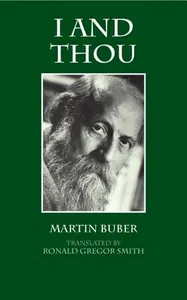
Martin Buber published "Ich und du" in 1922, proposing that reality is defined by relationships, not isolated things.
Martin Buber's "Ich und du" (I and You), published in 1922, argues that human existence is fundamentally shaped by relationships. Buber distinguishes between two primary modes of interaction: the "I-You" and the "I-It." The "I-You" represents a direct, whole encounter with another being, where the individual addresses the other as a unique person. In contrast, the "I-It" treats the other as an object of experience, observation, or use, reducing them to a collection of qualities and data. Buber suggests that a life lived solely in the "I-It" mode is impoverished and lacks genuine meaning. He posits that true human fulfillment comes from experiencing the world and others in the "I-You" manner, recognizing their inherent worth and engaging with them relationally. The book is structured around three essays that lay out this core philosophy of dialogue.
The work emerged in the aftermath of World War I, a time of significant societal and intellectual upheaval. Buber, a German-Jewish philosopher, engaged with prevailing philosophical currents but offered a unique perspective rooted in personalism and dialogue. He directly addressed thinkers who focused on social structures, proposing instead that authentic connection forms the basis of human reality. This philosophical stance challenged the mechanistic and individualistic views common in early 20th-century thought. The book's ideas have resonated with subsequent existentialist and humanistic traditions.
While "Ich und du" is often categorized within philosophy, its emphasis on direct encounter and the transformation of consciousness through relationship touches upon mystical traditions. Buber's concept of the "I-You" encounter mirrors contemplative practices that seek direct, unmediated experience of the other or the divine. His critique of treating individuals as objects aligns with certain mystical views that reject superficial analysis in favor of wholehearted engagement. The book's focus on the nature of being and connection resonates with traditions that explore the interconnectedness of all things, though Buber grounds his ideas in philosophical inquiry rather than purely spiritual revelation.
💡 Why Read This Book?
• You will learn to differentiate between experiencing objects and encountering persons, a core distinction articulated by Buber's "I-You" and "I-It" concepts, offering a new framework for understanding interactions. • You will gain insight into the philosophical underpinnings of authentic communication, directly engaging with Buber's 1922 ideas on dialogue as the basis for meaningful relationships. • You will explore the concept of the "eternal You," understanding how Buber links genuine interpersonal encounters to a transcendent dimension, providing a spiritual perspective on connection.
⭐ Reader Reviews
Honest opinions from readers who have explored this book.
❓ Frequently Asked Questions
What is the central philosophy of Martin Buber's "Ich und du"?
The central philosophy of "Ich und du" (I and You), published in 1922, is Buber's distinction between the "I-You" and "I-It" modes of existence, emphasizing that true being is found in relationship and direct encounter, not in objectification.
How does Buber differentiate between the 'I-You' and 'I-It' relationships?
Buber differentiates the 'I-You' relationship as one of whole-being, mutual presence, and unmediated encounter, while the 'I-It' relationship is characterized by experience, utility, and the treating of the other as an object or phenomenon.
What is the significance of 'the eternal You' in Buber's work?
'The eternal You' refers to the ultimate address of God or the divine that, for Buber, makes genuine "I-You" encounters possible. It suggests that all authentic relationships are grounded in and point towards this transcendent reality.
In what historical period was "Ich und du" written and published?
"Ich und du" was written by Martin Buber and first published in German in 1922, in the period following World War I, a time of significant intellectual and social upheaval in Europe.
What impact did "Ich und du" have on subsequent philosophical thought?
Published in 1922, "Ich und du" significantly influenced existentialist, phenomenological, and humanistic thought, particularly in its emphasis on dialogue, relationship, and the subjective experience of encounter.
Does Buber's philosophy in "Ich und du" relate to psychology?
Yes, Buber's 1922 work "Ich und du" has profound implications for psychology, particularly in existential and humanistic approaches, offering a framework for understanding therapeutic relationships and the nature of selfhood through dialogue.
🔮 Key Themes & Symbolism
The I-You Encounter
Buber's central thesis revolves around the 'I-You' relationship, first articulated in his 1922 work. This is not merely a social interaction but a state of direct, unmediated address where the whole self engages with another whole self. It is characterized by presence, mutuality, and the absence of objectification. Unlike the 'I-It' relationship, where one observes, analyzes, and uses the other, the 'I-You' is about genuine meeting. This concept challenges the modern tendency to view individuals as mere objects of study or utility, advocating instead for a radical form of authentic connection that forms the basis of all meaningful existence.
The I-It Relation
The counterpoint to the 'I-You' is the 'I-It' relation, a mode of experiencing and using the world and its inhabitants. In this stance, the other is treated as a collection of qualities, a phenomenon to be classified, controlled, or exploited. Buber argues that this mode, while necessary for practical engagement with the world (e.g., studying a tree, utilizing a tool), becomes problematic when it dominates human interaction. The danger lies in reducing persons to objects, thereby severing the possibility of genuine dialogue and mutual recognition. This perspective offers a critical lens on instrumentalism and objectification prevalent in various fields.
The Eternal You
Beyond the interpersonal 'I-You' lies the concept of 'the eternal You.' Buber posits that the possibility of experiencing genuine 'I-You' encounters with fellow human beings is grounded in and points towards an ultimate 'You' – often understood as God or the divine. This eternal address is not an object to be known but a presence to be encountered. It suggests that every authentic relationship with another being is, in a mysterious way, a relationship with the divine. This adds a transcendent dimension to Buber's philosophy, linking the immanent reality of dialogue to ultimate spiritual reality.
Dialogue and Character Formation
In "Ich und du," Buber connects the ability to enter into 'I-You' relationships with the formation of character. He suggests that true education and personal development occur not through instruction alone, but through the cultivation of the capacity for genuine dialogue. The "Education of Character" essay explores how individuals learn to address the world and others with authenticity and responsibility. This implies that developing a dialogical attitude is fundamental to becoming a fully realized human being, shaping one's moral and spiritual landscape through consistent engagement with the 'You'.
💬 Memorable Quotes
Direct passages from the work, attributed to the author.
“The world is to the man of spirit a great spiritual event.”
— This statement from Buber's 1922 text suggests that for someone attuned to genuine connection, everyday reality transforms from a collection of inert facts into a dynamic, meaningful experience, revealing deeper spiritual truths through every encounter.
“In every sphere of life one can only live in the I-It relation.”
— This interpretation highlights Buber's acknowledgment of the necessity of the 'I-It' mode for practical interaction and objective understanding. It frames this relationship not as inherently bad, but as distinct from, and potentially subservient to, the more profound 'I-You' encounter.
“Spirit is not present in the world, but between the world and man.”
— This phrasing suggests that spirit, or true consciousness, is not an inherent quality of an individual or the external world alone, but arises in the relational space between them – the dynamic interaction that constitutes the 'I-You' encounter.
“When You is spoken, the speaker has no bounds.”
— This concept emphasizes the transformative and expansive nature of the 'I-You' relationship. In this state of complete presence and openness, the individual transcends their ordinary limitations and ego boundaries, merging with the reality of the other.
“The relation is the true reality.”
— This is a concise encapsulation of Buber's core philosophy from "Ich und du." It asserts that the connections, dialogues, and encounters between beings are not secondary phenomena but constitute the fundamental essence of existence itself.
🌙 Esoteric Significance
Tradition
While not strictly adhering to a single esoteric lineage, Buber's work draws heavily from the contemplative and mystical traditions of Jewish Hasidism and Kabbalah. His emphasis on direct encounter, the sacredness of the present moment, and the potential for divine presence in human interaction aligns with mystical paths that seek immanent divinity. "Ich und du" can be seen as a philosophical articulation of the Hasidic ideal of *devekut* (cleaving to God) through everyday relationships, reinterpreting it for a secular and philosophical audience.
Symbolism
The primary symbolic motif is the duality of the 'I-You' and 'I-It' relationships themselves. The 'I-You' represents wholeness, encounter, and the sacred address, while the 'I-It' symbolizes fragmentation, objectification, and the world of utility and analysis. The concept of 'the eternal You' functions as a symbol for the ultimate, transcendent source of all genuine relationship, a divine presence that is encountered rather than conceptualized, mirroring the Kabbalistic notion of divine immanence within creation.
Modern Relevance
Buber's philosophy of dialogue continues to be highly relevant in contemporary fields such as psychotherapy (especially existential and humanistic approaches), conflict resolution, education, and spiritual formation. Thinkers and practitioners in these areas often reference "Ich und du" when discussing authentic communication, empathy, and the ethical imperative of recognizing the inherent dignity of the other. His ideas provide a philosophical grounding for practices that emphasize presence and relationality over instrumentalism.
👥 Who Should Read This Book
• Philosophers and theologians exploring existentialism, phenomenology, and the philosophy of religion, seeking foundational texts on dialogical existence and the nature of being. • Psychotherapists and counselors interested in the relational aspects of healing and the impact of authentic encounter on personal development and well-being. • Individuals seeking to deepen their understanding of interpersonal relationships and personal authenticity, looking for a framework to move beyond superficial interactions towards genuine connection.
📜 Historical Context
Martin Buber's "Ich und du" (I and You), first published in 1922, emerged in a European intellectual landscape profoundly shaped by the trauma of World War I and the subsequent disillusionment with positivism and mechanistic worldviews. Buber, a philosopher deeply engaged with Jewish mysticism, Hasidism, and interfaith dialogue, sought to offer an alternative to the atomistic individualism and objectifying tendencies of modern thought. His work directly challenged prevailing philosophical currents that emphasized subjective experience or objective analysis, proposing instead a philosophy centered on dialogical relationship. While thinkers like Georg Simmel explored social forms, Buber’s focus on the existential nature of the "I-You" encounter offered a unique contribution. The book's idealistic stance on authentic relation was influential but also met with philosophical critiques, notably from those adhering to more empirical or materialist frameworks, setting the stage for ongoing debates about the nature of human connection and consciousness.
📔 Journal Prompts
The I-You relationship: Reflect on a recent interaction where you felt truly present with another.
The I-It relation: Identify an instance where you treated a person or thing as an object of utility.
The eternal You: Consider what ultimate source of meaning might underlie your most profound connections.
Dialogue's impact: How has a dialogical encounter shaped your understanding of yourself or others?
Authentic address: Describe a situation where you felt truly addressed and seen by another being.
🗂️ Glossary
I-You Relation
A mode of existence where the individual addresses the other as a whole, unique being, engaging in direct, unmediated encounter and mutuality. It is characterized by presence and a lack of objectification.
I-It Relation
A mode of existence where the individual experiences and uses the other as an object, phenomenon, or means to an end. This involves observation, analysis, and categorization, treating the other as distinct and separate.
Eternal You
The concept of an ultimate, transcendent 'You' (often God or the divine) that is the source and ground of all genuine 'I-You' encounters. It represents the infinite address that makes dialogical existence possible.
Dialogue
In Buber's philosophy, dialogue is not just conversation but a fundamental way of being in the world, characterized by mutual address, presence, and the meeting of whole beings. It is the essence of the 'I-You' relationship.
Spirit
Buber views spirit not as an individual attribute but as arising in the relational space between beings. It is present in the 'I-You' encounter, signifying a deeper mode of connection and mutual recognition.
World
For Buber, the 'world' is not merely the sum of objects but the reality that is encountered. It can be engaged with as a collection of 'Its' (for use and experience) or as a area of 'You' (for genuine relationship).
Presence
A key element of the 'I-You' relation, signifying a state of being fully attentive, open, and engaged with the other in the here and now, without reservation or objectification.
🔮 Readers Also Liked
Browse all →









More by Martin Buber
All books →




More Free Mysticism & Contemplation Books
View all →