I ching
 63
63

I ching



Silas Hawthorne (Hermetic Studies Editor) — Kerson Huang's I Ching is a cornerstone for anyone serious about understanding this ancient oracle. Huang's translation and commentary transcend mere academic dissection, offering genuine esoteric insights into the hexagrams' profound symbolism. He illuminates the philosophical depth, revealing the I Ching not just as a divinatory instrument, but as a sophisticated map of cosmic principles and human experience. This edition is particularly valuable for its clarity on the underlying metaphysical currents, making it accessible to both seasoned practitioners and dedicated students of esoteric traditions. It provides a robust framework for interpreting the subtle messages of change and destiny, a true treasure for the discerning reader.
📝 Description
63
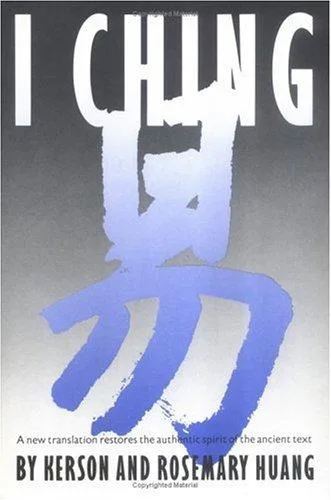
Kerson Huang's 1994 translation of the I Ching explains the hexagrams' symbolic meanings and philosophical depth.
Kerson Huang's interpretation of the I Ching moves beyond its common use as a divination tool. He focuses on the text as a system that reflects the dynamic forces shaping the cosmos and human destiny. Huang carefully explains the hexagrams, revealing layers of symbolic meaning tied to existence itself. The book examines the philosophical ideas about change, balance, and the Tao that have influenced thinkers for centuries.
This work encourages readers to see the unseen forces of the universe. It presents the I Ching as a communication with nature and the human experience. Huang's edition is for those seeking a deeper understanding of themselves and the cosmos. Its pages hold ancient knowledge, offering insight to those who approach it with curiosity and an open mind.
The I Ching, or Book of Changes, is a classical Chinese divination text and one of the oldest Chinese classics. Its origins are traced back to the Western Zhou dynasty (c. 1046–771 BCE). For millennia, it has been a central text in Chinese philosophy and religion, influencing Confucianism and Taoism. Its core is the sixty-four hexagrams, each a combination of six stacked horizontal lines, either broken or unbroken, representing fundamental principles of reality. These hexagrams are used to understand the dynamics of change and the patterns of the universe.
💡 Why Read This Book?
Unlock the wisdom of the ancients with Kerson Huang's I Ching. This book offers a profound exploration of change, destiny, and the philosophical underpinnings of Chinese thought. It is essential for seekers of hidden knowledge, scholars of Eastern philosophy, and practitioners of divination seeking a deeper, more nuanced understanding of this timeless oracle. Discover the universal patterns that govern existence and gain practical wisdom for navigating life's complexities.
⭐ Reader Reviews
Honest opinions from readers who have explored this book.
❓ Frequently Asked Questions
What is the I Ching?
The I Ching, or 'Book of Changes,' is an ancient Chinese divination text and one of the oldest of the Chinese classics. It is a complex system of philosophy, cosmology, and divination that uses 64 hexagrams to represent fundamental archetypes of reality and change.
Who was Kerson Huang?
Kerson Huang was a distinguished theoretical physicist and a respected translator of Chinese philosophical texts. His scientific background lent a unique perspective to his interpretations of the I Ching, bridging empirical reasoning with ancient metaphysical concepts.
How can the I Ching be used for divination?
Traditionally, the I Ching is consulted by casting yarrow stalks or coins to generate a hexagram, which is then interpreted using the text. The resulting hexagram and its changing lines offer guidance, insights, and predictions regarding a specific question or situation.
What is the philosophical significance of the I Ching?
The I Ching emphasizes the constant nature of change and the interconnectedness of all things. It provides a framework for understanding cosmic principles, ethical conduct, and the balance of Yin and Yang, offering a path towards harmony with the natural order.
Is this book suitable for beginners?
Yes, Kerson Huang's edition is highly regarded for its clarity and comprehensive explanations, making it an excellent starting point for those new to the I Ching, while still offering depth for experienced practitioners.
🔮 Key Themes & Symbolism
The Philosophy of Change (Yi)
Fundamentally, the I Ching is a proof of the ceaseless flux of existence. Huang's work meticulously unpacks the concept of 'Yi' – change – as the fundamental principle governing the universe. It teaches that nothing is static, and understanding the dynamics of transformation is key to navigating life. This theme explores how the hexagrams represent cyclical patterns of growth, decay, and renewal, encouraging adaptability and foresight in the face of inevitable shifts. It’s a profound invitation to embrace impermanence and find wisdom in the ebb and flow of all things.
Cosmic Harmony and the Tao
This edition studies the I Ching's profound connection to the Tao, the ultimate, ineffable principle that underpins reality. Huang reveals how the hexagrams illustrate the harmonious interplay of opposing forces, Yin and Yang, and how their balance dictates the state of the cosmos. Readers will discover how aligning oneself with the natural order, the Tao, leads to greater wisdom, peace, and effective action. It’s an exploration of universal laws that govern both the macrocosm and the microcosm, offering a path to living in accord with the divine rhythm of existence.
Symbolism and Archetypal Wisdom
The I Ching's power lies in its rich, multilayered symbolism. Huang's interpretation illuminates the archetypal imagery embedded within each hexagram, revealing profound truths about human nature and the forces at play in our lives. Each combination of lines represents universal situations and energies, offering a symbolic language to understand complex challenges and opportunities. This theme explores how deciphering these symbols provides a unique lens through which to view personal growth, decision-making, and the unfolding of destiny, connecting the reader to a timeless reservoir of collective wisdom.
💬 Memorable Quotes
Direct passages from the work, attributed to the author.
“When the right time comes, the dragon appears.”
— This proverb speaks to patience and opportune moments. Great potential often lies dormant, waiting for the perfect circumstances to manifest and achieve its full power.
“The superior man understands what is difficult and acts accordingly.”
— This highlights the value of discernment and strategic action. Recognizing challenges and responding with appropriate measures is a hallmark of wisdom and effective decision-making.
“He who knows the ways of the world does not become lost.”
— Understanding the underlying principles and dynamics of existence provides a compass for navigating life's complexities, preventing disorientation and fostering clarity.
💡 Key Ideas
Editorial paraphrase of the work's core concepts — not direct quotes.
The superior man acts before he speaks, and thus earns respect.
This quote emphasizes the importance of action and integrity over mere words. True leadership and influence stem from demonstrated character and deeds, fostering trust and admiration.
Change is the only constant.
A fundamental tenet of the I Ching, this quote reminds us that adaptation and flexibility are essential for survival and growth in an ever-evolving world.
🌙 Esoteric Significance
Tradition
The I Ching is deeply rooted in ancient Chinese esoteric traditions, primarily those associated with Taoism and Confucianism. Within these traditions, it is viewed not merely as a divination tool, but as a cosmic map, a repository of universal laws, and a guide to harmonious living. It embodies the principles of balance, cyclical change, and the interconnectedness of all things, offering a path to spiritual cultivation and alignment with the Tao. Its esoteric value lies in its ability to reveal the subtle energies and patterns that govern both the inner and outer worlds.
Symbolism
The primary symbolism of the I Ching revolves around its 64 hexagrams, each formed by six lines that are either solid (Yang) or broken (Yin). These lines and their combinations represent fundamental archetypes of human experience and natural phenomena. Key symbols include the trigrams (three-line combinations) like Heaven (creative), Earth (receptive), and Water (danger), which combine to form the hexagrams. The dynamic interplay of Yin and Yang, represented by these lines, illustrates the constant flux and balance within the universe, offering insights into timing, potential, and optimal courses of action.
Modern Relevance
In the modern era, the I Ching continues to offer profound relevance as a tool for introspection, decision-making, and spiritual growth. Its emphasis on adaptability and understanding change resonates deeply in our rapidly evolving world. Esoterically, practitioners use it to gain insight into complex situations, to connect with universal patterns, and to cultivate a more mindful approach to life. It serves as an oracle that challenges conventional thinking, encouraging a deeper perception of reality and fostering a sense of inner balance and wisdom amidst the chaos of contemporary life.
👥 Who Should Read This Book
This edition of the I Ching is a profound resource for a diverse audience. **Beginners** seeking an accessible yet comprehensive introduction to this ancient oracle will find Huang's clear prose and insightful commentary invaluable. **Scholars of Eastern philosophy and comparative religion** will appreciate its depth and scholarly rigor, offering a sophisticated understanding of its philosophical underpinnings. **Spiritual seekers and practitioners** of divination, Tarot, or other esoteric arts will discover a powerful tool for self-reflection, guidance, and connecting with universal wisdom. Those interested in **Confucianism, Taoism, and Chinese metaphysics** will find it an essential text for grasping the foundational concepts of these traditions.
📜 Historical Context
The I Ching, originating in ancient China, boasts a lineage stretching back over three millennia. Its earliest layers are attributed to legendary figures like Fu Hsi, with later additions and commentaries by Confucius and his disciples. This text emerged during a period of profound philosophical and societal upheaval, including the Spring and Autumn period and the Warring States period. It served as a vital source of wisdom for rulers, scholars, and commoners alike, offering guidance on governance, personal conduct, and understanding the will of Heaven. Its enduring influence shaped Chinese culture, philosophy, and even political thought, becoming a central to Confucianism and a profound influence on Daoism. The I Ching’s adaptability allowed it to transcend its historical origins, remaining a relevant source of insight into the human condition.
📔 Journal Prompts
Reflect on a recent significant change in your life. How does the symbolism of a relevant hexagram illuminate this transition?
Consider the interplay of Yin and Yang in a current challenge you are facing. How can understanding this dynamic offer a new perspective?
What does the concept of 'acting before speaking' mean in your personal or professional life? How can you embody this principle more fully?
The I Ching speaks of understanding what is difficult. Identify a difficult situation and brainstorm actions aligned with its potential insights.
How can you cultivate a greater sense of harmony with the natural order in your daily routine?
🗂️ Glossary
Hexagram
A figure composed of six stacked horizontal lines, where each line is either solid (Yang) or broken (Yin). The I Ching uses 64 unique hexagrams to represent fundamental archetypes and situations.
Trigram
A figure composed of three stacked horizontal lines (Yang or Yin). There are eight basic trigrams, which are the building blocks of the hexagrams, representing fundamental elements and forces.
Yin
In Chinese philosophy, the passive, dark, feminine, and receptive principle. It is often associated with the moon, water, and the earth.
Yang
In Chinese philosophy, the active, light, masculine, and creative principle. It is often associated with the sun, fire, and heaven.
Tao (or Dao)
The fundamental principle of the universe in Chinese philosophy, often translated as 'the Way.' It represents the ineffable, natural order and flow of all things.
This book appears in 3 collections
🔮 Readers Also Liked
Browse all →








More by Kerson Huang
All books →

From the “Tarot” Collection
View all →






More Free Divination & Tarot Books
View all →




![SQL [asterisk] forms operator's reference card](/img/thumb/sql-asterisk-forms-operator-s-reference-card-oracle-corporation.webp)