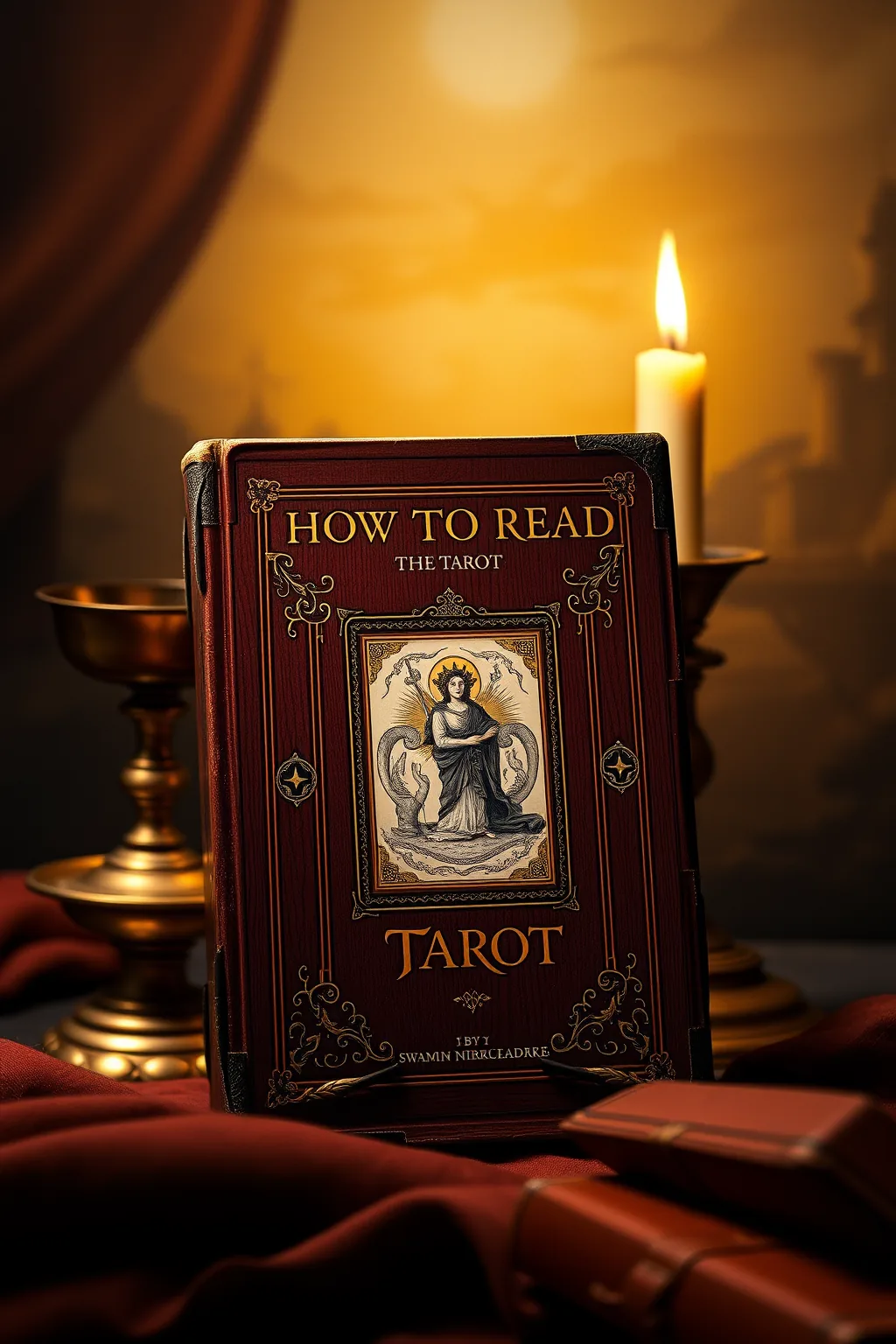
How to Read the Tarot
 61
61

How to Read the Tarot



Lorelei Sage (Contemplative Literature Editor) — Abbot George Burke's 'How to Read the Tarot' is a masterclass in esoteric interpretation, offering a profound and accessible entry into the mystical dimensions of the cards. Swami Nirmalananda Giri's deep understanding of ancient wisdom traditions shines through, elevating this work beyond mere technique to a spiritual discipline. He masterfully deciphers the intricate symbolism, revealing the Tarot as a potent mirror of the soul and a celestial map for spiritual growth. This book is indispensable for serious students of divination, spiritual seekers, and anyone wishing to cultivate a more profound understanding of themselves and the universe. Its clarity and depth make it a cherished resource.
📝 Description
61
Abbot George Burke's 'How to Read the Tarot' was first published in 1998.
Abbot George Burke's 1998 book, 'How to Read the Tarot,' presents the cards not just as tools for fortune telling but as a symbolic language. Burke, writing as Swami Nirmalananda Giri, uses his background in esoteric traditions to explain the deeper meanings within the Tarot deck. He focuses on how the archetypal images on the cards relate to universal principles and human consciousness.
The book aims to guide readers past simple interpretations to discover the psychological and spiritual insights embedded in the cards. It encourages a practice of self-discovery through the Tarot, viewing it as a map for personal growth and spiritual understanding. The text emphasizes that the Tarot can be a means of developing intuition and connecting with a larger spiritual framework.
This work is situated within the Western esoteric tradition, specifically drawing from Hermeticism and Gnosticism, which Abbot Burke extensively studied and wrote about. The book connects the Tarot's imagery to concepts found in these traditions, such as the relationship between the microcosm and macrocosm, and the idea of spiritual ascent. It frames the Tarot as a symbolic system that mirrors the structure of consciousness and the path of spiritual development, aligning with esoteric philosophies that see hidden meanings in symbols and correspondences.
💡 Why Read This Book?
Unlock the ancient wisdom of the Tarot and transform your understanding of self and cosmos. Abbot George Burke offers a profound, spiritually-infused approach to card interpretation, revealing hidden layers of meaning. Ideal for seekers of spiritual truth, practitioners of divination, and scholars of esoteric traditions who desire a deeper, more meaningful connection with the Tarot's archetypal language.
⭐ Reader Reviews
Honest opinions from readers who have explored this book.
❓ Frequently Asked Questions
What is the primary esoteric philosophy behind Abbot George Burke's Tarot method?
Abbot George Burke's approach is rooted in a blend of Hindu Vedanta and Western esoteric traditions, viewing the Tarot as a symbolic representation of the journey of consciousness and the unfolding of divine manifestation. It emphasizes self-awareness and spiritual evolution.
Is this book suitable for absolute beginners in Tarot?
Yes, while deeply esoteric, the book is structured to guide beginners through the foundational principles and symbolic language of the Tarot with clarity and patience, fostering a holistic understanding from the outset.
How does this book differ from standard Tarot guides?
Unlike many guides, this book delves into the philosophical and spiritual underpinnings of each card, connecting them to universal archetypes and the nature of reality. It prioritizes inner understanding over mere predictive techniques.
What spiritual disciplines are referenced or recommended in conjunction with Tarot study?
The book subtly integrates concepts from meditation, mindfulness, and the study of spiritual texts, suggesting a holistic approach to self-discovery that complements Tarot practice.
Can 'How to Read the Tarot' be used for personal growth and self-help?
Absolutely. The book frames Tarot as a powerful tool for introspection, self-discovery, and understanding life's challenges and opportunities from a higher, more spiritual perspective, facilitating profound personal transformation.
🔮 Key Themes & Symbolism
The Tarot as a Spiritual Map
This book posits the Tarot not merely as a tool for fortune-telling, but as a profound symbolic map of the human psyche and the journey of the soul through various stages of spiritual evolution. Each card is presented as an archetypal representation of universal energies, challenges, and potentials, offering a blueprint for self-understanding and transformation. The reader is encouraged to see the cards as a dialogue with the inner self and the divine.
Decoding Archetypal Symbolism
Abbot George Burke meticulously unpacks the wide range of symbols embedded within the Tarot deck, drawing connections to ancient mythologies, philosophical concepts, and the subtle energies that govern existence. He guides the reader to perceive the deeper meanings behind the imagery, fostering an intuitive understanding that transcends rote memorization. This allows for a more profound and personal resonance with the cards, unlocking their hidden wisdom.
The Tarot as a Path to Self-Realization
The ultimate aim of this esoteric exploration is to guide the reader towards self-realization and spiritual awakening. By understanding the Tarot's profound symbolism, individuals can gain clarity on their life path, identify obstacles, and harness their inner strengths. The book emphasizes the Tarot's role as a catalyst for introspection, fostering a deeper connection to one's true nature and the divine essence within.
💬 Memorable Quotes
Direct passages from the work, attributed to the author.
“Within each card lies an ancient story waiting to be heard.”
— This evokes the idea that the Tarot is a living repository of wisdom, and understanding its symbols is akin to listening to the timeless narratives of the cosmos and the human condition.
“The Fool's journey is the journey of every soul.”
— Highlighting the archetypal nature of the Tarot, this suggests that the universal quest for experience, growth, and meaning, as embodied by The Fool, is a fundamental aspect of all existence.
“Seek not to predict the future, but to understand the present.”
— This emphasizes the book's focus on using the Tarot for present-moment awareness, psychological insight, and spiritual guidance rather than solely for deterministic prognostication.
“The true magic lies in the unfolding of consciousness.”
— This points to the esoteric core of the book, suggesting that the transformative power of the Tarot is not in external forces, but in the expansion and deepening of one's own awareness.
💡 Key Ideas
Editorial paraphrase of the work's core concepts — not direct quotes.
The Tarot is a mirror held up to the soul.
This quote expresses the book's central theme: the Tarot's primary function is not external prediction, but internal reflection and self-discovery.
🌙 Esoteric Significance
Tradition
This work is deeply rooted in the Advaita Vedanta tradition of Hinduism, harmoniously interwoven with Western Hermeticism and Gnosticism. Abbot George Burke, as Swami Nirmalananda Giri, brings a yogic perspective, viewing the Tarot as a symbolic representation of the cosmic dance of creation, preservation, and dissolution, mirroring the journey of the Atman (individual soul) towards union with Brahman (Universal Consciousness).
Symbolism
The book meticulously deciphers the profound symbolism within each Tarot card, linking them to archetypal forces, chakras, astrological correspondences, and the Seven Rays. It reveals how the suits, numbers, and figures represent fundamental aspects of consciousness and the manifest universe, offering a rich lexicon for understanding the subtle energies at play in human experience and the cosmos.
Modern Relevance
In an age often characterized by disconnection and superficiality, Abbot George Burke's 'How to Read the Tarot' offers a potent antidote by providing a framework for deep introspection and spiritual connection. Its emphasis on self-awareness, inner wisdom, and the archetypal journey of the soul remains profoundly relevant for those seeking meaning, purpose, and a more integrated understanding of their lives and the world around them.
👥 Who Should Read This Book
This useful text is essential for a diverse audience. Absolute beginners seeking a profound and spiritual introduction to Tarot will find its clear explanations and clear insights invaluable. Seasoned practitioners looking to deepen their understanding beyond mere predictive techniques will discover a richer, more philosophical dimension. Scholars of esotericism and comparative religion will appreciate its synthesis of Eastern and Western mystical traditions. Spiritual seekers yearning for tools of self-discovery and consciousness expansion will find the Tarot presented as a powerful guide for their personal evolution.
📜 Historical Context
Published in an era where esoteric thought was experiencing a resurgence, 'How to Read the Tarot' by Abbot George Burke (Swami Nirmalananda Giri) emerged as a significant contribution to the metaphysical and spiritual literature landscape. The late 20th and early 21st centuries saw a growing interest in ancient wisdom traditions, mindfulness, and self-help techniques, moving beyond purely materialist worldviews. Burke's work resonated with this zeitgeist by offering a deeply spiritual and philosophical interpretation of the Tarot, grounding it in established spiritual lineages and presenting it as a tool for profound personal growth and consciousness expansion. It bridged the gap between traditional occultism and contemporary spiritual seeking, providing a comprehensive and insightful perspective for a new generation of practitioners.
📔 Journal Prompts
Reflect on the 'Fool's Journey' as depicted in the Major Arcana. How does this narrative mirror your own life's path and current stage of development?
Choose a card that speaks to a current challenge you are facing. What hidden message or guidance does its symbolism offer you?
Consider the relationship between the four suits of the Tarot and the different aspects of your life (e.g., emotions, intellect, material world, relationships). How can you bring greater balance?
Meditate on the archetypal figures within the Tarot. Which archetypes do you feel most drawn to, and why? What qualities do they represent for you?
How can integrating the wisdom of the Tarot into your daily life foster greater self-awareness and spiritual growth?
🗂️ Glossary
Archetype
Universal, primordial patterns or images that are part of the collective unconscious, representing fundamental human experiences and motivations. In Tarot, these are embodied by the figures and scenes on the cards.
Esoteric
Intended for or likely to be understood by only a small number of people with a specialized knowledge or interest; inner, hidden, or secret knowledge, often related to spiritual or mystical practices.
Vedanta
A school of Hindu philosophy that aims to understand the nature of ultimate reality (Brahman) and the self (Atman), often emphasizing spiritual liberation through knowledge and contemplation.
Hermeticism
A religious, philosophical, and esoteric tradition based on the purported teachings of Hermes Trismegistus, emphasizing divine wisdom, the interconnectedness of all things, and the pursuit of spiritual enlightenment.
Symbolism
The use of symbols to represent ideas and qualities by giving them symbolic meanings that are different from their literal sense. In Tarot, each image carries layers of symbolic meaning.
This book appears in 3 collections
🔮 Readers Also Liked
Browse all →
From the “Tarot” Collection
View all →
More Free Divination & Tarot Books
View all →