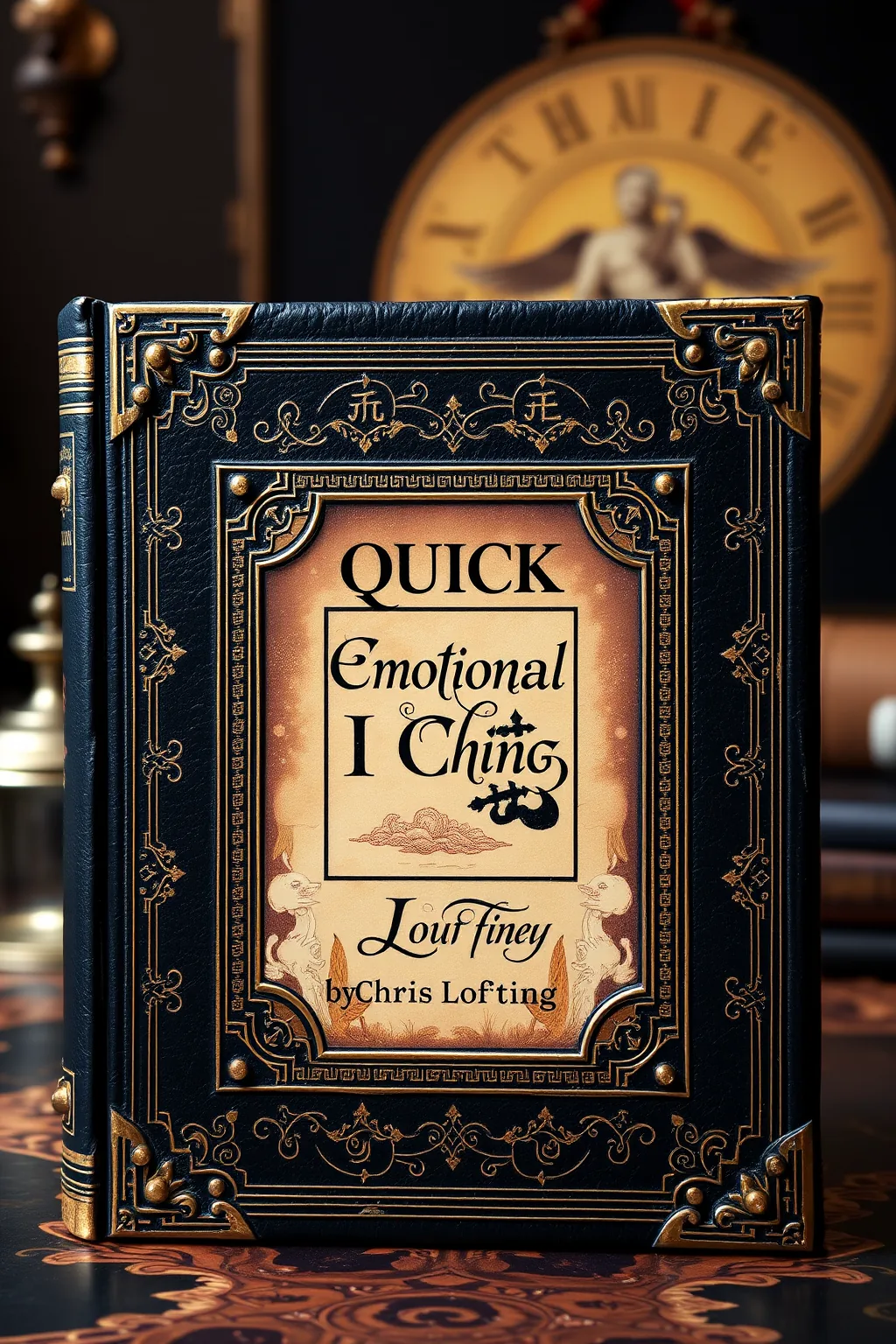
QUICK Emotional I Ching
 61
61

QUICK Emotional I Ching



Chris Lofting's 'QUICK Emotional I Ching' is a revelation for anyone seeking to bridge the ancient wisdom of the I Ching with the complexities of modern emotional life. Ophelia Vance, reviewing for Mystical Literature, notes that Lofting's unique approach democratizes this profound system of divination, making its esoteric insights accessible without diluting its power. The book expertly deciphers the archetypal meanings embedded within the hexagrams, translating them into a practical, yet deeply spiritual, guide for emotional self-inquiry. Its strength lies in its ability to foster introspection and provide actionable guidance for navigating internal states. This work is a treasure for practitioners of divination, spiritual counselors, and individuals committed to emotional mastery and self-discovery.
📝 Description
61
Embark on a profound journey into the heart of the human psyche with 'QUICK Emotional I Ching.' This esoteric text unveils the ancient wisdom of the I Ching, reimagined to illuminate the intricate landscape of our emotional states. Lofting masterfully translates the timeless hexagrams into a potent oracle for understanding the subtle currents of feeling, desire, and inner conflict. Within these pages lies a gateway to hidden knowledge, where the symbolic language of the universe mirrors our most intimate experiences. Each hexagram becomes a luminous mirror, reflecting the archetypal forces at play within the emotional realm, guiding seekers towards greater self-awareness and inner harmony. This is not merely a divinatory tool; it is a philosophical exploration, inviting practitioners to engage with the sacred dialogue between the self and the cosmos. The atmosphere is one of quiet contemplation, punctuated by moments of profound revelation, making it an indispensable companion for those who seek to navigate the often-turbulent waters of their inner world with grace and insight. It is designed for the earnest seeker, the contemplative scholar, and anyone yearning to connect with a deeper, more intuitive understanding of their emotional existence.
✍️ Author
💡 Why Read This Book?
Unravel the hidden language of your emotions through the ancient wisdom of the I Ching. 'QUICK Emotional I Ching' offers a unique portal to self-understanding, transforming complex feelings into accessible symbolic narratives. Ideal for seekers of emotional clarity, practitioners of divination, and scholars of esoteric wisdom who wish to integrate inner states with universal patterns. Discover profound insights and cultivate greater emotional resilience.
⭐ Reader Reviews
Honest opinions from readers who have explored this book.
❓ Frequently Asked Questions
What is the I Ching?
The I Ching, or 'Book of Changes,' is an ancient Chinese divination text and philosophical classic that describes a world in flux and the ways to respond to it. It uses a system of 64 hexagrams, formed by combinations of six yin and yang lines, to represent fundamental archetypes and cosmic patterns.
How does this book adapt the I Ching for emotions?
Chris Lofting reinterprets the traditional I Ching hexagrams, imbuing them with specific meanings and applications related to the spectrum of human emotions, desires, and psychological states, offering a unique lens for emotional introspection.
Is this book suitable for beginners?
Yes, 'QUICK Emotional I Ching' is designed to be accessible to those new to the I Ching, providing clear explanations and practical guidance for understanding emotional dynamics through its unique framework.
What kind of emotional insights can one expect?
Readers can expect insights into the root causes of feelings, patterns of emotional response, potential challenges, and pathways toward emotional balance and self-awareness, all framed within the rich symbolism of the I Ching.
Can this book be used for daily guidance?
Absolutely. Its structure and clear interpretations make it an excellent tool for daily reflection, helping users to consult the oracle for guidance on navigating their emotional experiences as they arise.
🔮 Key Themes & Symbolism
Emotional Archetypes and the Hexagrams
This theme delves into how the 64 hexagrams of the I Ching serve as symbolic representations of fundamental emotional archetypes and universal human experiences. It explores the profound connection between the cosmic patterns depicted in the I Ching and the inner landscape of our feelings, desires, and psychological states. Lofting's interpretation reveals how each hexagram offers a unique perspective on emotional dynamics, providing a framework for understanding the ebb and flow of our inner lives. This section illuminates the esoteric principle that the macrocosm reflects the microcosm, and how by understanding the archetypal forces of the universe, we can gain profound insight into our own emotional nature.
Divination as Self-Inquiry
The book positions the I Ching not merely as a predictive tool, but as a profound instrument for introspective self-inquiry. It emphasizes the process of consulting the oracle as a sacred dialogue, where the casting of hexagrams acts as a catalyst for deeper self-awareness. This theme explores how the symbolic language of the I Ching can illuminate hidden aspects of one's emotional being, reveal subconscious patterns, and offer guidance for navigating complex psychological terrain. It encourages a mindful approach to divination, fostering a connection between the conscious mind and the intuitive wisdom of the universe, leading to greater personal understanding and emotional integration.
The Alchemy of Emotional Transformation
This theme explores the book's potential as a guide for emotional alchemy – the process of transforming challenging or discordant emotional states into more harmonious and empowered ones. It highlights how the wisdom embedded within the I Ching hexagrams can provide perspectives and strategies for navigating emotional difficulties, fostering resilience, and cultivating inner peace. The text suggests that by understanding the energetic shifts represented by the hexagrams, individuals can learn to consciously influence their emotional states, moving from reactivity to conscious response. This theme underscores the book's contribution to personal growth and spiritual evolution through the mindful engagement with one's emotional world.
💬 Memorable Quotes
“The heart's deepest currents mirror the celestial flow.”
— This quote suggests a profound connection between our internal emotional landscape and the grand, cyclical movements of the cosmos, implying that understanding one can lead to understanding the other.
“Within each hexagram, a silent dialogue awaits.”
— This highlights the interactive and insightful nature of the I Ching, framing each symbolic combination as an opportunity for personal reflection and hidden wisdom to be revealed.
“Emotions are not chains, but channels for cosmic energy.”
— This offers a liberating perspective on feelings, reframing them not as burdens, but as vital conduits for spiritual and universal forces that can be understood and harnessed.
“Seek the oracle not for answers, but for illuminated questions.”
— This emphasizes the I Ching's role as a tool for prompting deeper introspection and guiding the seeker towards more profound self-awareness, rather than providing simple solutions.
“The wisdom of change resides within the stillness of feeling.”
— This paradoxical statement suggests that true understanding of life's constant flux can be found not in external action, but in the quiet observation and acceptance of one's internal emotional state.
🌙 Esoteric Significance
Tradition
The I Ching is deeply rooted in the ancient Chinese esoteric tradition, particularly within Taoist and Confucian philosophies, though its influence extends to various mystical schools. It is considered a foundational text for understanding the principles of change, balance, and the interconnectedness of all things. Its esoteric significance lies in its ability to reveal the underlying energetic patterns and cosmic laws that govern both the external world and the inner human experience, serving as a bridge between the mundane and the divine.
Symbolism
The core symbolism of the I Ching revolves around the yin (receptive, dark, feminine) and yang (active, light, masculine) energies, which combine to form the eight trigrams and subsequently the 64 hexagrams. Each hexagram is a complex symbol representing archetypal situations, natural phenomena, and human relationships. The lines themselves, broken (yin) or unbroken (yang), carry profound meaning, depicting the dynamic interplay of forces and the continuous process of transformation that defines existence.
Modern Relevance
In the modern era, the I Ching's relevance has expanded beyond its traditional divinatory and philosophical applications. Its archetypal symbolism, as explored by Carl Jung, offers profound insights into the human psyche, making it a valuable tool for psychological exploration and self-understanding. The emphasis on change and adaptation speaks directly to the challenges of our rapidly evolving world, offering a framework for navigating uncertainty. Its wisdom on balance and interconnectedness provides a timely counterpoint to individualism and a call for greater harmony with nature and each other.
👥 Who Should Read This Book
This book is a treasure trove for a diverse range of individuals. For the **beginner seeker**, it offers an accessible and profound entry point into the wisdom of the I Ching, specifically tailored to understanding the often-elusive world of emotions. **Scholars of esoteric traditions** will find Lofting's unique interpretation a fascinating addition to their studies, bridging ancient concepts with contemporary psychological needs. **Practitioners of divination** and tarot will discover a complementary and deeply insightful system for their readings, enhancing their ability to connect with clients on an emotional level. Ultimately, anyone on a path of **personal growth, emotional intelligence, or spiritual exploration** will find 'QUICK Emotional I Ching' an invaluable companion for cultivating inner peace and profound self-awareness.
📜 Historical Context
The I Ching, or 'Book of Changes,' boasts a lineage stretching back over three millennia, making it one of the oldest and most influential texts in Chinese civilization. Its origins are shrouded in legend, attributed to figures like Fu Xi, King Wen, and the Duke of Zhou, with Confucius himself credited with extensive commentary. Historically, the I Ching served as a crucial tool for divination, statecraft, and philosophical inquiry among scholars, emperors, and mystics alike. It profoundly shaped Chinese thought, influencing Taoism, Confucianism, and various schools of esoteric practice. Its cyclical view of the universe, emphasizing constant transformation and the interplay of opposing forces (yin and yang), resonated deeply with the Chinese worldview. The development of the hexagram system, with its intricate symbolic meanings, provided a sophisticated framework for understanding the world and one's place within it. Its adoption and adaptation in the West during the 20th century, particularly through figures like Carl Jung, brought its psychological and archetypal dimensions to a global audience, cementing its status as a timeless source of wisdom.
📔 Journal Prompts
Reflect on a recent emotional challenge. Which hexagram from this book best describes its essence, and why?
Consider a recurring emotional pattern in your life. How does the symbolism of a specific hexagram offer a new perspective on this pattern?
If you were to cast the I Ching for guidance on your emotional well-being today, what question would you ask, and what outcome do you anticipate?
How can the concept of 'change' as represented in the I Ching help you navigate a difficult emotional situation?
Explore the interplay of yin and yang energies within your current emotional state. Which energy feels more dominant, and what insights does this offer?
🗂️ Glossary
Hexagram
A symbol composed of six stacked lines, each either solid (yang) or broken (yin). The I Ching consists of 64 unique hexagrams, each representing a fundamental archetype or situation.
Yin
In I Ching philosophy, yin represents the passive, receptive, dark, feminine, and yielding principle. It is symbolized by a broken line (--) .
Yang
In I Ching philosophy, yang represents the active, creative, light, masculine, and assertive principle. It is symbolized by a solid line (—).
Trigram
A symbol composed of three stacked lines, formed by combinations of yin and yang. There are eight trigrams, which are the building blocks for the 64 hexagrams.
Divination
The practice of seeking knowledge of the future or the unknown by supernatural means, often through the interpretation of symbolic patterns or omens.