I Ching
 70
70

I Ching



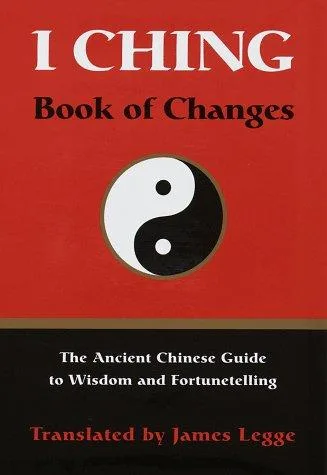
James Legge's rendition of the I Ching is an indispensable cornerstone for any serious student of esoteric divination. His translation breathes life into the ancient Chinese text, making its profound philosophical and mystical insights accessible without sacrificing its inherent depth. Ophelia Vance notes the remarkable clarity with which Legge navigates the complex symbolism, illuminating the I Ching's role as a mirror to the soul and a guide to cosmic principles. This edition is particularly potent for practitioners seeking to integrate its wisdom into their lives, offering a rich tapestry of guidance for navigating personal challenges and spiritual evolution. It is a testament to the enduring power of this oracle.
📝 Description
70
James Legge published his translation of the I Ching in 1882, making this classic text accessible to a wider audience.
James Legge's 1882 translation presents the I Ching, also known as the 'Book of Changes.' This ancient Chinese text uses sixty-four hexagrams, each composed of six lines, to offer guidance and insight. The I Ching's philosophy is built upon the interplay of Yin and Yang, the fundamental opposing yet complementary forces in the universe. Legge's work aims to make the text's cryptic pronouncements understandable for scholars and those interested in spiritual or philosophical inquiry.
This translation encourages readers to contemplate the patterns of life, exploring the relationship between fate and personal agency. It offers a framework for understanding change and adapting to life's transformations. The I Ching serves as a tool for self-reflection and a means to seek harmony with the surrounding world. Legge's edition is intended to facilitate a contemplative practice for those who wish to engage with its deeper meanings.
The I Ching is a foundational text in Chinese philosophy and religion, with roots stretching back thousands of years. It is considered one of the oldest Chinese philosophical classics. Its use extends beyond mere divination; it is a system for understanding the dynamics of the cosmos and human existence. The text's principles have influenced Taoism, Confucianism, and various schools of Chinese thought. Its symbolic language and philosophical depth have attracted practitioners and scholars across different cultures seeking to grasp universal patterns.
💡 Why Read This Book?
Unravel the secrets of the universe's constant transformation. The I Ching offers a profound system for self-discovery, ethical guidance, and understanding life's cyclical nature. Ideal for seekers of ancient wisdom, philosophers, and those wishing to deepen their connection to universal patterns. Legge's translation provides an accessible yet deeply authoritative portal into this timeless oracle.
⭐ Reader Reviews
Honest opinions from readers who have explored this book.
❓ Frequently Asked Questions
What is the I Ching?
The I Ching, or 'Book of Changes,' is one of the oldest Chinese classic texts, revered as a philosophical and divinatory tool that describes the fundamental principles of reality and the forces of change.
Who was James Legge?
James Legge was a Scottish sinologist and missionary who dedicated his life to translating Chinese classics into English, making works like the I Ching accessible to the Western world.
How is the I Ching used for divination?
Divination involves posing a question and using methods like coin tossing or yarrow stalks to generate hexagrams, which are then interpreted using the text's explanations and commentaries.
Is the I Ching only for divination?
No, while renowned for its divinatory uses, the I Ching is also a profound philosophical text offering insights into ethics, cosmology, and the nature of human existence.
What makes this translation special?
Legge's translation is celebrated for its scholarly accuracy, detailed annotations, and comprehensive introduction, providing a rich historical and philosophical context for the I Ching's wisdom.
🔮 Key Themes & Symbolism
The Nature of Change (Bian)
Fundamentally, the I Ching is a profound exploration of Bian, the ceaseless flux and transformation inherent in the universe. It posits that change is the only constant, and understanding its dynamics is key to navigating life harmoniously. Through its 64 hexagrams, each representing a specific state or process, the text illustrates how opposing forces, Yin and Yang, interact and evolve, leading to new beginnings and endings. This theme encourages acceptance of impermanence, fostering resilience and adaptability in the face of life's inevitable shifts, guiding the practitioner toward alignment with cosmic currents.
Cosmic Harmony and Balance (Yin & Yang)
The fundamental dualistic principle of Yin and Yang underpins the entire structure of the I Ching. These complementary forces, representing feminine and masculine, passive and active, dark and light, are not in opposition but in dynamic interplay. The hexagrams visually represent various combinations of these forces, illustrating how their balance or imbalance influences events and states of being. The text guides the reader to recognize these forces within themselves and the world, promoting the cultivation of equilibrium and harmony as the path to spiritual and practical well-being.
The Sage's Wisdom and Ethical Guidance
Beyond its divinatory function, the I Ching serves as a repository of ancient ethical wisdom, often attributed to sage-kings and philosophers. The commentaries within the text offer clear insights into proper conduct, decision-making, and the cultivation of virtue. It encourages introspection, self-reflection, and the development of a moral compass aligned with natural law. The I Ching challenges the reader to act with integrity, wisdom, and foresight, offering guidance on how to live a meaningful and auspicious life by understanding and acting in accordance with the cosmic order.
💬 Memorable Quotes
Direct passages from the work, attributed to the author.
“The superior man understands the changes of things.”
— This highlights the I Ching's central theme: the ability to perceive and adapt to the constant flux of life, a mark of true wisdom and foresight.
“He who knows the ways of the world will not be perplexed by its events.”
— This suggests that understanding the underlying principles and patterns, as revealed by the I Ching, leads to a state of inner peace and clarity, free from confusion.
“When the sun is highest, it begins to set.”
— A potent reminder of the cyclical nature of all things, emphasizing that even peak moments contain the seeds of their own decline, urging caution and preparedness.
“To understand the changes of things is to understand the will of Heaven.”
— This connects the study of the I Ching to a divine or cosmic intelligence, implying that by comprehending natural processes, one aligns themselves with a higher purpose.
“The superior man acts without the expectation of reward.”
— This points to the virtue of selfless action and ethical conduct, a key teaching within the I Ching for cultivating a balanced and harmonious life.
🌙 Esoteric Significance
Tradition
The I Ching is a foundational text within the Taoist and Confucian traditions, but its esoteric significance extends deeply into Chinese mysticism, geomancy (Feng Shui), and various forms of folk religion and Daoist alchemy. It is considered a 'Book of Heaven,' a cosmological map that reveals the underlying patterns and energetic flows of the universe. Its hexagrams are seen as archetypal representations of spiritual processes and stages of development, making it a powerful tool for meditation, self-transformation, and understanding the subtle interplay between the material and spiritual realms.
Symbolism
The I Ching's symbolism is rich and complex, centered on the binary of Yin (receptive, dark, feminine) and Yang (active, light, masculine) lines. These lines form the eight trigrams (Ba Gua), which are then combined to create the 64 hexagrams. Each hexagram, line, and associated imagery (like mountains, water, thunder) carries layers of meaning, representing archetypal situations, forces, and transformations. The symbolism is not static but dynamic, depicting the continuous interplay and evolution of these cosmic energies, offering clear insights into balance, change, and the interconnectedness of all things.
Modern Relevance
In the modern era, the I Ching continues to offer profound relevance. It provides a framework for understanding complex systems, navigating uncertainty, and fostering personal growth in a rapidly changing world. Its emphasis on balance, adaptability, and ethical action resonates deeply with contemporary challenges in psychology, environmentalism, and business strategy. For individuals, it serves as a powerful tool for introspection, decision-making, and cultivating a sense of purpose by connecting with timeless universal principles. Its wisdom offers solace, clarity, and a path toward greater self-awareness and harmony.
👥 Who Should Read This Book
This translation of the I Ching is useful for a diverse audience. **Beginners** seeking an accessible yet authoritative introduction to ancient Chinese wisdom will find Legge's work informative. **Scholars** of Eastern philosophy and religion will appreciate the meticulous scholarship and historical context. **Seekers** on a spiritual path will discover a profound oracle for self-reflection and guidance. **Practitioners** of divination, mindfulness, and contemplative arts will find a rich source of inspiration and practical application. Anyone drawn to understanding the deeper currents of life and the nature of change will find this edition a timeless companion.
📜 Historical Context
The I Ching's origins are deeply rooted in ancient China, with its earliest components dating back to the Western Zhou Dynasty (c. 1046–771 BCE). Initially, it was a manual for divination, used by rulers and shamans to interpret the will of Heaven and guide state affairs. Over centuries, it evolved, incorporating philosophical and ethical commentaries from Confucian scholars, most notably attributed to Confucius and his disciples. The Warring States period and the subsequent Han Dynasty saw the I Ching solidified as a core text within the Chinese canon, influencing not only divination but also philosophy, governance, and personal cultivation. James Legge's translation in the 19th century brought this profound Eastern wisdom to the West, bridging cultural divides and introducing its combination of mysticism and pragmatism to a global audience.
📔 Journal Prompts
Reflect on a recent significant change in your life. How does its 'hexagram' manifest in your experience?
Consider a situation where you felt in 'balance' or 'imbalance.' What were the dominant Yin and Yang energies at play?
How can the principle of 'constant change' be applied to overcome a current personal challenge?
Identify an action you can take today that embodies the 'superior man's' wisdom and ethical guidance.
Meditate on the symbolism of a specific hexagram that appeals to you. What insights does it offer about your current path?
🗂️ Glossary
Hexagram
A symbol composed of six stacked horizontal lines, representing a complex situation or state of being, formed by the combination of two trigrams.
Trigram
A symbol composed of three stacked horizontal lines, representing eight fundamental forces or concepts, such as Heaven, Earth, Water, Fire.
Yin
The passive, dark, receptive, feminine principle in Chinese philosophy, often represented by broken lines.
Yang
The active, light, creative, masculine principle in Chinese philosophy, often represented by solid lines.
Yi Jing
The original Chinese name for the 'Book of Changes,' emphasizing its core concept of transformation and adaptability.
This book appears in 3 collections
🔮 Readers Also Liked
Browse all →








More by James Legge
All books →




From the “Tarot” Collection
View all →





More Free Divination & Tarot Books
View all →