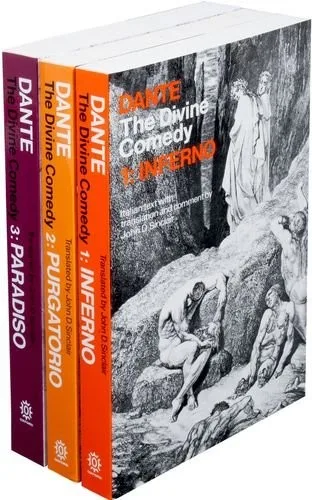
Dante's Divine Comedy Set
 62
62

Dante's Divine Comedy Set



Sophia Crane (Associate Editor) — Dante's "Divine Comedy" remains a cornerstone of Western esoteric thought, offering a profound, allegorical journey through the realms of the soul. This set presents a crucial text for understanding medieval Christian cosmology and its mystical underpinnings. The intricate symbolism, from the beasts in the dark wood to the celestial hierarchies, provides fertile ground for contemplation and spiritual practice. It’s a challenging yet immensely rewarding read for scholars of occult literature, theologians, and anyone seeking a deeper understanding of the archetypal journey of the soul. Its enduring relevance lies in its potent depiction of spiritual ascent and the consequences of moral choices, making it an indispensable addition to any serious metaphysical library.
📝 Description
62
Dante Alighieri's epic poem, written in the early 14th century, details a visionary journey through hell, purgatory, and heaven.
Dante Alighieri's "Divine Comedy" recounts a spiritual journey through the afterlife. The poem begins in the Inferno, depicting the eternal punishments for sins, where the suffering of the damned reflects their earthly deeds. Following this, the narrative moves to Purgatorio, illustrating the process of purification and the difficult ascent toward salvation. The final part, Paradiso, presents a vision of divine light, love, and ultimate reality. Each section is rich with allegory and symbolism, inviting readers to uncover deeper meanings.
The work engages with complex philosophical and theological ideas. It explores morality, the nature of free will, and humanity's relationship with the divine. The "Divine Comedy" offers a structured vision of the soul's path from sin to grace, using vivid imagery and intricate design to convey its message. This poem has long attracted those interested in spiritual quests and the structure of the cosmos.
Written in the early 14th century, Dante's "Divine Comedy" draws heavily on medieval Christian theology and cosmology, but also incorporates elements that resonate with esoteric traditions. Its allegorical structure and symbolic language lend themselves to interpretations beyond the literal narrative. The poem's depiction of different spiritual realms and the soul's progression through them can be seen as an articulation of mystical ascent, a common theme in various esoteric lineages. The numerological significance and the ordering of its cantos and canticles also suggest a deliberate, symbolic architecture.
💡 Why Read This Book?
Uncover profound spiritual allegories and hidden esoteric knowledge within the archetypal journey from Hell to Heaven. Explore rich symbolism and philosophical depths that resonate with seekers of truth, scholars of mystical traditions, and practitioners of spiritual disciplines. This epic poem offers a timeless map for navigating the soul's transformation and understanding the cosmic order.
⭐ Reader Reviews
Honest opinions from readers who have explored this book.
❓ Frequently Asked Questions
What is the primary esoteric interpretation of the Divine Comedy?
The Divine Comedy is often interpreted as an alchemical or psycho-spiritual allegory. It maps the soul's journey through stages of purification and transformation, mirroring processes of spiritual enlightenment and the integration of shadow aspects into a higher consciousness.
How does the Divine Comedy relate to Tarot symbolism?
Many scholars draw parallels between the stages and figures in the Divine Comedy and the archetypes found in Tarot, particularly the Major Arcana. Both offer symbolic pathways through life's challenges, spiritual growth, and the discovery of inner truth.
Is this book suitable for beginners in esoteric studies?
While challenging, the Divine Comedy is highly rewarding for diligent beginners. Its rich symbolism and narrative structure provide a foundational understanding of Western esoteric concepts and the archetypal journey of the soul. Patience and study are key.
What is the significance of the number three in the Divine Comedy?
The number three is paramount, representing the Holy Trinity. The poem is structured in three parts (Inferno, Purgatorio, Paradiso), each with 33 cantos (plus an introductory canto), reflecting divine order and spiritual perfection.
Can the Divine Comedy be used for divination or personal insight?
Yes, many practitioners use the Divine Comedy for personal contemplation and insight, akin to bibliomancy. Randomly opening to a passage can offer guidance or reflections on current life situations and spiritual progress.
🔮 Key Themes & Symbolism
The Archetypal Journey of the Soul
The "Divine Comedy" is a profound allegory for the soul's descent into the depths of sin and its arduous ascent towards divine union. It maps the universal stages of spiritual transformation, from confronting the shadow self in Inferno, through the trials of purification in Purgatorio, to the ecstatic illumination of Paradiso. This journey mirrors the alchemical process of dissolution and reintegration, offering a potent blueprint for personal growth and enlightenment for seekers across traditions.
Cosmic Order and Divine Justice
Dante meticulously constructs a divinely ordered cosmos where every soul's fate is a direct consequence of their earthly choices. The poem explores intricate hierarchies of sin and virtue, reflecting a profound belief in cosmic justice. This celestial architecture serves as a powerful metaphor for the interconnectedness of all beings and the ultimate accountability of the spirit. For those studying metaphysical systems, it provides a vivid depiction of a universe governed by divine law and moral causality.
Symbolism and Hidden Knowledge
Beneath its epic narrative, the "Divine Comedy" is a valuable collection of esoteric symbolism. From the allegorical beasts in the dark wood to the celestial choirs of angels, each element carries layers of meaning drawn from classical philosophy, Christian theology, and mystical traditions. Unlocking these symbols is akin to deciphering ancient Gnostic texts, revealing hidden truths about the nature of reality, consciousness, and the divine plan. It invites readers to engage in a deep hermeneutic practice.
💬 Memorable Quotes
Direct passages from the work, attributed to the author.
“Abandon all hope, ye who enter here.”
— A stark warning at the gates of Hell, symbolizing the absolute cessation of worldly desires and the unchangeable nature of divine judgment for those lost to sin.
“The love that moves the sun and the other stars.”
— The final, transcendent vision of Paradiso, representing the ultimate divine force and unifying principle of the cosmos, the source of all being and motion.
“Midway upon the journey of our life, I found myself within a forest dark.”
— This opening sets the stage for the allegorical journey, symbolizing a crisis of faith or spiritual awakening in the middle of human existence.
“And then, beyond the stars, He placed His seat.”
— Illustrates the ultimate transcendence of God, residing beyond the material universe, yet intimately connected to it.
💡 Key Ideas
Editorial paraphrase of the work's core concepts — not direct quotes.
For in Him we live, and move, and have our being.
Echoing biblical scripture, this quote emphasizes the pervasive presence of the divine, the animating force within all creation.
🌙 Esoteric Significance
Tradition
The "Divine Comedy" is deeply rooted in Western esoteric traditions, particularly Christian mysticism, Gnosticism, and Hermeticism. It embodies the Neoplatonic concept of emanation and the soul's journey back to the One. The allegorical structure mirrors alchemical processes of transformation and purification, while its numerological and symbolic layers resonate with Kabbalistic principles of divine order and cosmic structure. It can be seen as a spiritual roadmap for achieving gnosis, or direct experiential knowledge of the divine.
Symbolism
The poem is a vast set of symbolic imagery. The "dark wood" represents spiritual confusion; the beasts (lion, leopard, wolf) symbolize cardinal sins. The journey itself is an allegory for the soul's purification, with each circle of Hell, terrace of Purgatory, and sphere of Heaven representing distinct spiritual states or lessons. Figures like Virgil (reason) and Beatrice (divine love/grace) embody guiding principles. The celestial light in Paradiso symbolizes divine truth and ultimate consciousness.
Modern Relevance
In an age often characterized by spiritual searching and existential questioning, Dante's "Divine Comedy" offers clear insights into the human condition and the timeless quest for meaning. Its exploration of sin, redemption, and the pursuit of higher consciousness resonates deeply with contemporary seekers. The poem's archetypal journey provides a framework for understanding personal growth, confronting inner demons, and aspiring towards spiritual enlightenment, making it a vital text for modern practitioners of esoteric disciplines and anyone seeking profound existential and spiritual guidance.
👥 Who Should Read This Book
This monumental work is essential for scholars of medieval literature and theology, offering exceptional insight into historical cosmological beliefs. Esoteric practitioners will find a rich source of allegorical guidance for spiritual development and understanding archetypal journeys. Seekers of profound philosophical and spiritual truths will be captivated by its exploration of morality, free will, and the divine. Beginners in occult studies can approach it as a foundational text, unlocking layers of symbolism that inform many subsequent mystical traditions. Its poetic beauty and profound depth reward diligent readers from all backgrounds.
📜 Historical Context
Composed in the early 14th century, Dante Alighieri's "Divine Comedy" emerged during a period of immense intellectual and spiritual ferment in Europe. The Late Middle Ages witnessed a complex interplay between scholastic philosophy, burgeoning humanism, and deeply ingrained mystical traditions within Christianity. Dante, exiled from Florence, channeled his political disillusionment and profound theological understanding into this epic poem. The work reflects the medieval worldview, a hierarchical universe ordered by divine will, and incorporates influences from Aristotelian philosophy, Neoplatonism, and biblical exegesis. Its creation marked a central moment in literature, solidifying the Tuscan dialect as the standard for Italian and establishing a new benchmark for poetic ambition and theological depth. The poem's enduring influence spans centuries, shaping Western thought, art, and spirituality.
📔 Journal Prompts
Reflect on a personal 'dark wood' moment in your life and what guides (Virgil or Beatrice figures) helped you navigate it.
Imagine yourself in one of the circles of Hell, Purgatory, or spheres of Heaven. What lesson would you learn or impart there?
How does the concept of divine justice, as depicted by Dante, challenge or affirm your own understanding of karma and consequence?
Consider the role of love (divine or earthly) in your own spiritual journey, inspired by Beatrice's influence.
If you were to create your own allegorical journey of the soul, what symbolic landscapes and figures would you include?
🗂️ Glossary
Allegory
A narrative in which characters, events, and settings represent abstract ideas or moral qualities, serving as a deeper symbolic meaning beyond the literal story.
Gnosis
A Greek term for knowledge, specifically referring to spiritual or esoteric knowledge that leads to enlightenment or salvation, often gained through direct experience.
Neoplatonism
A philosophical school that emerged from Plato's teachings, emphasizing a hierarchical universe emanating from a divine, transcendent source (The One) and the soul's journey to reunite with it.
Hermeticism
A religious, philosophical, and esoteric tradition based on writings attributed to Hermes Trismegistus, emphasizing divine wisdom, the correspondences between the macrocosm and microcosm, and spiritual transformation.
Bibliomancy
A form of divination involving the use of books, typically by opening a sacred text at random and interpreting the passage that appears for guidance.
This book appears in 3 collections
🔮 Readers Also Liked
Browse all →








More by Dante Alighieri
All books →




From the “Tarot” Collection
View all →





More Free Divination & Tarot Books
View all →