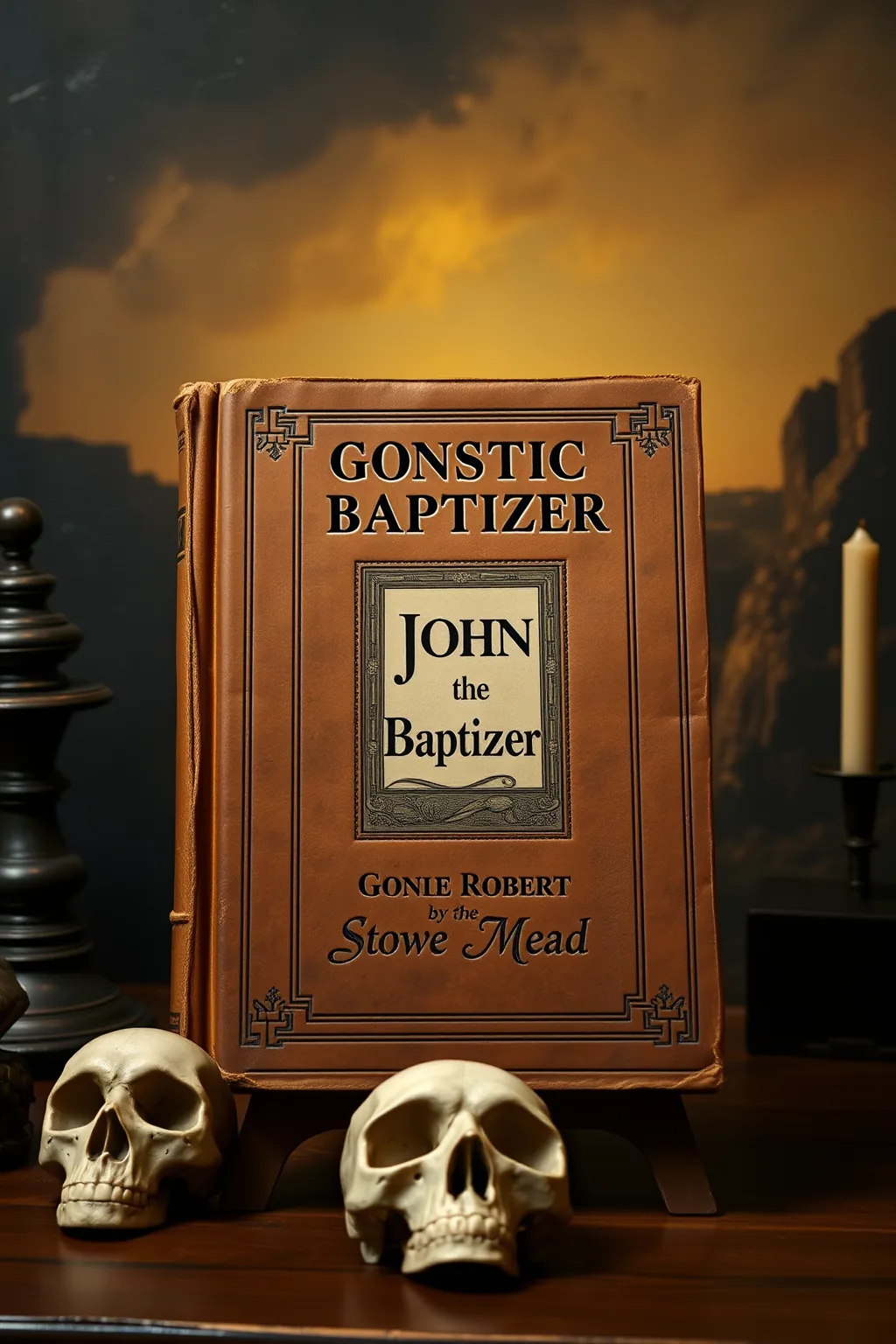
Gnostic John the Baptizer
 75
75

Gnostic John the Baptizer



Alaric Kestrel (Metaphysical Studies Reviewer) — George Robert Stowe Mead's 'Gnostic John the Baptizer' remains an indispensable cornerstone for serious Gnostic studies. Mead's erudite translation and insightful contextualization of Mandaean texts offer unparalleled access to an early Christian lineage often obscured. This work is a triumph, illuminating John the Baptist not merely as a precursor, but as a central figure within a sophisticated Gnostic cosmology. Its strength lies in its dual approach: rigorous scholarship married with deep reverence for the spiritual essence of the texts. Essential for anyone seeking to grasp the heterodox streams that profoundly shaped early Western mysticism.
📝 Description
75
George Robert Stowe Mead's 1924 book analyzes the Mandaean John-book.
Published in 1924, George Robert Stowe Mead's 'Gnostic John the Baptizer' examines the sacred texts of the Mandaeans, specifically focusing on their John-book. Mead translated selections from this text and placed them within the context of early Gnosticism and developing Christian thought. He argued for a significant role for John the Baptist within Gnostic traditions, presenting a view distinct from conventional historical accounts. The book includes narrative pieces, hymns, and descriptions of rituals, aiming to show the spiritual world of John and his followers.
This volume is intended for readers interested in the less common streams of Western spirituality. It offers insights into the beliefs and practices of a group whose history is intertwined with early mystical movements. Mead's work provides a scholarly approach to understanding a figure often viewed through a singular lens, opening up a broader perspective on religious history and esoteric thought.
This book sits within the study of early Christian Gnosticism and related heterodox movements. It connects the figure of John the Baptist to Mandaean traditions, a lineage often considered Gnostic or proto-Gnostic. Mead's work engages with the historical and textual evidence to understand John not just as a precursor to Jesus, but as a central figure in his own right within certain mystical currents. It aims to clarify the relationship between early Baptist groups and the broader Gnostic milieu of the Roman Empire.
✍️ Author

George Robert Stowe Mead
George Robert Stowe Mead was an English author and scholar of Gnosticism and early Christian mysticism.
Esoteric Writer
💡 Why Read This Book?
Uncover the esoteric significance of John the Baptist beyond canonical narratives. Explore the rich, mystical traditions of Mandaeism and their connections to early Gnosticism. This book is for seekers of hidden spiritual knowledge, scholars of comparative religion, and practitioners interested in ancient baptismal rites and Gnostic cosmology.
⭐ Reader Reviews
Honest opinions from readers who have explored this book.
❓ Frequently Asked Questions
What is the Mandaean John-book?
The Mandaean John-book, or Ginza Rba, is a central religious text of Mandaeism, a Gnostic religion. It contains hymns, narratives, and liturgical texts dedicated to John the Baptist.
How does this book differ from standard Christian accounts of John the Baptist?
Mead presents John the Baptist through the lens of Mandaean tradition, highlighting his role as a divine messenger and initiator into Gnosis, often diverging from the purely prophetic and penitential roles emphasized in canonical Gospels.
Is this book suitable for beginners in Gnosticism?
While academically rigorous, Mead's clear prose and extensive annotations make it accessible. However, a foundational interest in esoteric traditions will greatly enhance comprehension and appreciation.
What is Gnosis?
Gnosis refers to a form of spiritual knowledge or insight that leads to salvation. It emphasizes direct experience of the divine and an understanding of the true spiritual nature of reality, often contrasting with exoteric religious dogma.
What is the significance of baptism in Mandaean tradition?
Baptism (masbuta) is a central, continuous ritual in Mandaeism, symbolizing purification and rebirth into the spiritual realm. It is deeply connected to the teachings and lineage of John the Baptist.
🔮 Key Themes & Symbolism
The Gnostic Christology of John the Baptist
This theme looks at Mead's groundbreaking assertion that John the Baptist was not merely a herald but a central figure in a Gnostic spiritual lineage. The book examines how Mandaean texts portray John as a divine revealer, an intermediary to the higher realms, and an initiator into esoteric knowledge. It explores the concept of the Mandaean John as a manifestation of the divine light, distinct from but complementary to other spiritual emissaries, offering a profound reinterpretation of his role within the broader spectrum of early Christian and Gnostic thought, emphasizing his function in awakening dormant spiritual consciousness.
Mandaean Ritual and Symbolism
Mead meticulously unpacks the rich, symbolic language and ritual practices of the Mandaeans, as revealed in the John-book. This theme focuses on the intricate details of their baptismal rites, their cosmology, and the symbolic significance of light, water, and the spiritual 'worlds' they sought to navigate. The book illuminates how these elements served as vehicles for spiritual ascent and communion with the divine, offering readers a rare glimpse into an ancient, living Gnostic tradition and its potent, enduring symbolism that speaks to the soul's journey towards liberation and reunion with the source.
Bridging Gnostic and Early Christian Traditions
This theme explores Mead's ambitious project of situating John the Baptist within the complex matrix of early religious thought, specifically the interplay between emerging Christian doctrines and established Gnostic currents. The book argues for a continuity and influence between these traditions, suggesting that Gnostic insights, particularly those associated with John, were integral to the spiritual landscape that gave rise to Christianity. It highlights how understanding John through a Gnostic lens enriches our appreciation of the diversity and intellectual vibrancy of the ancient spiritual world, revealing a more nuanced picture of religious evolution.
💬 Memorable Quotes
Direct passages from the work, attributed to the author.
“The light of the Father of all life.”
— This phrase expresses the Mandaean concept of the supreme, transcendent Godhead, the ultimate source of all existence and spiritual illumination, a core tenet of their Gnostic cosmology.
“The Jordan is the stream of the soul's purification.”
— This highlights the profound symbolic meaning of baptism within Mandaeism, representing not just physical cleansing but the spiritual journey of the soul towards divine purity and rebirth.
“He who knows the Mysteries, knows the Truth.”
— This emphasizes the Gnostic pursuit of direct, experiential knowledge (Gnosis) as the key to spiritual liberation and understanding the fundamental nature of reality, as opposed to mere intellectual assent.
“The Kingdom of Heaven is within you.”
— While often associated with Jesus, this carries the Gnostic belief in the immanence of the divine within the individual, accessible through inner realization and spiritual awakening.
“In the beginning was the Word, and the Word was with God, and the Word was God.”
— This foundational Gnostic and Christian concept speaks to the primordial creative force, the divine utterance that brought forth existence, signifying the spiritual origin and essence of all things.
🌙 Esoteric Significance
Tradition
This work is deeply rooted in Gnosticism, particularly the Mandaean tradition, which represents one of the oldest extant Gnostic religions. It explores themes of dualism, the descent and ascent of the soul, the importance of esoteric knowledge (Gnosis) for salvation, and the concept of a transcendent, unknowable Godhead. Mead's analysis connects these Mandaean elements to other Gnostic schools and early Christian mystical thought, revealing a shared spiritual quest for liberation from the material world and union with the divine.
Symbolism
The book is rich with esoteric symbolism, central among which are water and light. Water, particularly in the context of baptism, symbolizes spiritual purification, rebirth, and the descent of the soul. Light represents the divine realm, the ultimate source of Gnosis, and the spiritual essence within humanity striving for return. Other symbols include the Jordan River as a conduit between realms, the 'Kingdom' as an inner spiritual state, and figures like John the Baptist as divine messengers guiding souls towards awakening and liberation.
Modern Relevance
In an age seeking authentic spiritual experiences beyond dogma, Mead's work offers a profound exploration of alternative Christian lineages and Gnostic wisdom. It provides seekers with a deeper understanding of baptism as a transformative spiritual rite and the perennial quest for Gnosis. For scholars and practitioners, it illuminates the historical roots of mystical thought, offering insights into the diverse ways humanity has sought connection with the divine, making its teachings on inner knowing and spiritual liberation highly relevant for contemporary spiritual exploration.
👥 Who Should Read This Book
This book is a treasure for the dedicated seeker of esoteric knowledge, offering a profound dive into the less-explored spiritual currents of early Christianity and Gnosticism. Scholars of comparative religion, early Christian history, and Gnostic studies will find Mead's meticulous research and translations useful for their academic pursuits. Practicing mystics and those interested in the deeper, symbolic meanings of baptism and spiritual initiation will benefit greatly from the Mandaean perspective presented. While its depth may be challenging for absolute beginners, those with a burgeoning interest in ancient wisdom traditions and the hidden pathways to spiritual awakening will find this work deeply rewarding and clear.
📜 Historical Context
Published in 1924, George Robert Stowe Mead's 'Gnostic John the Baptizer' emerged during a period of intense revival and scholarly interest in Gnosticism and early Christian apocrypha. The early 20th century saw significant archaeological discoveries and textual translations that brought previously obscure Gnostic writings to light, fueling a desire to understand the heterodox spiritual movements that coexisted with, and often challenged, nascent Christianity. Mead, a prolific scholar in occult and esoteric traditions, aimed to bridge the gap between these newly accessible texts and established Western religious history. The era was characterized by a growing disillusionment with purely materialist worldviews, leading many to seek deeper, more mystical explanations for existence and the human condition, making works that explored hidden spiritual knowledge highly relevant.
📔 Journal Prompts
Reflect on the concept of 'Gnosis' and how it differs from intellectual understanding. Where have you experienced moments of profound spiritual knowing?
Consider the symbolism of water in your own spiritual or life experiences. What does purification and rebirth mean to you?
How does the Mandaean portrayal of John the Baptist challenge or expand your existing understanding of this figure?
Explore the idea of a 'spiritual lineage.' What traditions or teachers have influenced your spiritual path, and in what ways?
Meditate on the concept of divine light. How do you perceive or experience this light in your life, both externally and internally?
🗂️ Glossary
Gnosis
A Greek term meaning 'knowledge,' referring to direct, intuitive, or experiential spiritual insight that leads to salvation or liberation. It is a central concept in Gnosticism.
Mandaeism
An ancient Gnostic religion that venerates John the Baptist as its chief prophet and practices continuous baptism. Their scriptures are written in Aramaic and are part of the broader Gnostic tradition.
Dualism
A philosophical or religious concept that posits two fundamental, often opposing, principles or forces (e.g., good and evil, spirit and matter, light and darkness) that shape reality.
Baptism (Masbuta)
In Mandaeism, a sacred and essential ritual of ritual washing or immersion in living water, symbolizing spiritual purification, rebirth, and initiation into the Mandaean faith.
The Aeons
In Gnostic cosmology, divine emanations or spiritual beings that originate from the unknowable, transcendent Godhead. They form the Pleroma, or fullness of the divine realm.
This book appears in 5 collections
🔮 Readers Also Liked
Browse all →






More by George Robert Stowe Mead
All books →





From the “Meditation” Collection
View all →





More Free Mysticism & Contemplation Books
View all →