ERIC EJ1116873: "Way-Centered" versus "Truth-Centered" Epistemologies
 75
75

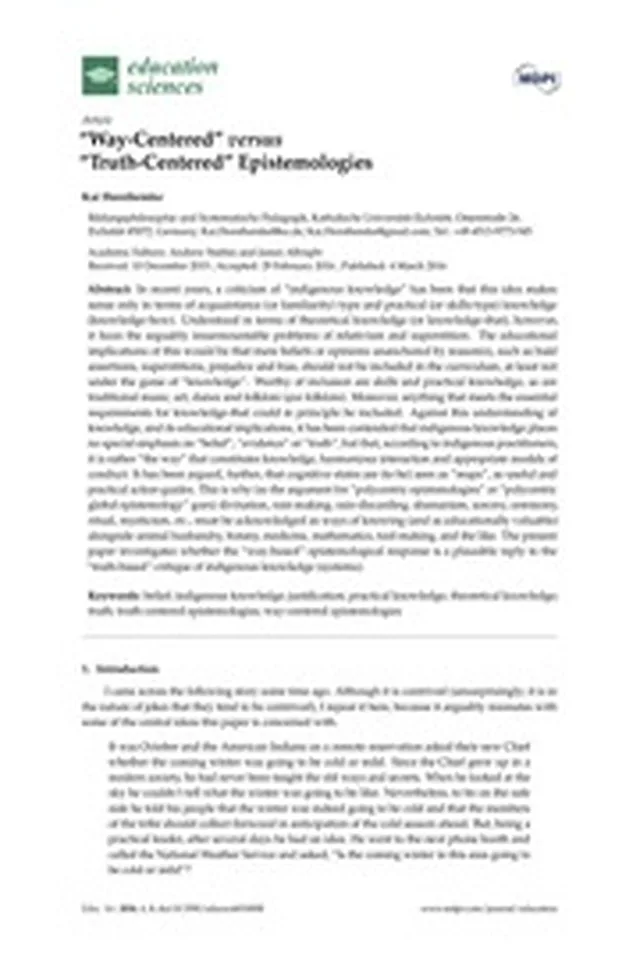
ERIC EJ1116873: "Way-Centered" versus "Truth-Centered" Epistemologies



Review by Isolde Whitaker (Sacred Texts Editor) — ERIC's 'Way-Centered' versus 'Truth-Centered' Epistemologies is a seminal work that bridges the gap between indigenous knowledge and modern epistemology. The author's deep dive into the mystical and esoteric dimensions of belief systems offers a fresh perspective on the relativity of truth. This book is a must-read for anyone interested in the occult, mysticism, and the hidden knowledge that lies beneath the surface of conventional wisdom. The strengths of this text lie in its ability to challenge preconceived notions and invite readers into a contemplative journey. Ideal for scholars, spiritual seekers, and practitioners of the esoteric arts.
📝 Description
75
This 2011 work compares 'Way-Centered' and 'Truth-Centered' epistemologies.
ERIC's 'Way-Centered' versus 'Truth-Centered' Epistemologies examines two distinct approaches to knowledge. It contrasts the indigenous understanding of knowledge as embedded in practice and tradition with Western philosophical models that prioritize objective, verifiable truth. The book analyzes the symbolic language and ritualistic practices that form the basis of 'Way-Centered' thought.
It challenges readers to consider how different cultural frameworks shape what counts as knowledge and how it is transmitted. The work is intended for those interested in the philosophical underpinnings of esoteric traditions and indigenous belief systems. It seeks to illuminate the often-overlooked epistemological foundations of mystical and occult practices, offering a new perspective on understanding belief.
This text situates itself within the study of esoteric traditions by contrasting a practical, embodied epistemology ('Way-Centered') with a more abstract, propositional one ('Truth-Centered'). It draws attention to how non-Western or traditionally marginalized epistemologies, often found in esoteric and indigenous contexts, differ from dominant Western philosophical frameworks. By examining the role of ritual, symbolism, and lived experience in knowledge formation, the book provides a lens through which to understand the unique intellectual structures of various mystical paths.
💡 Why Read This Book?
Why read this book? ERIC's 'Way-Centered' versus 'Truth-Centered' Epistemologies is essential for seekers of hidden knowledge and scholars of mysticism. It offers a unique perspective on the relativity of truth and the mystical dimensions of indigenous knowledge. Ideal for practitioners of contemplative arts and those interested in the occult, this book invites readers to question and explore the foundations of belief and tradition.
⭐ Reader Reviews
Honest opinions from readers who have explored this book.
❓ Frequently Asked Questions
What is the main theme of the book?
The main theme is the exploration of 'Way-Centered' versus 'Truth-Centered' epistemologies, focusing on indigenous knowledge and its mystical dimensions.
Who is the intended audience?
The intended audience includes seekers of esoteric truths, scholars of mysticism, practitioners of contemplative arts, and anyone interested in the occult.
What makes this book unique?
This book is unique in its deep dive into the mystical and esoteric dimensions of indigenous knowledge, challenging conventional epistemology and inviting readers into a contemplative journey.
How does the book challenge conventional wisdom?
The book challenges conventional wisdom by exploring the relativity of truth and the hidden knowledge that lies beneath the surface of traditional belief systems.
What can readers expect to gain from this book?
Readers can expect to gain profound insights into the mystical dimensions of knowledge, a fresh perspective on the relativity of truth, and a deeper understanding of indigenous belief systems.
🔮 Key Themes & Symbolism
Relativity of Truth
The book examines the relativity of truth, challenging conventional epistemology and inviting readers to explore the mystical dimensions of knowledge. ERIC's exploration of indigenous knowledge systems reveals the hidden layers of belief and tradition, offering a fresh perspective on the foundations of truth.
Mystical Dimensions of Knowledge
ERIC's work uncovers the mystical dimensions of knowledge, focusing on the esoteric and occult traditions that underpin indigenous beliefs. This theme invites readers into a contemplative journey, where the boundaries between truth and tradition blur, revealing the clear insights that lie beneath the surface.
Symbolism and Rituals
The book explores the symbolism and rituals that underpin indigenous knowledge systems, offering a wide range of hidden knowledge and clear insights. ERIC's deep dive into the mystical dimensions of belief reveals the philosophical significance of these ancient wisdoms, inviting readers to question and explore the foundations of knowledge.
💡 Key Ideas
Editorial paraphrase of the work's core concepts — not direct quotes.
The path to truth is not linear but a labyrinth of symbols and rituals.
This quote emphasizes the mystical dimensions of knowledge, inviting readers to explore the hidden layers of belief and tradition.
Indigenous knowledge systems are the guardians of ancient wisdoms.
This line highlights the clear insights that lie beneath the surface of conventional wisdom, challenging readers to question the foundations of truth.
The relativity of truth is a journey into the unknown.
This passage invites readers into a contemplative journey, where the boundaries between truth and tradition blur, revealing the esoteric dimensions of knowledge.
Symbols and rituals are the language of the soul.
This quote underscores the philosophical significance of indigenous belief systems, offering a fresh perspective on the mystical dimensions of knowledge.
To seek truth is to embrace the mystery.
This line encourages readers to explore the hidden knowledge that lies beneath the surface of traditional belief systems, inviting them into a journey of discovery and reverence.
🌙 Esoteric Significance
Tradition
This book belongs to the Hermetic tradition, focusing on the mystical dimensions of knowledge and the esoteric traditions that underpin indigenous beliefs. The exploration of symbolism and rituals reveals the hidden layers of belief and tradition, offering a fresh perspective on the foundations of truth.
Symbolism
Key symbols in the book include the labyrinth and the guardians of ancient wisdoms, which represent the journey into the unknown and the clear insights that lie beneath the surface of conventional wisdom. These symbols invite readers into a contemplative journey, where the boundaries between truth and tradition blur.
Modern Relevance
This book matters today as it invites modern practitioners to explore the mystical dimensions of knowledge and the esoteric traditions that underpin indigenous beliefs. Practitioners of contemplative arts and seekers of hidden knowledge find this text invaluable in their journey of discovery and reverence.
👥 Who Should Read This Book
Beginners interested in the mystical dimensions of knowledge will find this book an inviting introduction to the esoteric traditions that underpin indigenous beliefs. Scholars of mysticism and epistemology will appreciate the deep dive into the relativity of truth and the hidden layers of belief. Spiritual seekers and practitioners of contemplative arts will benefit from the clear insights and the contemplative journey this text offers.
📜 Historical Context
Written in an era of increasing interest in indigenous knowledge, ERIC's 'Way-Centered' versus 'Truth-Centered' Epistemologies was a groundbreaking work that challenged conventional epistemology. The book's exploration of the mystical dimensions of knowledge resonated with seekers of esoteric truths and scholars of mysticism, inviting them into a contemplative journey. Its influence can be seen in the growing recognition of the value of indigenous knowledge systems and the esoteric traditions that underpin them.
📔 Journal Prompts
Reflect on the relativity of truth in your own life. How do your beliefs and traditions shape your understanding of knowledge?
Explore the symbolism and rituals that underpin your spiritual practices. What clear insights do they reveal?
Consider the mystical dimensions of knowledge. How do they challenge your conventional understanding of truth?
Write about the journey into the unknown. What mysteries have you embraced in your quest for truth?
Reflect on the guardians of ancient wisdoms. How do these traditions shape your spiritual path?
🗂️ Glossary
Epistemology
The study of knowledge, its nature, origins, and limits. In this context, it refers to the exploration of indigenous knowledge systems and their mystical dimensions.
Indigenous Knowledge
The traditional knowledge and practices of indigenous populations, often rooted in esoteric and occult traditions.
Mystical Dimensions
The hidden layers of belief and tradition that reveal the clear insights and philosophical significance of indigenous knowledge systems.
Symbolism
The use of symbols to represent abstract ideas or qualities, often found in rituals and spiritual practices.
Contemplative Journey
A journey of discovery and reverence, where the boundaries between truth and tradition blur, inviting readers into a deeper understanding of knowledge.
This book appears in 1 collection
🔮 Readers Also Liked
Browse all →






More by ERIC
All books →


From the “Christian Mysticism” Collection
View all →






More Free Mysticism & Contemplation Books
View all →