Eagle's Gift
 75
75

Eagle's Gift
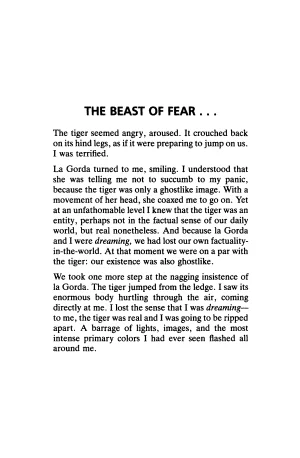
The 1991 release of *Eagle's Gift* finds Carlos Castaneda deep into his shamanic education, a phase marked by a shift in his primary instructors and a concentrated focus on the art of dreaming. The book immediately distinguishes itself by placing a formidable female sorceress, La Gorda, at the forefront of instruction, a significant departure from the earlier emphasis on Don Juan and Don Genaro. This shift introduces a potent dynamic, showcasing a different facet of the sorcerous lineage's power structure and pedagogical methods. Castaneda meticulously describes La Gorda's rigorous, often confrontational, approach to teaching him how to navigate and control the dream state, presenting dreaming not as passive experience but as a sophisticated form of energetic engagement. While the detailed descriptions of dream mechanics and the energetic principles involved are compelling, the narrative sometimes strains under the weight of its own established formula. The constant emphasis on Castaneda's struggle and eventual, albeit partial, comprehension can feel repetitive to long-time readers. However, the introduction of La Gorda and her specific teachings offers a fresh perspective, making *Eagle's Gift* a valuable, if familiar, exploration of the sorceric path.
📝 Description
75
Carlos Castaneda's Eagle's Gift, published in 1991, details his apprenticeship with La Gorda, a shaman.
Carlos Castaneda's 1991 book, *Eagle's Gift*, continues his account of learning from sorcerers. Following the departure of his main teachers, Don Juan Matus and Don Genaro, Castaneda finds himself under the guidance of new figures. This book focuses on the teachings of La Gorda, a powerful female shaman.
The central theme is the art of dreaming, presented not as simple fantasy but as a conscious, controlled method for engaging with other realities. Castaneda describes this as a vital practice within the sorceric path he documents. The book examines the dynamics of this specific apprenticeship and the transmission of esoteric knowledge.
This work is for readers familiar with Castaneda's earlier books. It will interest those who study shamanism, altered states of consciousness, and the philosophical ideas behind his sorcery system. Individuals curious about the practical use of dreaming techniques within the Nagual tradition, the role of women in esoteric lineages, and the perception of non-ordinary reality will find it a notable addition to his bibliography.
Published in the early 1990s, *Eagle's Gift* emerged when interest in Castaneda's shamanic accounts remained strong. His work, influenced by Yaqui traditions, was often discussed alongside New Age spirituality. While academics debated his methods, his books sold widely. This era saw growing public interest in mysticism and alternative spiritual paths, positioning Castaneda as a significant, though debated, figure in the exploration of esoteric knowledge and non-ordinary consciousness.
💡 Why Read This Book?
• Understand the 'art of dreaming' as a rigorous sorceric discipline, distinct from ordinary sleep, as detailed in Castaneda's accounts from the early 1990s. • Explore the significant role and power of female shamans within the Nagual tradition, as exemplified by the formidable instructor La Gorda. • Learn about the concept of the 'dreaming body' and its function in accessing alternate realities, a core tenet of the sorcery described in this work.
⭐ Reader Reviews
Honest opinions from readers who have explored this book.
❓ Frequently Asked Questions
When was Carlos Castaneda's *Eagle's Gift* first published?
*Eagle's Gift* by Carlos Castaneda was first published in December 1991, continuing his series on shamanic journeys.
Who is the main instructor in *Eagle's Gift*?
The primary instructor in *Eagle's Gift* is a powerful female sorceress known as La Gorda, who teaches Carlos Castaneda the art of dreaming.
What is the central theme of *Eagle's Gift*?
The central theme is the disciplined practice of dreaming as a method for accessing and consciously navigating alternate realities and expanding perception.
Does *Eagle's Gift* follow the same characters as earlier Castaneda books?
While Carlos Castaneda is the narrator, *Eagle's Gift* focuses on new instructors, primarily La Gorda, after the departure of Don Juan and Don Genaro.
What is the 'dreaming body' according to *Eagle's Gift*?
The 'dreaming body' is presented as an energetic construct that can be consciously directed and utilized within the practice of dreaming to interact with the world.
Is *Eagle's Gift* considered an anthropological study?
No, *Eagle's Gift* is presented as a personal account of spiritual and shamanic apprenticeship, rather than a formal ethnographic study.
🔮 Key Themes & Symbolism
The Art of Dreaming
This book elaborates on dreaming not as passive subconscious activity but as a core sorceric practice. Castaneda details the meticulous training required to achieve conscious control within the dream state, learning to 'enter' dreams deliberately and interact with its landscape and inhabitants. The 'dreaming body' is introduced as a distinct energetic form capable of independent action within these non-ordinary realities, diverging significantly from conventional understandings of sleep and imagination, and offering a pathway to expanded awareness.
Female Sorcery Power
A significant aspect of *Eagle's Gift* is the prominent role and immense power attributed to female practitioners within the sorceric lineage. La Gorda, the primary instructor, embodies a fierce and demanding pedagogical style, challenging Castaneda's ego and perceptions. Her authority and effectiveness underscore the tradition's acknowledgment of potent feminine energies and leadership, presenting a nuanced view of power dynamics within the shamanic path that moves beyond earlier portrayals.
Accessing the Second Attention
The teachings in *Eagle's Gift* are framed around the development of the 'second attention,' a mode of awareness distinct from ordinary, everyday consciousness (the 'first attention'). Dreaming is presented as a primary vehicle for cultivating and engaging this second attention. By mastering the dream state, practitioners learn to perceive and interact with different energetic realities, expanding their capacity for awareness beyond the confines of the physical world and conventional logic.
Personal Power and Discipline
Central to the sorcery described is the acquisition and application of personal power, which is intrinsically linked to rigorous self-discipline. Castaneda's journey under La Gorda emphasizes the constant effort required to overcome ingrained habits, disbelief, and the limitations imposed by the self. This theme highlights that true power in this context is not innate but cultivated through sustained practice, deliberate intention, and the relentless pursuit of knowledge beyond the ordinary.
💬 Memorable Quotes
Direct passages from the work, attributed to the author.
“The art of dreaming is the art of seeing.”
— This concise statement captures the book's central thesis: dreaming is not mere fantasy but a sophisticated perceptual skill. It suggests that conscious dreaming allows for a deeper, more direct form of apprehension of reality, akin to a focused, awakened state.
“La Gorda taught me that the world is a dream.”
— This highlights the philosophical underpinnings of the sorceric path, proposing that ordinary reality itself is a construct, a 'dream' that can be understood and potentially altered through disciplined practice like the one taught by La Gorda.
“To enter the dream, one must first learn to remain aware.”
— This emphasizes the preparatory discipline required for the art of dreaming. It implies that the ability to consciously enter and work through the dream state is contingent upon developing a foundational level of self-awareness and presence.
“My allies were my teachers, and my enemies were my trainers.”
— This paradoxical statement suggests that all interactions, whether perceived as positive or negative, serve a central role in the sorcerer's development, offering necessary lessons and challenges for growth.
“The assemblage point shifts when we dream.”
— This refers to a key concept in Castaneda's system, suggesting that dreaming facilitates a change in the fundamental point of awareness, thereby altering one's perception of and interaction with the world.
🌙 Esoteric Significance
Tradition
Castaneda's work, including *Eagle's Gift*, is generally situated within the broader context of shamanism, specifically drawing inspiration from what he termed the Nagual tradition, purportedly rooted in Yaqui shamanic practices. While distinct from established Western esoteric lineages like Hermeticism or Kabbalah, it shares common ground in its focus on altered states of consciousness, energy manipulation, and the pursuit of hidden knowledge. Castaneda's system departs by emphasizing a specific lineage structure, mentorship, and a unique cosmology centered around the assemblage point and the energetic nature of reality.
Symbolism
A primary symbol is the 'dreaming body,' representing the practitioner's energetic double capable of independent action within the dream state. The 'assemblage point' is another crucial concept, symbolizing the locus of consciousness that determines our perception of reality; its controlled shifting is key to accessing different states. La Gorda herself functions as a potent symbol of feminine power and rigorous spiritual authority within the lineage, challenging traditional patriarchal structures often found in esoteric narratives.
Modern Relevance
Contemporary thinkers and practitioners in fields ranging from consciousness studies to certain branches of modern shamanism and lucid dreaming continue to engage with Castaneda's concepts. His detailed descriptions of energy manipulation and perception refinement offer frameworks for exploring non-ordinary states of awareness. While direct lineage claims are debated, the practical techniques and philosophical questions raised in works like *Eagle's Gift* still resonate with those seeking alternative pathways to self-knowledge and expanded consciousness beyond mainstream psychology and spirituality.
👥 Who Should Read This Book
• Students of shamanism and altered states of consciousness seeking detailed accounts of non-ordinary perception and practice. • Readers interested in the philosophical implications of reality as a construct and the potential for conscious manipulation of perception. • Individuals exploring the dynamics of mentorship and power within esoteric traditions, particularly those intrigued by the role of female spiritual authority.
📜 Historical Context
Published in 1991, *Eagle's Gift* arrived at a moment when Carlos Castaneda's distinctive brand of shamanic narrative had already achieved cult status worldwide. His earlier works, beginning with *The Teachings of Don Juan* (1968), had tapped into a countercultural fascination with altered states, mysticism, and non-Western spiritual traditions. By the 1990s, Castaneda’s oeuvre was often discussed in relation to the burgeoning New Age movement, though his specific claims about Yaqui sorcery and his rigorous, often austere, portrayal of the path set him apart from more generalized spiritual seeking. While academic anthropologists debated the veracity of his accounts, figures like Terence McKenna were exploring related themes of consciousness expansion through psychoactive substances and ancient wisdom. Castaneda's influence was undeniable, shaping popular perceptions of shamanism even as critics questioned his methodology and the very existence of Don Juan Matus.
📔 Journal Prompts
La Gorda's rigorous methods for teaching dreaming.
The energetic nature of the dreaming body.
Working through the dream landscape with intention.
The role of allies and enemies in sorceric training.
Shifting the assemblage point through dream practice.
🗂️ Glossary
Nagual
In Castaneda's works, the Nagual refers to a lineage of sorcerers and the specific shamanic tradition they practice, often contrasted with the 'Tonal,' which represents the known, everyday world.
Tonal
The Tonal encompasses everything that is known, ordered, and familiar—the world of ordinary consciousness, language, and social constructs. It is the domain of the 'first attention'.
Assemblage Point
A theoretical point of luminous energy where an individual's awareness coalesces, determining their perception of reality. Shifting this point is fundamental to accessing different states of consciousness and realities.
Second Attention
A mode of awareness distinct from ordinary waking consciousness (the first attention). It is accessed through disciplined practices like dreaming and is crucial for perceiving the energetic nature of the universe.
Dreaming Body
An energetic duplicate or aspect of the practitioner that can be consciously directed and utilized within the dream state to interact with the dream world.
La Gorda
A powerful female sorceress and key instructor in *Eagle's Gift*, who teaches Carlos Castaneda the sophisticated techniques of the art of dreaming.
Personal Power
The energy and capacity accumulated through rigorous practice and self-discipline within the sorceric path, enabling the practitioner to enact change and perceive hidden realities.
This book appears in 1 collection
🔮 Readers Also Liked
Browse all →









From the “Shamanism” Collection
View all →






More Free Occult Philosophy Books
View all →