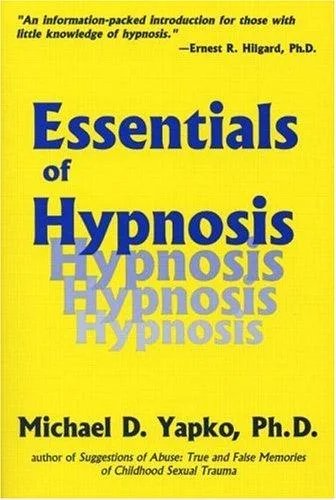
Essentials of Hypnosis
 81
81

Essentials of Hypnosis
Michael D. Yapko’s Essentials of Hypnosis, Second Edition, provides a much-needed grounding in the actual practice and science of hypnosis, effectively stripping away the theatrical mystique. Yapko, a seasoned clinician, writes with an authority that comes from decades of experience. He successfully bridges the gap between the public's often-misinformed perception of hypnosis and its legitimate role in integrative health. A particular strength is the detailed explanation of how neuroscientific research, particularly fMRI studies on hypnotized individuals, is illuminating brain function, offering concrete evidence for the efficacy of hypnotic techniques. The book's limitation, if one can call it that, is its comprehensive nature, which might feel dense for the absolute beginner seeking only a quick primer. However, Yapko’s clarity on concepts like "hypnotic susceptibility" makes even complex ideas accessible. The section detailing the collaborative aspect of hypnosis, where the hypnotist acts as a facilitator rather than a controller, is particularly well-articulated. It’s a vital resource for anyone seeking an informed perspective on a frequently misunderstood discipline.
📝 Description
81
Michael D. Yapko's Essentials of Hypnosis, Second Edition, demystifies hypnosis for modern healthcare and neuroscience.
This book presents hypnosis as a practical tool for therapy and scientific study, moving past sensationalism. It details the fundamental principles, techniques, and theories behind hypnotic states. Yapko covers the nature of hypnotic states, how suggestions work, the unconscious mind's role, and hypnosis in therapy.
The author stresses the importance of collaboration and rapport in hypnosis. He details various methods, including induction, deepening techniques, and the use of imagination. The book is for mental health professionals, medical staff, researchers, students, and anyone interested in the mind-body connection or altered consciousness. Its clear language suits both beginners and those with prior knowledge.
While this book focuses on the scientific and therapeutic aspects of hypnosis, it touches upon a tradition stretching back to 18th-century mesmerism, championed by figures like Franz Mesmer. Early work by Jean-Martin Charcot in neurology and the indirect methods of Milton H. Erickson represent earlier phases of its integration into psychological practice. Yapko's work stands within this lineage, acknowledging historical roots while prioritizing current research and treatment approaches.
💡 Why Read This Book?
• You will gain a clear understanding of the scientific underpinnings of hypnosis, moving beyond stage tricks to grasp its therapeutic potential, as detailed in the sections discussing modern neuroscience and brain scanning studies. • You will learn about the foundational techniques and ethical considerations of hypnotic practice, enabling you to differentiate between sensationalism and genuine clinical application, as presented in the core principles chapters. • You will discover the historical trajectory of hypnosis, from its early associations to its current acceptance in integrative healthcare, providing context for its evolving role and scientific validation.
⭐ Reader Reviews
Honest opinions from readers who have explored this book.
❓ Frequently Asked Questions
What is the difference between hypnosis and sleep?
Hypnosis is not sleep; it is an altered state of consciousness characterized by focused attention, heightened suggestibility, and reduced peripheral awareness. Individuals remain conscious and aware during hypnosis, often reporting a sense of deep relaxation but also mental alertness.
Can anyone be hypnotized?
While most people can experience some level of hypnotic response, the depth and responsiveness vary significantly among individuals. Factors such as motivation, belief, and rapport play a role in hypnotic susceptibility, a concept explored extensively in the book.
Is hypnosis safe?
When conducted by a trained and ethical professional, hypnosis is generally considered safe. The book emphasizes the importance of professional training and ethical guidelines, distinguishing clinical hypnosis from unregulated practices.
What are the primary uses of hypnosis in therapy?
Hypnosis is used therapeutically for a wide range of issues, including pain management, anxiety reduction, habit control (like smoking cessation), phobia treatment, and improving sleep. Its effectiveness is often enhanced when integrated with other therapeutic modalities.
How does modern neuroscience view hypnosis?
Modern neuroscience is increasingly studying hypnosis using brain imaging techniques like fMRI. These studies are revealing how hypnosis affects brain activity, particularly in areas related to attention, self-awareness, and executive control, providing empirical support for its effects.
What is "hypnotic susceptibility"?
Hypnotic susceptibility refers to an individual's capacity to enter a hypnotic state and respond to hypnotic suggestions. Yapko discusses various scales and factors that influence this, highlighting that it's a spectrum rather than an all-or-nothing phenomenon.
🔮 Key Themes & Symbolism
Mind-Body Integration
This work illuminates the profound connection between the mind and body, presenting hypnosis not as mere mental suggestion but as a powerful tool that influences physiological processes. By engaging the mind's capacity for focused attention and suggestion, practitioners can facilitate tangible changes in physical well-being, from pain management to stress reduction. The book underscores how this integration is increasingly recognized within modern integrative health care, moving beyond a purely psychological framework to acknowledge the body's responsive capabilities to mental states.
Neuroscience of Consciousness
Essentials of Hypnosis studies the scientific investigation of altered states of consciousness, particularly through the lens of modern neuroscience. It highlights how brain scanning studies of hypnotized individuals are providing unprecedented insights into brain functioning, revealing specific neural correlates of hypnotic phenomena. This empirical approach explains hypnosis, positioning it as a subject of rigorous scientific inquiry rather than a purely mystical art, and demonstrating how understanding these brain patterns can lead to new therapeutic interventions.
Therapeutic Applications
The book meticulously details the diverse therapeutic applications of hypnosis across various medical and psychological domains. It moves beyond anecdotal evidence to showcase hypnosis as a legitimate and effective modality for conditions ranging from chronic pain and anxiety to phobias and habit disorders. Yapko emphasizes the ethical and practical considerations for utilizing hypnosis within clinical settings, stressing its role as a collaborative process between therapist and client aimed at facilitating positive change and enhancing well-being.
Clarifying Hypnosis
A central theme is the effort to explain hypnosis, stripping away layers of misconception and sensationalism that have historically surrounded the practice. Yapko presents a clear, accessible, and scientifically grounded perspective, illustrating that hypnosis is a natural human capacity that can be cultivated and utilized responsibly. By focusing on its core principles and evidence-based techniques, the book aims to educate readers and professionals alike, fostering a more informed and accurate understanding of its potential.
💬 Memorable Quotes
Direct passages from the work, attributed to the author.
“Some of the most important methods in modern integrative health care have a foundation in hypnosis.”
— This statement highlights the often-overlooked historical and foundational role of hypnosis in the development of contemporary therapeutic practices. It suggests that techniques now considered standard in areas like pain management or stress reduction owe a significant debt to early hypnotic principles.
“Modern neuroscience is regularly learning new things about brain functioning from brain scanning studies of hypnotized individuals.”
— This emphasizes the scientific validation of hypnosis. It points to ongoing research using advanced technologies like fMRI, which are actively revealing the neurological basis of hypnotic states and their effects on the brain, moving the field from speculation to empirical understanding.
“The emphasis in Essentials of Hypnosis Second Edition is on the use of hypnosis as a practical and effective tool.”
— This interpretation suggests the book prioritizes a functional, results-oriented approach to hypnosis. It frames the practice not as an abstract concept but as a concrete methodology with demonstrable benefits and applications in real-world scenarios, particularly within healthcare.
“Readers may be surprised to discover that some of the most important methods in modern integrative health care have a foundation in hypnosis.”
— This interpretation suggests that the book aims to challenge common assumptions about hypnosis. It implies that many people are unaware of the deep historical roots and foundational influence of hypnotic techniques on current medical and psychological treatments.
“Essentials of Hypnosis Second Edition provides a warm and rich introduction to the fascinating field of hypnosis by one of its leading experts.”
— This interpretation conveys that the book offers an accessible and in-depth overview of hypnosis, authored by a highly respected figure in the field. It suggests a welcoming tone suitable for those new to the subject, while promising substantial content for a thorough understanding.
🌙 Esoteric Significance
Tradition
While not explicitly tied to a single esoteric lineage, Essentials of Hypnosis engages with concepts that echo traditions emphasizing the power of the mind and inner states. Its focus on directed consciousness and accessing deeper mental resources aligns with Hermetic principles of "As Above, So Below" and the mind's capacity to influence reality. The exploration of altered states can be seen as a practical, secularized approach to practices found in various mystical traditions aimed at achieving altered perception or higher consciousness.
Symbolism
The primary 'symbol' explored is the focused mind itself, often visualized as a directed beam of light or a calm, deep pool, representing clarity and access to the subconscious. The concept of 'suggestion' acts as a symbolic bridge between conscious intent and subconscious response, akin to a carefully crafted spell or invocation. The therapeutic process itself can be seen as symbolic, representing a journey of inner transformation where old patterns are released and new potentials are realized.
Modern Relevance
Contemporary applications of hypnosis detailed in the book directly influence fields like positive psychology, mindfulness-based stress reduction (MBSR), and cognitive behavioral therapy (CBT). Thinkers and practitioners focusing on the placebo effect, psychoneuroimmunology, and consciousness studies often draw upon the principles and demonstrated efficacy of hypnotic techniques. Yapko’s work provides a scientifically validated framework for these related disciplines, bridging esoteric ideas about mind power with empirical research.
👥 Who Should Read This Book
• Mental health professionals (therapists, counselors, psychologists) seeking to integrate evidence-based hypnotic techniques into their clinical practice for conditions like anxiety, depression, or trauma. • Medical practitioners (doctors, nurses, pain specialists) interested in non-pharmacological approaches to pain management, patient compliance, and psychosomatic symptom relief. • Students and researchers of psychology, neuroscience, and consciousness studies looking for a comprehensive, scientifically grounded introduction to the field of hypnosis and its empirical validation.
📜 Historical Context
The study and practice of hypnosis have evolved significantly since the 18th-century work of Franz Mesmer and his 'animal magnetism.' By the mid-20th century, figures like Milton H. Erickson were revolutionizing hypnotic techniques, moving towards more indirect and conversational styles that differed markedly from the more authoritarian approaches previously common. Essentials of Hypnosis, Second Edition, published in 2014, arrives in an era where neuroscience plays an increasingly dominant role in understanding the mind. While earlier thinkers like Jean-Martin Charcot explored hypnosis in neurology, Yapko’s work benefits from advanced brain imaging technologies unavailable to his predecessors. The book's reception is within a field that still contends with popular misconceptions fueled by stage hypnosis, yet it aligns with a growing academic and clinical acceptance, supported by researchers like Ernest Hilgard and his work on the "neodissociation theory" of hypnosis.
📔 Journal Prompts
The phenomenon of "hypnotic susceptibility" and personal response patterns.
The role of "suggestion" in shaping perception and behavior.
Hypnosis as a tool within "integrative health care" compared to other modalities.
The relationship between focused attention and physiological change.
Ethical considerations in the "therapeutic applications" of hypnosis.
🗂️ Glossary
Hypnosis
An altered state of consciousness characterized by focused attention, heightened suggestibility, and a diminished sense of peripheral awareness, typically achieved through guided relaxation and suggestion.
Suggestion
A communication designed to influence the thoughts, feelings, or behaviors of another person, which is particularly potent within the hypnotic state due to increased receptivity.
Induction
The process or technique used to guide an individual into a hypnotic state, often involving relaxation exercises and focused attention prompts.
Hypnotic Susceptibility
The degree to which an individual is able to respond to hypnotic suggestions and enter a hypnotic state. This varies widely among individuals.
Ideomotor Response
An involuntary physical movement that occurs in response to a subtle, often unconscious, suggestion or thought. It's a key indicator used in some hypnotic assessments.
Integrative Health Care
A coordinated approach to healthcare that combines conventional medical treatments with complementary therapies, such as hypnosis, to address the whole person.
Neuroplasticity
The brain's ability to reorganize itself by forming new neural connections throughout life. Hypnosis can potentially facilitate positive changes related to neuroplasticity.