Enneads
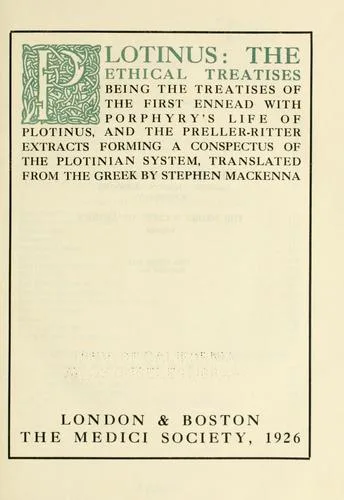
 84
84

Enneads
Plotinus's Enneads presents a challenging yet immensely rewarding philosophical edifice. The ambition to articulate the ineffable nature of The One and its cascading emanations is staggering. Porphyry's organizational structure, while helpful, cannot entirely smooth the dense prose and intricate arguments. A particular strength lies in Plotinus's detailed examination of the soul's journey, especially his discussion in "On the Soul" (Ennead III.6) regarding the soul's relationship to the body and its potential for transcendence. However, the abstract nature of the highest principles can sometimes feel removed from lived experience, requiring significant effort to connect with. Despite this, the work remains a cornerstone for understanding the trajectory of Western metaphysical thought. The Enneads offers a rigorous intellectual framework for spiritual exploration, its enduring influence a testament to its philosophical power.
📝 Description
84
Plotinus compiled his philosophical treatises into the Enneads around 270 CE, forming Neoplatonism's core text.
The Enneads collects the philosophical writings of Plotinus, a 3rd-century thinker. His student Porphyry organized these treatises into nine sections, giving the work its name. Plotinus details a hierarchical cosmology where all existence emanates from an ineffable source he called "The One." This system describes the nature of the soul and the intellect, and the process of achieving mystical union with the divine.
Plotinus taught in Rome during a period of significant intellectual and spiritual inquiry. His philosophy synthesized Platonic thought, Aristotelian logic, and Stoic ethics with mystical insights. While influenced by Plato and Aristotle, Plotinus also engaged critically with Gnostic ideas prevalent at the time. Porphyry’s meticulous compilation and editing ensured the preservation and transmission of Plotinus's complex arguments. The first collected edition appeared in 1582.
The Enneads is a primary source for Neoplatonism, a philosophical school that deeply influenced subsequent mystical and esoteric thought. Plotinus's concept of a singular, transcendent source from which reality unfolds provided a framework for understanding spiritual hierarchies and the path of return to the divine. His ideas on the soul's journey beyond the material world and its potential for union with the ultimate principle resonated through centuries of mystical traditions, including later Christian, Jewish, and Islamic contemplative practices.
💡 Why Read This Book?
• Gain a foundational understanding of Neoplatonism, directly from its most influential figure, Plotinus, whose ideas shaped Western philosophy and theology for centuries. • Explore the concept of "The One," the ultimate, ineffable source of all existence, and the process of emanation as described in the Enneads. • Understand the soul's journey, its descent into materiality, and its potential ascent towards union with the divine, a core theme elaborated throughout the text.
⭐ Reader Reviews
Honest opinions from readers who have explored this book.
❓ Frequently Asked Questions
When did Plotinus live and teach?
Plotinus lived and taught in the 3rd century CE, primarily in Rome. He was active around the mid-170s to his death in 270 CE, a period marked by significant philosophical and religious developments.
Who organized and published Plotinus's writings?
Plotinus's student, Porphyry, meticulously organized and compiled his teacher's treatises into the nine books known as the Enneads. Porphyry's efforts ensured the preservation and systematic presentation of Plotinus's philosophy.
What is the core metaphysical concept in the Enneads?
The central concept is "The One," an ultimate, transcendent, and ineffable principle that is the source of all reality. All existence emanates from The One in a hierarchical structure.
What is the relationship between the soul and the material world according to Plotinus?
Plotinus describes the soul as an intermediary entity that emanates from the Intellect. It animates the cosmos and individual beings but can become entangled in the material world, necessitating a spiritual ascent.
What philosophical tradition does Plotinus represent?
Plotinus is the most prominent figure of Neoplatonism, a philosophical school that developed Plato's ideas and significantly influenced subsequent Western and Eastern thought, including Christian theology and Gnosticism.
What does 'Enneads' mean?
'Enneads' is derived from the Greek word 'ennea,' meaning nine. It refers to the structure of the work, which is organized into nine books, each containing several treatises.
🔮 Key Themes & Symbolism
The One and Emanation
The Enneads posits "The One" as the absolute, transcendent source of all reality, beyond being and thought. It is not a god in the anthropomorphic sense but an ultimate principle. All existence flows from The One through a process of "emanation," not creation, akin to light radiating from a source. This hierarchy moves from The One to Intellect (Nous), then to Soul (Psyche), and finally to the material world. Understanding this emanation is key to grasping Plotinus's cosmology and the interconnectedness of all things.
The Ascent of the Soul
A significant theme is the soul's journey, its descent from the divine realm into the material world and its potential for spiritual purification and return. Plotinus details methods for the soul to divest itself of worldly attachments and distractions, turning inward towards the Intellect and ultimately seeking union with The One. This ascent is achieved through philosophical contemplation, ethical living, and ultimately, a mystical experience that transcends intellect itself.
The Nature of Intellect and Being
Plotinus elaborates on the area of "Intellect" (Nous), which is the locus of Plato's Forms and the ultimate reality accessible to thought. This realm is perfect, eternal, and unified, containing the archetypes of all things. The Enneads distinguishes between the contemplative activity of Intellect and the more dispersed, animating function of Soul. Understanding Intellect is crucial for the soul's ascent, as it serves as the bridge between the ineffable One and the multiplicity of existence.
The Problem of Evil and Matter
The Enneads addresses the existence of evil and the nature of the material world. Matter is seen as the furthest point from The One, representing absence, limitation, and a deficiency of being. Evil is not a positive force but rather a privation, a lack of the good and the true. The material world, while necessary for the full expression of reality, is characterized by multiplicity, change, and imperfection, posing the primary obstacle to the soul's return journey.
💬 Memorable Quotes
Direct passages from the work, attributed to the author.
“All things are in the All; and again, All is not the All.”
— This aphorism, found within the Enneads, captures the paradoxical nature of Plotinus's metaphysics. It reflects the idea that the universe contains all potential, yet the ultimate source, The One, transcends this totality.
“We must not be too eager to see, but must learn to see.”
— This reflects Plotinus's emphasis on developing the capacity for spiritual perception. True seeing is not a passive act but an active, cultivated ability to apprehend higher realities through intellectual and spiritual discipline.
“The One is not any existing thing; it is beyond existence.”
— This direct statement from the Enneads underscores the ineffable and transcendent nature of the ultimate principle. The One is not a being among beings but the ground of all being, fundamentally unknowable through ordinary means.
💡 Key Ideas
Editorial paraphrase of the work's core concepts — not direct quotes.
The soul that is about to be initiated enters an empty place.
This quote from "On the Soul" (Ennead III.6) speaks to the necessary purification and detachment required for spiritual progress. The soul must empty itself of worldly concerns and distractions to become receptive to higher realities.
The intellectual principle creates the world; it is the source of beauty and order.
This paraphrased concept highlights the role of Intellect (Nous) in Plotinus's system. It is the divine mind that brings forth the structured cosmos, containing the Forms that give shape and meaning to existence.
🌙 Esoteric Significance
Tradition
Plotinus is the central figure of Neoplatonism, a philosophical system deeply rooted in Plato's metaphysics but expanded and spiritualized. While not fitting neatly into later categorized traditions like Hermeticism or Kabbalah, Neoplatonism served as a primary intellectual conduit through which Platonic and Gnostic ideas were transmitted and reinterpreted, becoming a foundational pillar of Western esotericism.
Symbolism
The Enneads frequently employs symbolic language, though often allegorical rather than strictly symbolic. Key motifs include "light" emanating from "The One" to represent the cascade of existence, and the "cave" (borrowed from Plato's Republic) symbolizing the soul's entrapment in the material world. The "journey" or "ascent" itself functions as a powerful metaphor for spiritual progress and the return to the divine source.
Modern Relevance
Neoplatonism, particularly as articulated by Plotinus, continues to influence contemporary metaphysics, phenomenology, and mystical theology. Thinkers and practitioners in fields ranging from comparative religion to depth psychology draw upon his concepts of the unified source, the nature of consciousness, and the pursuit of transcendence. Its ideas also resonate within modern esoteric traditions seeking a philosophical grounding for spiritual practice.
👥 Who Should Read This Book
• Students of ancient philosophy seeking to understand the origins of Western metaphysical thought and its influence on later religious and philosophical systems. • Aspiring mystics and contemplatives looking for a rigorous intellectual framework to explore the nature of the divine and the path to spiritual union. • Scholars of comparative religion and intellectual history interested in the development of ideas about emanation, the soul, and ultimate reality across different traditions.
📜 Historical Context
Plotinus lectured in Rome from approximately 170 to 270 CE, a period of intense philosophical and religious activity in the Roman Empire. His work synthesized Platonic dialogues, Aristotelian logic, and Stoic ethics, creating a sophisticated metaphysical system that profoundly influenced later thought. He engaged critically with various contemporary schools, notably Gnosticism, which offered alternative cosmologies and salvation narratives. Plotinus's student, Porphyry, organized his teacher's treatises into the nine books of the Enneads after Plotinus's death in 270 CE. The philosophical currents Plotinus navigated included the ongoing legacy of Greek philosophy and the burgeoning influence of Eastern mystical ideas, setting the stage for the development of Neoplatonism as a major intellectual force that would shape Christian theology, Jewish Kabbalah, and Islamic philosophy for centuries.
📔 Journal Prompts
The nature of The One as beyond being, and its relationship to existence.
The soul's detachment from the material world and its turning inward.
The hierarchy of Intellect, Soul, and Matter in Plotinus's cosmology.
The concept of emanation as distinct from creation.
The process and purpose of the soul's ascent.
🗂️ Glossary
The One (To Hen)
The ultimate, absolute, transcendent, and ineffable source of all reality in Plotinus's philosophy. It is beyond being, thought, and description, the ultimate ground of existence from which all emanates.
Intellect (Nous)
The second hypostasis or level of reality in Plotinus's system, emanating from The One. It is the area of the Forms, the divine mind, where true being and eternal realities reside. It is both the principle of thought and the object of thought.
Soul (Psyche)
The third hypostasis, emanating from Intellect. It is the principle of life, motion, and consciousness that animates the cosmos and individual beings. It bridges the gap between the intelligible world and the material realm.
Emanation
The process by which reality flows or radiates from The One, Intellect, and Soul without diminishing the source. It is a necessary outpouring of divine fullness, creating a hierarchy of being.
Matter
In Plotinus's philosophy, matter represents the furthest point from The One, characterized by privation, limitation, and absence of form. It is the principle of multiplicity and imperfection in the material world.
Ascent
The spiritual and intellectual journey of the soul towards reunification with the divine, particularly with The One. It involves purification, contemplation, and turning away from the material world.
Hypostasis
A fundamental level or principle of reality in Neoplatonic metaphysics. Plotinus describes three primary hypostases: The One, Intellect (Nous), and Soul (Psyche).
🔮 Readers Also Liked
Browse all →![The Teti Cemetery at Saqqara / N. Kanawati and M. Abder-Raziq ; with contributions by A. McFarlane ... [et al.].](/img/thumb/the-teti-cemetery-at-saqqara-n-kanawati-and-m-abder-raziq-with-contributions-by-a-mcfarlane-et-al-n--688041.webp)








More by Plotinus
All books →




More Free Occult Philosophy Books
View all →