Divine Pymander
 62
62

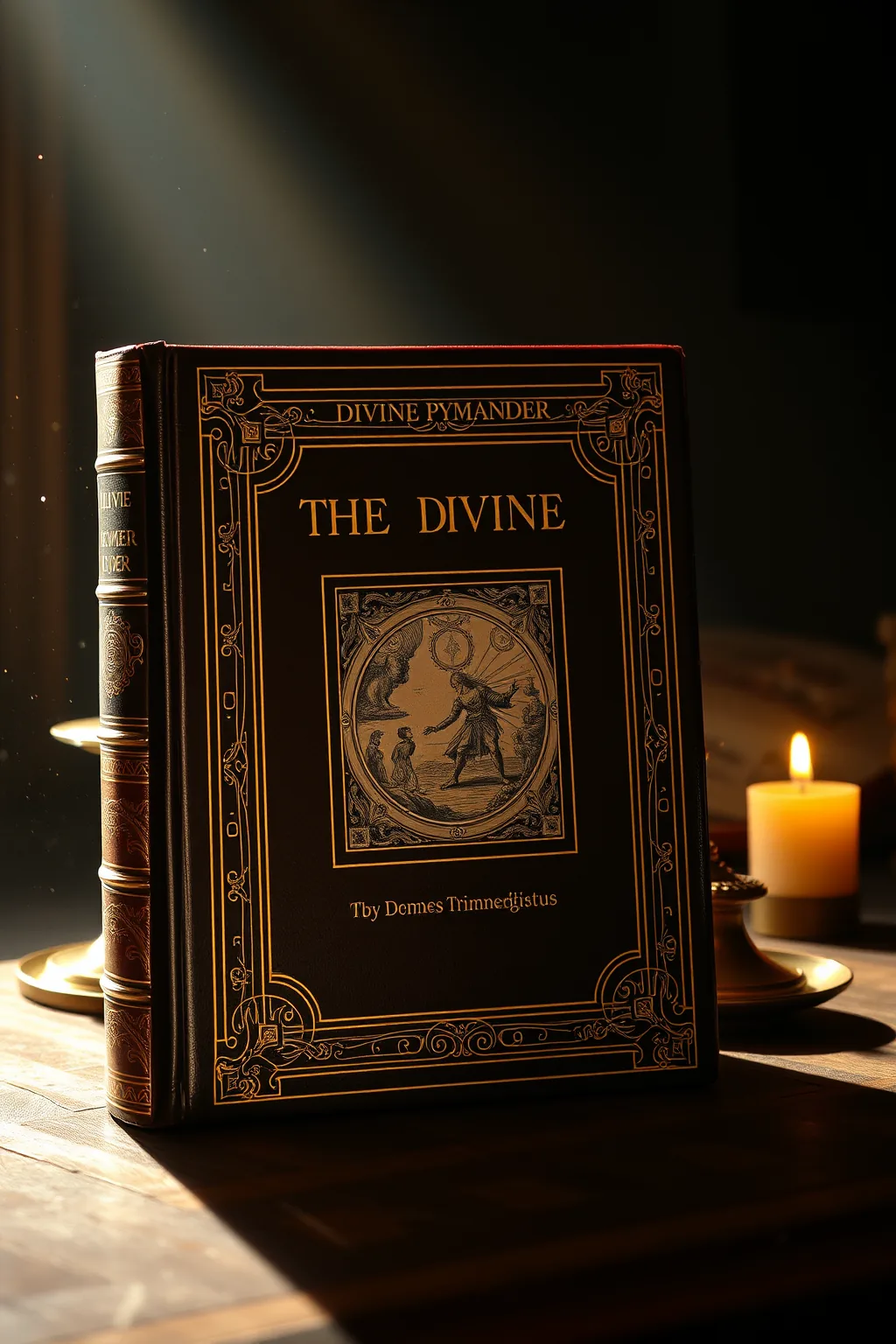
Divine Pymander



Ophelia Vance (Mystical Literature Reviewer) — 'The Divine Pymander' stands as a monumental pillar of Western esoteric thought, offering a direct conduit to the Hermetic tradition. Its profound exploration of cosmology, theology, and anthropology provides unparalleled insights into the soul's journey from material illusion to divine reunion. The text’s layered symbolism and philosophical rigor reward deep contemplation, making it essential for serious practitioners and scholars of ancient mysticism. While dense, its clarity on fundamental spiritual principles is remarkable, serving as a potent catalyst for personal transformation and esoteric understanding. A truly indispensable work for anyone seeking the roots of spiritual philosophy.
📝 Description
62
Attributed to Hermes Trismegistus, the 'Divine Pymander' collects treatises on cosmology and theology.
This collection of texts, attributed to the legendary Hermes Trismegistus, discusses the creation of the cosmos and the nature of God. It also addresses the soul's journey and the connection between the material and spiritual worlds. Through dialogues and allegories, the author guides the reader through concepts of creation, illumination, and gnosis. Each section acts as a guide to understanding the fundamental structure of existence.
The 'Divine Pymander' offers a deep meditation on the divine essence present in all beings. Its symbolism and philosophical content appeal to those seeking to understand ultimate truths and their role in the universe. This work is a significant text for students of esoteric philosophy and spiritual development.
The 'Divine Pymander' is a key text within the Hermetic tradition, which emerged in Hellenistic Egypt. This tradition synthesizes Greek philosophy with Egyptian religious beliefs, personified by the syncretic deity Hermes Trismegistus. Hermeticism focuses on divine revelation, the occult sciences, and the path to spiritual knowledge. The 'Pymander' specifically deals with cosmology, theology, and alchemy, serving as a foundational document for later Renaissance Hermeticism and subsequent esoteric movements.
💡 Why Read This Book?
Uncover the foundational principles of Western esotericism and the Hermetic tradition. Gain profound insights into cosmology, divine creation, and the soul's spiritual journey. 'The Divine Pymander' is essential for seekers of hidden knowledge, scholars of ancient philosophy, and practitioners aiming to deepen their understanding of mystical truths and their application in modern life.
⭐ Reader Reviews
Honest opinions from readers who have explored this book.
❓ Frequently Asked Questions
Who is Hermes Trismegistus?
Hermes Trismegistus is a legendary, syncretic figure representing the fusion of the Greek god Hermes and the Egyptian god Thoth. He is considered the author of the Hermetic Corpus, a collection of ancient philosophical and religious texts.
What is the primary message of The Divine Pymander?
The core message revolves around the nature of God, the creation of the universe, the origin and destiny of the human soul, and the path to spiritual enlightenment through knowledge and divine union.
Is The Divine Pymander a religious text?
While it contains profound theological and spiritual teachings, it is considered more of a philosophical and mystical text within the esoteric tradition, aiming for personal gnosis rather than adherence to a specific dogma.
What is the significance of the 'Pymander' title?
The title 'Pymander' is often interpreted as 'The Shepherd of Men,' suggesting a role of spiritual guidance and the revelation of divine knowledge to humanity, leading them towards understanding.
How does The Divine Pymander relate to other esoteric traditions?
It is a cornerstone of Hermeticism and has profoundly influenced Neoplatonism, Gnosticism, Kabbalah, alchemy, and Western occultism, providing a unified philosophical framework.
🔮 Key Themes & Symbolism
The Divine Mind and Creation
This theme explores the concept of the primordial Divine Mind, the ultimate source of all existence. It explores the process of divine emanation and creation, describing how the cosmos unfolds from this singular, transcendent intelligence. The text meticulously details the stages of creation, from the initial spark of divine will to the formation of the material world and the intelligences that govern it. Understanding this aspect is crucial for grasping the Hermetic view of an ordered, divinely designed universe, where every element has its place and purpose within the grand cosmic symphony.
The Soul's Journey and Gnosis
Central to 'The Divine Pymander' is the concept of the human soul's origin, its descent into the material realm, and its ultimate path back to the divine. The text describes the soul as a spark of the divine, often trapped by the illusions and limitations of the physical body and the material world. It emphasizes the pursuit of 'gnosis' – direct, intuitive knowledge of the divine – as the means to liberation. This journey involves self-awareness, understanding the nature of illusion, and actively seeking spiritual illumination to transcend earthly bonds and reunite with the One.
The Interconnectedness of All Things
Hermes Trismegistus profoundly illustrates the principle of 'As Above, So Below,' highlighting the intricate web of connections that bind the microcosm (humanity) to the macrocosm (the universe). This theme underscores the idea that understanding the principles governing the cosmos allows one to understand oneself, and vice versa. It speaks to the divine unity underlying all apparent diversity, suggesting that recognizing this interconnectedness is key to spiritual awakening and the realization of one's divine heritage. Every element, from the smallest particle to the grandest celestial body, reflects the same divine essence.
💬 Memorable Quotes
Direct passages from the work, attributed to the author.
“The eye of understanding is the eye of God.”
— This highlights the importance of inner wisdom and spiritual insight as the direct means to perceive divine truth, equating true understanding with a divine faculty.
“Man is a microcosm, a world within himself.”
— This speaks to the concept of correspondence, where the individual human being mirrors the structure and principles of the entire universe.
“The sensible world is the image of the intelligible world.”
— This foundational Hermetic principle asserts that the physical reality we perceive is a reflection or manifestation of a higher, spiritual, or conceptual realm.
“Know thyself, and thou shalt know the universe and the gods.”
— A classic maxim of self-knowledge as the ultimate key to understanding both the external world and the divine mysteries.
💡 Key Ideas
Editorial paraphrase of the work's core concepts — not direct quotes.
For God is all, and in all, and of all.
This quote captures the pantheistic and immanent nature of the divine as presented in Hermetic philosophy, emphasizing the omnipresence and ultimate unity of God with creation.
🌙 Esoteric Significance
Tradition
The Divine Pymander is a cornerstone text of Hermeticism, a philosophical and religious tradition rooted in the purported teachings of Hermes Trismegistus. It embodies the core tenets of this ancient wisdom, emphasizing divine unity, the creative power of thought and word, the soul's spiritual evolution, and the pursuit of gnosis. Hermeticism seeks to understand the divine order of the cosmos and humanity's place within it, fostering a path of personal transformation and spiritual enlightenment through the study of nature and the divine mind.
Symbolism
Rich with allegorical and symbolic language, 'The Divine Pymander' employs cosmic imagery, alchemical metaphors, and numerological significance. Symbols like the 'Nous' (Divine Mind), the 'Logos' (Word), and the seven planetary spheres represent complex metaphysical concepts. The journey through different realms and the interactions with divine beings illustrate stages of consciousness and spiritual ascent. Water, light, and darkness are common motifs representing purification, illumination, and ignorance, respectively, guiding the reader through the intricate symbolic field of spiritual awakening.
Modern Relevance
'The Divine Pymander' continues to resonate deeply with modern seekers of spiritual wisdom. Its exploration of consciousness, the interconnectedness of all things, and the power of self-knowledge offers a timeless framework for personal growth and understanding in an often fragmented world. The text's emphasis on direct spiritual experience and the pursuit of inner truth provides an antidote to superficial materialism, empowering individuals to explore their own spiritual potential and connect with a deeper sense of purpose and meaning in their lives.
👥 Who Should Read This Book
This profound text is useful for anyone starting a serious study of Western esoteric traditions, from beginners captivated by ancient wisdom to seasoned practitioners seeking to deepen their understanding of Hermetic principles. Scholars of philosophy, theology, and comparative religion will find its historical and intellectual depth immensely rewarding. Seekers of spiritual truth and those on a path of self-discovery will find in its pages a guiding light, offering useful insights into the nature of reality and the human soul's potential for divine union. Practitioners of magic, alchemy, and meditation will discover foundational concepts that inform and enrich their work.
📜 Historical Context
The 'Corpus Hermeticum,' of which 'The Divine Pymander' is a significant part, emerged during the Hellenistic period in Egypt, a vibrant melting pot of Greek, Egyptian, and Jewish thought, flourishing particularly between the 1st and 3rd centuries CE. This era was characterized by intense philosophical and religious syncretism, where various traditions sought to reconcile their beliefs and create a universal spiritual philosophy. The texts were attributed to the mythical figure Hermes Trismegistus, a syncretized deity of wisdom and magic, believed to be an ancient Egyptian sage. During the Renaissance, these texts were rediscovered and enthusiastically embraced by scholars and mystics, profoundly influencing the Hermetic, alchemical, and magical traditions of Western esotericism, and shaping figures like Marsilio Ficino and Giordano Bruno.
📔 Journal Prompts
Reflect on the concept of the 'Divine Mind' as described in the Pymander. How does this concept influence your understanding of your own consciousness and the universe?
The text speaks of the soul's descent and ascent. Describe a personal experience or realization that felt like a step in your own spiritual ascent or descent.
Consider the Hermetic principle 'As Above, So Below.' How do you observe this correspondence in your own life or in the world around you?
What does 'gnosis' mean to you personally, and what practices or insights are helping you to cultivate this direct knowing?
Explore a symbol from 'The Divine Pymander' that particularly appeals to you. What deeper meaning do you find within it?
🗂️ Glossary
Nous
Often translated as 'Mind' or 'Intellect,' the Nous represents the Divine Mind, the primordial creative intelligence from which all existence emanates. It is the ultimate source of order and understanding.
Logos
The 'Word' or 'Reason,' often understood as the divine creative force or principle that manifests the universe. It is the intermediary between the Divine Mind and creation.
Gnosis
Direct, intuitive knowledge of spiritual truths, often achieved through divine illumination rather than through rational deduction. It is a profound, experiential understanding of the divine.
Emptiness (Kenoma)
In contrast to the 'Pleroma' (Fullness), Kenoma refers to the material, illusory world, often seen as a field of deficiency or 'emptiness' from which the soul seeks escape.
Theurgy
A branch of magic concerned with invoking divine beings and performing rites to achieve spiritual purification and union with the divine. It is seen as a way to align oneself with cosmic forces.
This book appears in 3 collections
🔮 Readers Also Liked
Browse all →









More by Hermes Trismegistus
All books →





From the “Tarot” Collection
View all →






![Paul Foster Case The Tarot ( A Key To The Wisdom Of The Ages)[ebook Pdf]](/img/thumb/paul-foster-case-the-tarot-a-key-to-the-wisdom-of-the-ages-ebook-pdf.webp)


More Free Divination & Tarot Books
View all →