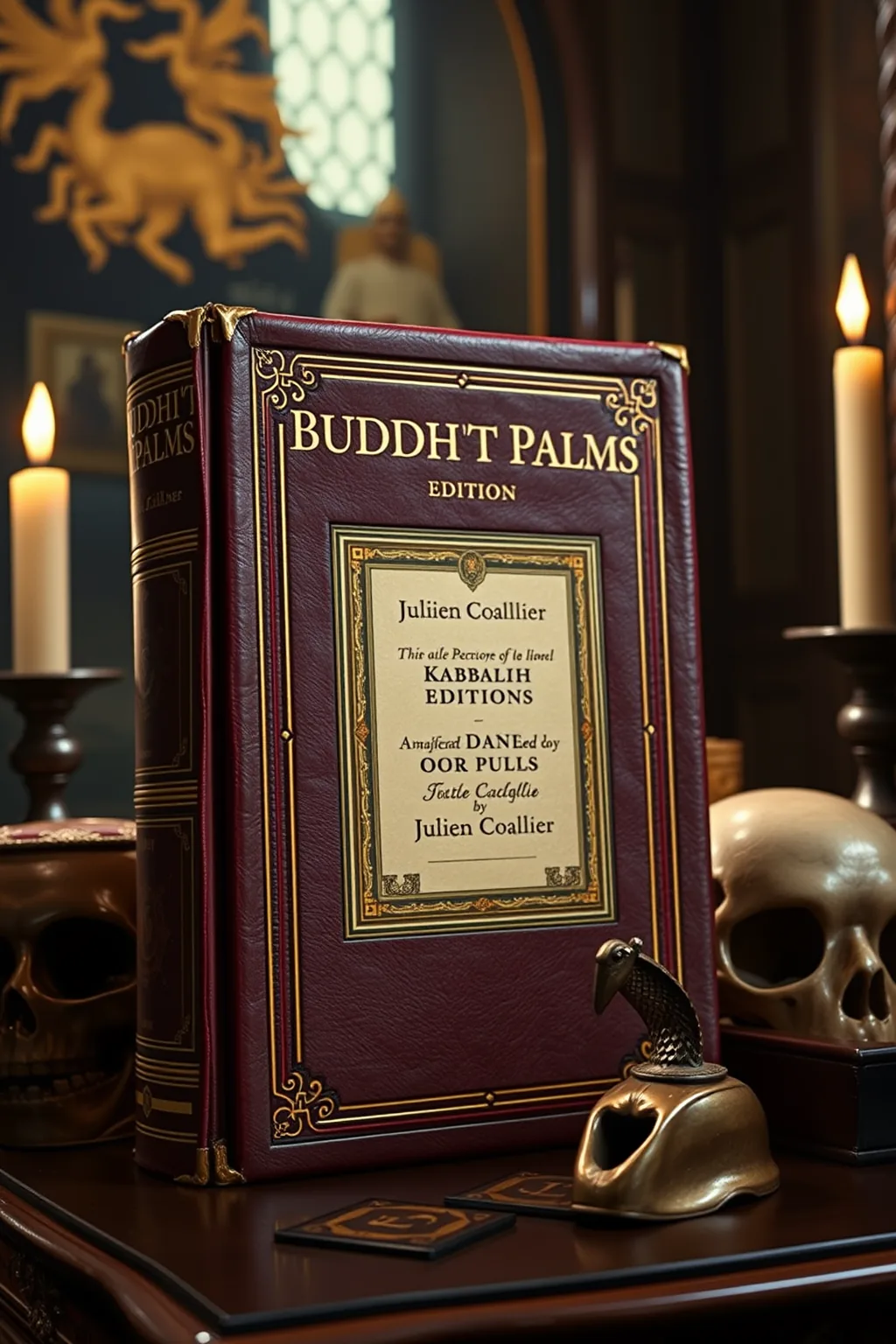
Buddhist Psalms - Kabbalah Edition
 61
61

Buddhist Psalms - Kabbalah Edition


Silas Hawthorne (Hermetic Studies Editor) — 'Buddhist Psalms - Kabbalah Edition' is a groundbreaking synthesis, offering a unique lens through which to perceive the shared currents of mystical wisdom. Julien Coallier's erudition shines as he bridges the serene austerity of Buddhist thought with the vibrant, multidimensional cosmology of the Kabbalah. This work is not merely an academic exercise; it is a potent tool for spiritual transformation. The insightful parallels drawn between concepts like emptiness (sunyata) and Ain Soph, or the Bodhisattva path and the ascent through the Sephiroth, are revelatory. Esoteric practitioners and serious students of mysticism will find this a deeply rewarding, illuminating, and potentially life-altering read.
📝 Description
61
Julien Coallier's 'Buddhist Psalms - Kabbalah Edition' connects Buddhist contemplation and Kabbalistic mysticism.
This edition explores the connections between Buddhist thought and Kabbalistic mysticism, as presented by Julien Coallier. The book examines how the meditative aspects of Buddhism align with the symbolic system of the Kabbalistic Tree of Life. Coallier bridges these traditions, suggesting a shared language underlying spiritual experiences. It encourages readers to look beyond apparent differences and consider the underlying unity of spiritual paths. The text focuses on introspection and the dissolution of dualistic thinking. It is intended for those seriously interested in esoteric studies, whether they are experienced practitioners or scholars.
This work sits within the esoteric tradition of comparative mysticism. It follows a lineage of thinkers who sought to find universal principles across diverse religious and spiritual systems. By linking the meditative practices of Buddhism with the symbolic cosmology of Kabbalah, Coallier contributes to a broader conversation about the interconnectedness of spiritual knowledge. The book aims to reveal underlying structures that inform both ecstatic experience and structured contemplation, placing it alongside other texts that map the spiritual cosmos.
💡 Why Read This Book?
Uncover the esoteric nexus between Buddhist contemplation and Kabbalistic ascent. This book offers a unique perspective on universal spiritual truths, revealing hidden connections that illuminate the path to inner awakening. Ideal for seekers of wisdom, practitioners of meditation and Kabbalah, and scholars interested in comparative mysticism. Explore profound symbolism and unlock deeper layers of consciousness.
⭐ Reader Reviews
Honest opinions from readers who have explored this book.
❓ Frequently Asked Questions
What is the primary aim of 'Buddhist Psalms - Kabbalah Edition'?
This edition aims to reveal the profound esoteric connections and shared symbolic language between Buddhist philosophy and Kabbalistic mysticism, offering a unified path to spiritual understanding and inner enlightenment.
Is prior knowledge of Buddhism or Kabbalah required?
While some familiarity may enhance the experience, the work is crafted to be accessible. Coallier provides clear explanations, guiding both novices and experienced practitioners through the complex interweavings of these traditions.
What kind of symbolism is explored in the book?
The book delves into rich symbolism, exploring concepts such as the Tree of Life's Sephiroth in relation to Buddhist concepts of consciousness, emptiness, and the path to liberation, alongside divine names and sacred geometry.
Who is the intended audience for this edition?
The intended audience includes spiritual seekers, students of comparative religion and mysticism, practitioners of meditation and Kabbalistic meditation, and anyone interested in exploring the universal threads of spiritual wisdom.
How does this edition differ from standard Buddhist or Kabbalistic texts?
This edition uniquely synthesizes these traditions, highlighting their synergistic potential rather than treating them in isolation. It offers a cross-cultural esoteric perspective not commonly found elsewhere.
🔮 Key Themes & Symbolism
The Universal Tree of Contemplation
This theme explores the profound resonance between the Kabbalistic Tree of Life and the Buddhist path to enlightenment. It posits that the emanations of the Divine (Sephiroth) can be understood as stages of consciousness, mirroring the stages of awakening described in Buddhist teachings. The descent into manifestation and the ascent back to unity find parallel expressions in both traditions, revealing a cosmic diagram of spiritual evolution and the interconnectedness of all existence. This section illuminates how the Kabbalistic structure provides a geometric and energetic framework for understanding the journey of the Bodhisattva or the liberated mind.
The Alchemy of Emptiness and Divine Presence
Here, the seemingly disparate concepts of Buddhist 'emptiness' (sunyata) and Kabbalistic 'divine presence' (Ein Soph, the Infinite) are brought into dialogue. The text argues that true emptiness is not a void but a boundless potentiality, the fertile ground from which all existence arises, akin to the unmanifest Godhead. The book explores how the disciplined practice of mindfulness and detachment, central to Buddhism, can prepare the practitioner to perceive and interact with the subtle divine energies described in Kabbalistic lore. It's an alchemical process of transmuting mundane perception into spiritual awareness.
Sacred Syllables, Sacred Geometry
This theme looks at the power of sacred sound, sacred names, and sacred geometry as conduits for spiritual experience. It examines how the Mantras and Dhāranīs of Buddhism, imbued with vibrational potency, can be seen as elements of the Divine Names in Kabbalah. The geometric patterns inherent in both the Mandalas of Buddhist art and the symbolic diagrams of Kabbalistic mysticism are presented as keys to unlocking higher states of consciousness and understanding the underlying order of the cosmos. The confluence of sound and form becomes a pathway to direct experience of the ineffable.
💬 Memorable Quotes
Direct passages from the work, attributed to the author.
“Each Sephiroth is a breath of the cosmic mind, a step on the path within.”
— This highlights the dynamic and personal nature of the Kabbalistic Tree of Life, likening its divine emanations to conscious stages of spiritual development accessible through inner exploration.
“Where the lotus unfurls, the divine light whispers.”
— This evocative phrase connects the symbolic purity and awakening of the Buddhist lotus flower with the subtle manifestation of divine radiance and presence.
“To silence the self is to hear the symphony of creation.”
— This speaks to the Buddhist practice of ego dissolution as a prerequisite for perceiving the divine harmony and interconnectedness of all things, a core theme in mystical traditions.
“The path upward is the path inward, etched in divine proportion.”
— This emphasizes the reciprocal relationship between spiritual ascent and inner exploration, suggesting that the divine order and geometry are both external cosmic principles and internal maps of consciousness.
💡 Key Ideas
Editorial paraphrase of the work's core concepts — not direct quotes.
The void is not an absence, but the womb of all presence.
This quote bridges Buddhist emptiness with Kabbalistic potentiality, suggesting that the ultimate reality is a boundless source from which all manifest existence emerges, not a void of nothingness.
🌙 Esoteric Significance
Tradition
This work profoundly engages with the esoteric traditions of both Buddhism and Kabbalah, viewing them not as separate entities but as facets of a singular, universal spiritual science. It draws upon the contemplative practices and philosophical insights of Mahayana Buddhism, particularly its understanding of emptiness and compassion, and fuses them with the intricate symbolic cosmology and mystical pathways of Kabbalistic Judaism, such as the Tree of Life and the divine emanations. The significance lies in revealing the shared archetypal patterns and energetic structures that underpin human spiritual aspiration across diverse cultures.
Symbolism
The book is rich with cross-cultural symbolism, interpreting the Kabbalistic Sephiroth as stages of consciousness and spiritual development, mirroring Buddhist concepts of the Bodhisattva path or the levels of enlightenment. It explores the symbolism of light, void, divine names, and sacred geometry as common languages of the soul. For instance, the concept of Ain Soph (The Infinite) is juxtaposed with the boundless nature of Sunyata (emptiness), revealing a shared understanding of ultimate reality. The geometry of the Tree of Life finds parallels in sacred Buddhist diagrams, signifying universal order and interconnectedness.
Modern Relevance
In an age often characterized by fragmentation and a search for meaning, 'Buddhist Psalms - Kabbalah Edition' offers a powerful message of unity and interconnectedness. It demonstrates that profound spiritual insights are not confined to a single tradition but are universal. For the modern seeker, it provides a framework for integrating contemplative practices with a deeper understanding of cosmic order, fostering personal growth and a more holistic worldview. The book encourages a dialogue between inner experience and outer symbolic systems, empowering individuals to find their own path to wisdom and spiritual fulfillment in a complex world.
👥 Who Should Read This Book
This unique edition beckons to a diverse array of seekers. **Beginners** in spiritual studies will find it an accessible yet profound introduction to comparative mysticism, clear the universal nature of spiritual quests. **Scholars** of religion and comparative philosophy will appreciate its insightful synthesis and the novel connections drawn between two major wisdom traditions. **Practitioners** of meditation, mindfulness, and Kabbalistic disciplines will discover new avenues for deepening their practice, finding resonance between Buddhist techniques and Kabbalistic frameworks. **Esoteric enthusiasts** and those on a path of self-discovery will be drawn to its exploration of hidden knowledge, symbolism, and the potential for profound inner transformation.
📜 Historical Context
The genesis of 'Buddhist Psalms - Kabbalah Edition' emerges from a period of increased cross-cultural spiritual inquiry. While specific publication dates for this particular edition are not provided, the intellectual climate of the late 19th and early 20th centuries saw a fervent interest in comparative religion and esoteric philosophies. Scholars and mystics began to seek common threads in ancient traditions, moving beyond rigid sectarian boundaries. This era witnessed the translation and dissemination of Eastern texts in the West, sparking dialogues that challenged existing paradigms. The book represents a culmination of this esoteric renaissance, an effort to synthesize seemingly disparate mystical systems into a coherent, unified vision of universal truth, reflecting a growing desire for a holistic understanding of the divine and the human soul.
📔 Journal Prompts
Reflect on a time you experienced a sense of profound interconnectedness. How might this relate to the Kabbalistic concept of Keter or the Buddhist understanding of emptiness?
Consider the 'void' not as an absence but as a source of potential. How does this perspective shift your understanding of challenges or limitations in your life?
Explore the symbolism of light in both Buddhist and Kabbalistic traditions. How does 'divine light' manifest in your own inner landscape or daily experiences?
If each Sephiroth is a 'breath of the cosmic mind,' what 'breath' are you currently experiencing or striving to embody?
How can the practice of silencing the self (as suggested by the quote) lead to a greater appreciation of the 'symphony of creation' in your own life?
🗂️ Glossary
Ein Soph
A Kabbalistic term meaning 'Without End' or 'Infinite.' It refers to the unmanifest, unknowable, absolute Godhead that exists beyond all conceptualization and creation, representing the ultimate source of all existence.
Sunyata (Śūnyatā)
A core Buddhist concept, often translated as 'emptiness' or 'voidness.' It does not imply nothingness but rather the absence of inherent, independent existence in all phenomena, highlighting interdependence and impermanence.
Sephiroth
In Kabbalah, the ten divine emanations or attributes through which God created the universe and interacts with creation. They are often depicted as a 'Tree of Life,' representing a map of the cosmos and the human soul.
Bodhisattva
In Mahayana Buddhism, an enlightened being who has attained enlightenment but delays their own final nirvana out of compassion to help all sentient beings achieve enlightenment.
Mantra
A sacred utterance, sound, syllable, word, or group of words believed to have psychological and spiritual power. Mantras are used in Buddhism and Hinduism for meditation, invocation, and spiritual transformation.
This book appears in 1 collection
🔮 Readers Also Liked
Browse all →








More by Julien Coallier
All books →





From the “Kabbalah” Collection
View all →








More Free Kabbalah & Jewish Mysticism Books
View all →