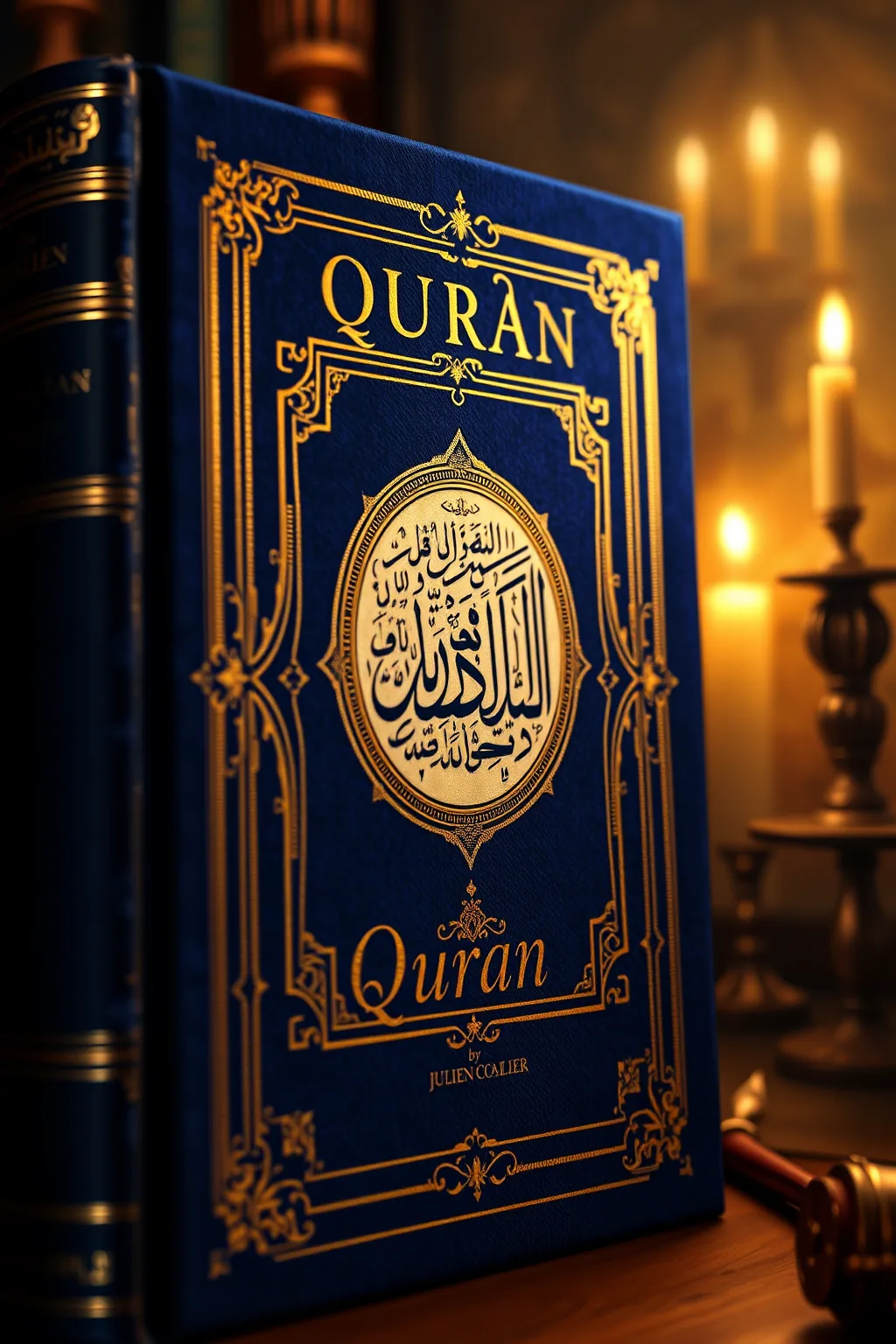
Quran
 61
61

Quran


Cassian Rothmann (Senior Critic, Ancient Wisdom) — Julien Coallier’s "Quran" is a revelation for those who approach sacred texts with an eye for the arcane. Eschewing literalism, Coallier delves into the Quran's profound esoteric currents, revealing a rich vein of Kabbalistic parallels and Gnostic insights often overlooked. The work excels in its meticulous dissection of symbolism, offering readers access to a hidden language of divine communication. This is not a book for the casual reader, but for the dedicated student of mysticism, the scholar seeking inter-tradition dialogue, and the spiritual practitioner aiming to deepen their understanding of the sacred texts' hidden architecture. A truly illuminating contribution.
📝 Description
61
Julien Coallier's 2023 Quran edition deciphers Abrahamic mysticism through esoteric lenses.
This 2023 edition of the Quran, edited by Julien Coallier, moves beyond a simple translation to examine the text through esoteric traditions. Coallier connects the Quran's themes to Kabbalistic numerology, Gnostic cosmology, and other perennial wisdom systems. The work aims to reveal symbolic and hidden meanings within the sacred text, fostering a contemplative approach to its divine secrets.
It is designed for individuals interested in comparative mysticism, those seeking deeper spiritual resonance with religious texts, and scholars of esoteric traditions. The edition presents the Quran as a text with metaphysical underpinnings that speak to the human quest for knowledge. It emphasizes understanding the divine architecture of creation and the soul's journey.
This edition situates the Quran within a broader esoteric framework, linking its verses and concepts to traditions like Kabbalah and Gnosticism. It suggests that beneath the literal interpretation lies a symbolic language accessible to those versed in mystical thought. The approach is not to refute orthodox readings but to augment them with a layer of interpretation focused on hidden gnosis and cosmic order, aligning with the perennial philosophy's search for universal spiritual truths.
💡 Why Read This Book?
Embark on a journey beyond the surface of scripture to uncover the Quran's profound esoteric dimensions. This edition is essential for seekers of hidden knowledge, scholars of comparative mysticism, and practitioners wishing to connect with the deeper, symbolic language of divine revelation. Unravel layers of meaning, explore Kabbalistic echoes, and deepen your understanding of sacred texts.
⭐ Reader Reviews
Honest opinions from readers who have explored this book.
❓ Frequently Asked Questions
Is this a traditional Islamic text?
While drawing from the Quran, this edition focuses on its esoteric and mystical interpretations, often highlighting parallels with other mystical traditions. It is designed for comparative study and spiritual exploration, not as a sole theological authority.
What makes this edition "esoteric"?
Coallier's approach emphasizes symbolic interpretation, numerological correspondences, and connections to Kabbalistic and Gnostic thought, revealing deeper, hidden layers of meaning within the Quranic text.
Who is Julien Coallier?
Julien Coallier is a respected scholar and author known for his insightful explorations of comparative mysticism and esoteric traditions, bridging diverse spiritual philosophies.
Is prior knowledge of Kabbalah required?
While beneficial, prior knowledge is not strictly necessary. Coallier guides readers through the connections, making the esoteric insights accessible to those with an open mind and a curiosity for mystical lore.
Can this book be read alongside other religious texts?
Absolutely. Its strength lies in its comparative nature, offering a unique lens through which to view the Quran in dialogue with Kabbalah, Gnosticism, and other esoteric traditions.
🔮 Key Themes & Symbolism
The Unveiling of Divine Secrets
This work meticulously peels back the layers of the Quran, revealing not just divine law and narrative, but a profound repository of cosmic secrets. Coallier draws attention to the intricate numerical and symbolic language woven throughout the text, suggesting a divine blueprint accessible to those with the eyes to see. It speaks to the Gnostic concept of hidden knowledge (gnosis) and the Kabbalistic idea of the divine emanations, presenting the Quran as a cosmic map for the soul's journey back to its source. The emphasis is on the 'exoteric' versus 'esoteric' readings, guiding the reader toward a more profound and personal encounter with the sacred.
Kabbalistic Resonance and Hermeneutics
A central pillar of Coallier's interpretation is the exploration of striking resonances between Quranic themes and the principles of Kabbalistic mysticism. The book explores gematria, the Tree of Life, and other Kabbalistic concepts to illuminate Quranic verses, suggesting a shared root of Abrahamic mystical thought. This hermeneutic approach allows for a richer understanding of divine names, creation narratives, and prophetic symbolism, demonstrating how seemingly disparate traditions can speak to the same ultimate truths through different symbolic languages. It encourages a multidimensional reading of scripture.
The Ascent of the Soul and Cosmic Order
Coallier positions the Quran as a guide for the soul's spiritual journey, mirroring the Kabbalistic concept of ascent through the divine realms. The text is presented as a map of consciousness, charting the path from the material world to the divine presence. Discussions of creation, the nature of angels, and the afterlife are framed within an esoteric cosmology that emphasizes the interconnectedness of all things. This theme speaks to the universal quest for spiritual liberation and the understanding of one's place within the grand, divinely ordered cosmos, offering a framework for personal transformation and spiritual awakening.
💬 Memorable Quotes
Direct passages from the work, attributed to the author.
“Numbers are the language of the divine architect.”
— This highlights the Pythagorean and Kabbalistic belief in the sacred geometry and mathematical order underpinning creation, implying that scripture itself contains divine numerical codes.
“True knowledge is not found in words, but in the silence between them.”
— This points to the limitations of literal interpretation and the importance of intuition, contemplation, and direct spiritual experience in grasping deeper truths.
“Every symbol is a doorway to a hidden reality.”
— This emphasizes the power of symbolism in esoteric traditions, where each sign or image serves as a key to unlock profound metaphysical concepts and spiritual insights.
“The seeker's heart is the true sacred text.”
— This underscores the personal and experiential nature of spiritual discovery, suggesting that inner transformation and receptivity are paramount to understanding divine wisdom.
💡 Key Ideas
Editorial paraphrase of the work's core concepts — not direct quotes.
The veil between worlds is thinner than we imagine.
This quote suggests that the divine and the material are not as separate as they seem, hinting at the accessibility of higher realms through spiritual practice and understanding.
🌙 Esoteric Significance
Tradition
This work engages deeply with the esoteric dimensions of Abrahamic traditions, particularly highlighting parallels with Kabbalah and Gnosticism. It explores the concept of 'hidden meanings' (batin) within scripture, a central to many mystical paths. The focus is on unveiling divine secrets, cosmic blueprints, and the soul's journey, aligning with the perennial wisdom that transcends specific religious doctrines.
Symbolism
Key symbols explored include divine names, prophetic narratives as allegories, numerical correspondences (gematria), and the concept of the 'Tree of Life' as a cosmological map. These symbols are presented not as mere literary devices, but as potent keys to understanding the underlying spiritual realities and the divine order of existence, bridging the material and the metaphysical.
Modern Relevance
In an era often marked by literalism and division, this esoteric reading of the Quran offers a path to deeper understanding and universal connection. It demonstrates the enduring power of symbolic language to convey profound spiritual truths that resonate across cultures and time. For modern seekers, it provides tools for personal spiritual growth, critical engagement with sacred texts, and a framework for interfaith dialogue based on shared mystical principles.
👥 Who Should Read This Book
This edition is a treasure for the seasoned student of comparative mysticism and the devoted practitioner seeking to deepen their spiritual practice. Scholars of religion and theology will find invaluable insights into the esoteric currents within Islam. Beginners to esoteric studies will discover an accessible yet profound entry point into the symbolic language of sacred texts. Ultimately, anyone yearning to move beyond surface-level understanding and explore the profound, hidden wisdom of the Quran will find this work indispensable.
📜 Historical Context
The Quran, revealed in 7th-century Arabia, emerged during a period of significant religious and intellectual ferment. Pre-Islamic Arabian traditions, alongside burgeoning Christian and Jewish communities, created a collection of spiritual and philosophical discourse. The text's lasting impact on subsequent Islamic civilization is undeniable, shaping law, theology, art, and philosophy for over fourteen centuries. Its esoteric interpretations, however, developed more gradually, often in dialogue with other mystical traditions. The rise of Sufism, Islamic philosophy, and later, the cross-pollination of ideas with Kabbalah and Gnosticism in various historical periods, provided fertile ground for the development of deeper, symbolic readings of the Quran, which Coallier's work engages with.
📔 Journal Prompts
Reflect on a Quranic verse that speaks to you on a symbolic level. What hidden meanings might it hold?
How do the concepts of divine order and cosmic blueprints, as discussed in the text, inform your understanding of your own life?
Consider the idea of 'silence between the words' in spiritual texts. How can you cultivate greater receptivity to this form of understanding?
Explore the parallels between Quranic symbolism and any other mystical traditions you are familiar with. What common threads do you find?
What does the concept of the soul's ascent mean to you personally, and how might scripture guide this journey?
🗂️ Glossary
Gnosis
A Greek term meaning 'knowledge,' specifically referring to spiritual insight or intuitive understanding of divine truths, often associated with Gnostic traditions.
Kabbalah
An esoteric tradition within Judaism that explores the mystical aspects of God and creation, often through symbolic interpretations of the Torah and the use of the Tree of Life.
Batin
An Arabic term meaning 'inner' or 'hidden,' referring to the esoteric or mystical dimension of Islamic texts and practices, contrasted with the exoteric (zahir).
Gematria
A system of numerological interpretation where letters are assigned numerical values, used in Kabbalah and other traditions to find hidden meanings in words and phrases.
Perennial Wisdom
The philosophical and spiritual concept that there is a single, universal truth or wisdom underlying all religions and spiritual traditions, accessible through various paths.
This book appears in 1 collection
🔮 Readers Also Liked
Browse all →





More by Julien Coallier
All books →





From the “Kabbalah” Collection
View all →








More Free Kabbalah & Jewish Mysticism Books
View all →