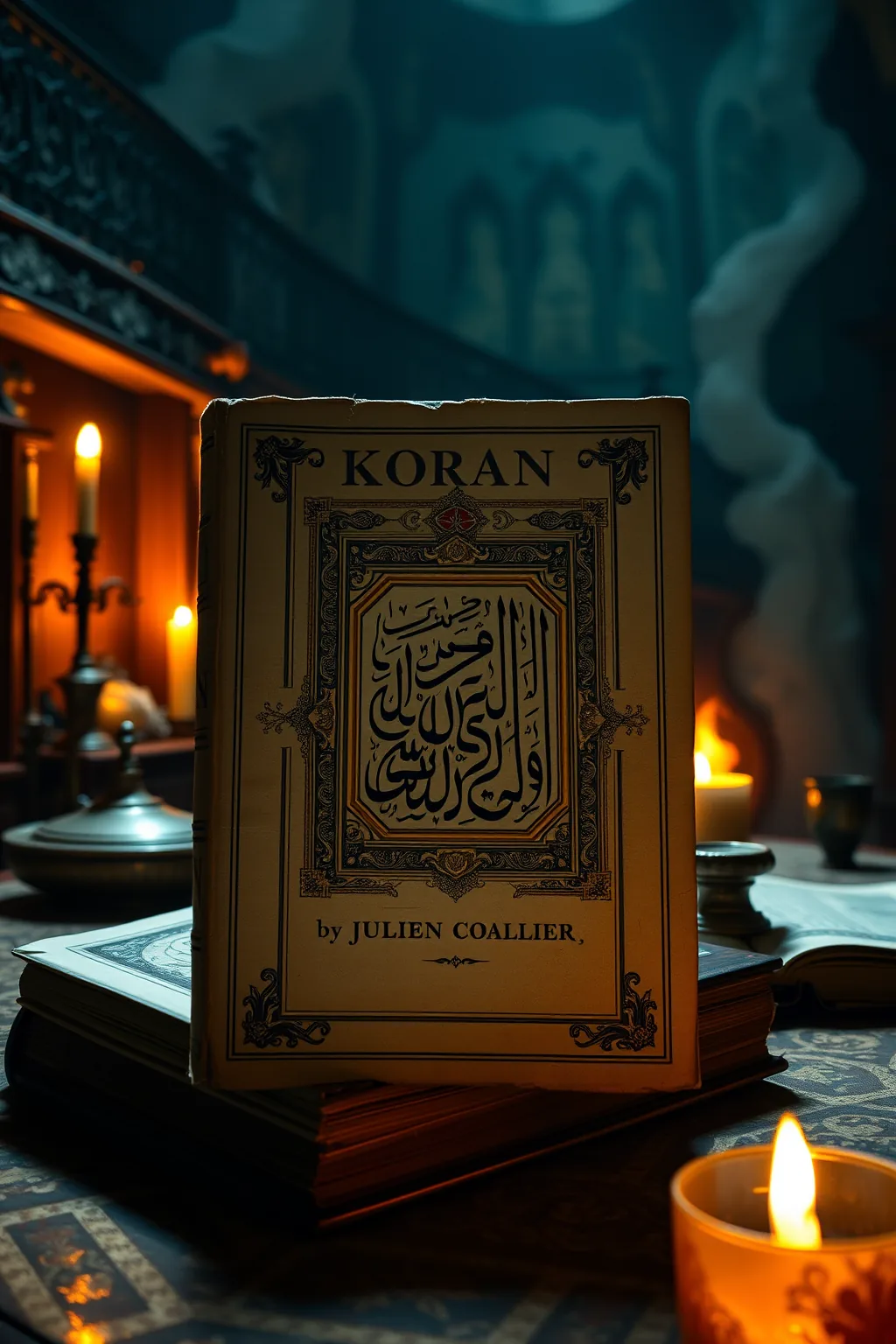
Koran
 61
61

Koran


Celeste Moreau (Divination & Symbolism Reviewer) — Julien Coallier's 'Koran' is a masterful revelation for those who seek the esoteric heart of sacred texts. This work doesn't just interpret; it transmutes, offering profound insights into the Kabbalistic underpinnings that resonate within the Koran. Coallier's prose is both scholarly and deeply intuitive, illuminating complex concepts with remarkable clarity. The book excels in its ability to connect seemingly disparate mystical traditions, revealing universal truths. It is an indispensable guide for students of Kabbalah, comparative religion, and anyone on a dedicated path of spiritual awakening, inviting them to perceive the divine architecture within the spoken word.
📝 Description
61
Julien Coallier's 'Koran' examines the Quran through a Kabbalistic lens.
This book does not offer a traditional interpretation of the Quran. Instead, Julien Coallier analyzes the sacred text for its mystical dimensions, focusing on how Kabbalistic ideas might be read into its verses. Coallier discusses concepts like gematria, divine names, and the Sefirotic Tree as they relate to the Quran's language and structure. The work aims to show how the text can be understood as a source of spiritual insight, connecting ancient contemplative methods with modern spiritual interests.
Coallier structures his analysis to guide readers through layers of meaning he identifies within the Quran. He presents the text as more than a religious document, but as a conduit to spiritual understanding. The book is intended for those interested in comparative mysticism, Jewish esoteric traditions, and the integration of these concepts into personal spiritual practice. It proposes a way to see the universe as a divine emanation, drawing parallels between different esoteric systems.
This work situates itself within the field of comparative esotericism, specifically examining the intersection of Islamic scripture and Jewish mysticism. By applying Kabbalistic frameworks, such as gematria and the Sefirotic Tree, to the Quran, Coallier engages with a long tradition of interpretive methods that seek hidden meanings in sacred texts. This approach often involves seeing correspondences between different religious and mystical traditions, suggesting universal spiritual principles underlying diverse expressions of faith. The book aims to illuminate potential connections between these seemingly distinct esoteric systems.
💡 Why Read This Book?
Uncover the hidden Kabbalistic architecture embedded within the Koran. This book offers a unique esoteric lens for understanding divine symbolism and cosmic interconnectedness. It is ideal for seekers of deeper spiritual meaning, scholars of mysticism, and practitioners wishing to integrate ancient Jewish esoteric wisdom into their personal journey.
⭐ Reader Reviews
Honest opinions from readers who have explored this book.
❓ Frequently Asked Questions
Is this book a literal interpretation of the Koran?
No, 'Koran' by Julien Coallier is an esoteric and mystical interpretation, focusing on the symbolic and Kabbalistic resonances within the text, rather than a literal or historical exegesis.
What is Kabbalah?
Kabbalah is the esoteric tradition of Jewish mysticism, concerned with the divine nature, the creation of the universe, and the relationship between the hidden God and the visible world.
What esoteric concepts are explored in this book?
The book delves into concepts such as gematria, the Sefirotic Tree, divine names, angelic hierarchies, and the mystical union of the soul with the divine, as interpreted through a Kabbalistic framework.
Who is the intended audience?
The book is intended for serious spiritual seekers, scholars of comparative mysticism, and practitioners of esoteric traditions, particularly those interested in Kabbalah and Jewish mysticism.
Does this book require prior knowledge of Kabbalah?
While prior knowledge can enhance the experience, Coallier's clear and evocative prose aims to make the esoteric concepts accessible to dedicated readers willing to explore.
🔮 Key Themes & Symbolism
The Divine Architecture of Sacred Text
This theme explores how sacred scriptures, beyond their literal narrative, contain intricate layers of symbolic meaning and numerical correspondence. Coallier illuminates how the Koran, through a Kabbalistic lens, reveals an underlying divine architecture, a celestial blueprint of creation and consciousness. It emphasizes the idea that divine messages are not merely conveyed through words but are encoded within the very structure and numerology of the text, offering a profound connection to the mind of the Creator.
Gematria and Numerical Mysticism
Central to this theme is the exploration of gematria, the ancient practice of assigning numerical values to Hebrew letters, and its application to unlock hidden meanings within the Koran. Coallier demonstrates how these numerical relationships reveal profound connections between concepts, verses, and even entire chapters, suggesting a divinely orchestrated harmony. This explores the understanding that numbers are not merely quantitative but qualitative, acting as keys to spiritual understanding and cosmic order.
The Sefirotic Tree and Divine Emanation
This theme examines the Sefirotic Tree, the symbolic map of divine attributes and emanation in Kabbalah, and its perceived parallels or reflections within the Koran's teachings. Coallier guides the reader to see how the dynamic flow of divine energy, as described by the Sefirot, can be understood as a framework for interpreting the Koran's messages on creation, divine presence, and the path of spiritual ascent. It highlights the interconnectedness of all existence stemming from the divine source.
💬 Memorable Quotes
Direct passages from the work, attributed to the author.
“The echo of the divine name resonates in every silent pause.”
— This emphasizes the omnipresence of the divine, suggesting that sacredness is not just in the spoken word but in the contemplative spaces and the subtle vibrations of existence.
“Each verse, a star in the celestial map of understanding.”
— This metaphor compares verses of the Koran to stars, implying they guide us and form part of a grand cosmic design, revealing spiritual truths when viewed collectively.
“To know the letter is to glimpse the Creator's blueprint.”
— This highlights the profound significance of individual letters in esoteric traditions, suggesting that understanding their essence can lead to insights into the divine plan for creation.
“The path to the divine is paved with symbolic stones.”
— This indicates that spiritual progression is achieved by deciphering and understanding the symbolic language found in sacred texts and the universe itself.
💡 Key Ideas
Editorial paraphrase of the work's core concepts — not direct quotes.
Within the sacred word lies a hidden garden of numerical blossoms.
This quote suggests that the Koran, like a garden, holds beauty and spiritual nourishment, accessible through numerical interpretation (gematria) which reveals hidden insights.
🌙 Esoteric Significance
Tradition
This work is deeply rooted in the esoteric tradition of Kabbalah, the mystical dimension of Judaism. It applies Kabbalistic principles, such as gematria, the Sefirotic Tree, and the sacredness of divine names, to interpret the Koran. The significance lies in demonstrating how these tools, developed within one tradition, can illuminate the mystical layers of another, suggesting a universal language of the divine.
Symbolism
Key symbols explored include the Hebrew alphabet as a divine building material, the Sefirot as stages of divine emanation and human consciousness, and various numerical correspondences that link concepts across verses. The Koran itself, in this context, becomes a symbolic representation of cosmic order, divine will, and the path of spiritual return to the source.
Modern Relevance
In a world often fractured by religious differences, Coallier's approach offers a pathway to understanding common spiritual ground. 'Koran' is relevant for its ability to foster interfaith dialogue through esoteric study, provide tools for personal spiritual growth by revealing hidden meanings, and encourage a more contemplative and symbolic engagement with sacred texts in an increasingly secularized society.
👥 Who Should Read This Book
This book is a treasure for the dedicated spiritual seeker yearning for a deeper, more mystical understanding of sacred texts. Scholars of comparative religion and mysticism will find its unique perspective on the Koran useful for their research. Practitioners of Kabbalah and Jewish mysticism will appreciate the novel application of their tradition's tools. Beginners to esoteric studies will be guided by Coallier's evocative prose, provided they approach it with an open mind and a genuine desire to explore hidden spiritual dimensions.
📜 Historical Context
Julien Coallier's 'Koran' emerges from a rich tradition of comparative mysticism and esoteric scholarship, particularly active in the late 19th and 20th centuries, which sought to find universal spiritual truths across diverse religious and philosophical systems. This era saw a surge of interest in Kabbalah, Gnosticism, and Eastern philosophies, often viewed as keys to unlocking deeper, hidden meanings within established religious texts. Coallier's work can be seen as a continuation of this lineage, applying the analytical and contemplative tools of Kabbalistic thought to the Koran. His approach reflects a desire to demonstrate the interconnectedness of spiritual traditions and to reveal the underlying unity of divine revelation, challenging purely literal interpretations and inviting readers to engage with the text on a more profound, symbolic, and mystical level.
📔 Journal Prompts
How does the concept of divine names resonate with your understanding of the Koran's verses?
If you were to apply gematria to a favorite verse, what hidden connections might emerge?
Reflect on the parallels between the Sefirotic Tree and the journey of spiritual growth described in the Koran.
What symbolic meanings of 'light' or 'darkness' do you find in the Koran, and how do they relate to esoteric principles?
How can understanding the Koran through a Kabbalistic lens foster greater empathy and understanding with other spiritual traditions?
🗂️ Glossary
Kabbalah
The esoteric and mystical tradition of Judaism, concerned with the divine nature, the creation of the universe, and the relationship between God and humanity, often employing symbolic interpretation and numerology.
Gematria
A Kabbalistic method of interpreting the Hebrew Bible by assigning numerical values to Hebrew letters and words, revealing hidden meanings and connections through these numerical correspondences.
Sefirot
The ten divine emanations or attributes of God in Kabbalistic cosmology, often represented as a diagram known as the Tree of Life, symbolizing the process of creation and divine revelation.
Divine Names
In Kabbalah, specific names or combinations of letters believed to hold immense spiritual power and to represent different aspects or energies of the divine, used in meditation and invocation.
Esoteric
Intended for or likely to be understood by only a small number of people with a specialized knowledge or interest; pertaining to inner, hidden, or secret spiritual teachings.
This book appears in 1 collection
🔮 Readers Also Liked
Browse all →








More by Julien Coallier
All books →





From the “Kabbalah” Collection
View all →
![Kabbalah Dictionary [Hebrew To English].pdf (PDFy mirror)](/img/thumb/kabbalah-dictionary-hebrew-to-english-pdf-pdfy-mirror.webp)







More Free Kabbalah & Jewish Mysticism Books
View all →