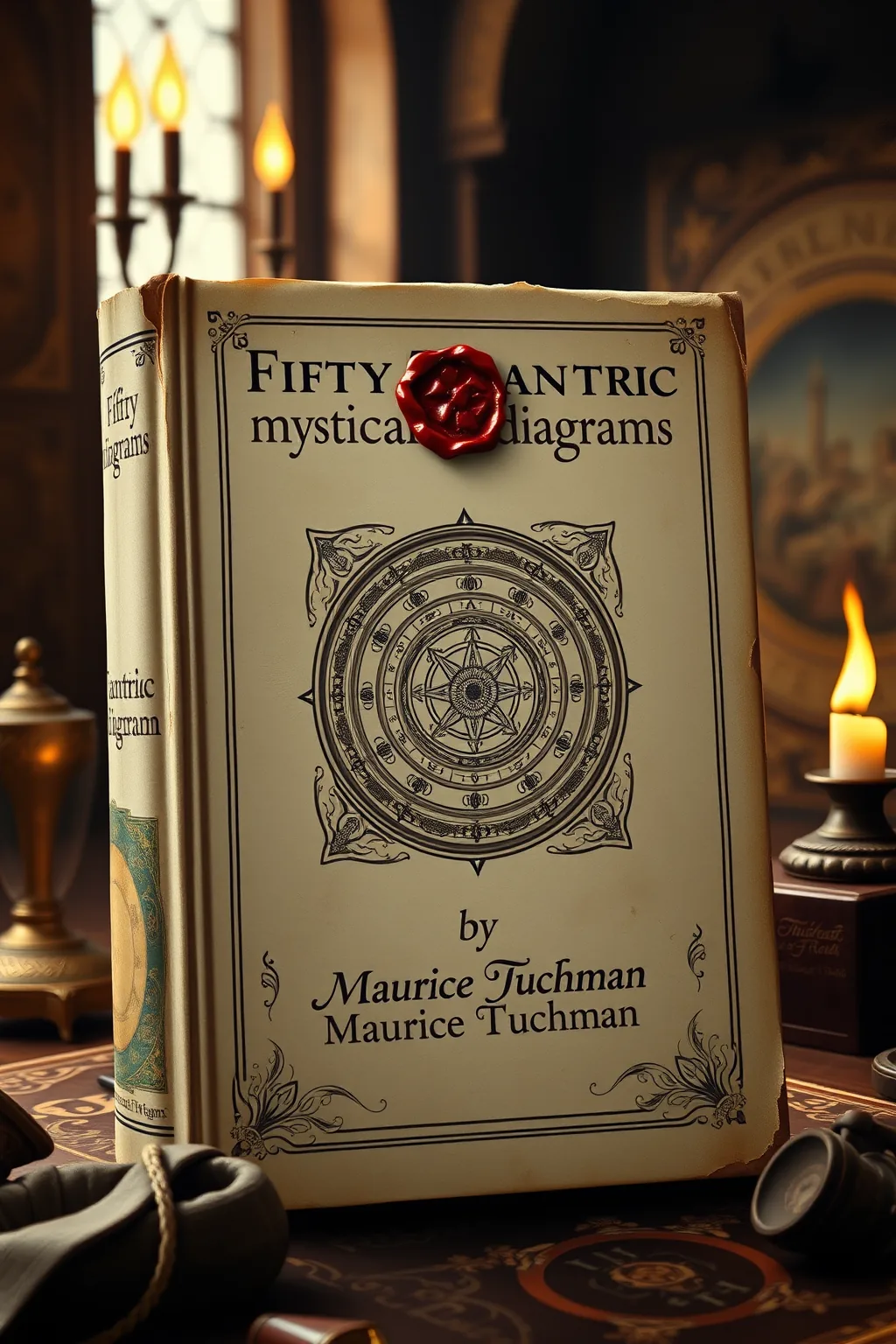
Fifty Tantric mystical diagrams
 62
62

Fifty Tantric mystical diagrams


Sophia Crane (Associate Editor) — Maurice Tuchman's "Fifty Tantric Mystical Diagrams" is an indispensable volume for anyone delving into the visual language of mysticism. Tuchman offers a rare and insightful exploration of Tantric Buddhist yantras and mandalas, illuminating their complex symbolism and profound spiritual efficacy. The collection itself is a testament to the power of geometric form in evoking higher consciousness. This work transcends simple art appreciation, serving as a practical guide for practitioners seeking to understand and utilize these sacred diagrams for meditation and spiritual development. Its strength lies in its clear presentation and Tuchman's deep understanding of the esoteric currents at play, making it a vital resource for scholars and seekers alike.
📝 Description
62
Maurice Tuchman's "Fifty Tantric Mystical Diagrams" presents 50 visual aids for spiritual practice.
Published in 1978, Maurice Tuchman's collection offers fifty diagrams used in Tantric traditions. These are not simply artworks but functional tools for spiritual development. The diagrams, including yantras and mandalas, carry rich symbolism drawn from Tantric Buddhism and Kabbalistic cosmology.
Tuchman's commentary explains the complex geometries and philosophical ideas behind these visual forms. He demonstrates how each diagram acts as a model of the universe, a representation of the macrocosm in miniature. The book suggests these visual tools can lead to altered states of consciousness and a deeper understanding of existence. It is intended for active study and contemplation rather than passive reading.
This book sits within the esoteric study of Tantra, a tradition that uses ritual, visualization, and symbolic imagery to achieve spiritual goals. The diagrams presented are forms of yantras and mandalas, visual tools employed for meditation and concentration in various Indian religions, including Hinduism and Buddhism. Their inclusion of Kabbalistic elements suggests a syncretic approach, linking Eastern mystical concepts with Western esoteric traditions. The work engages with the idea of sacred art as a direct means to access altered states of consciousness and understand universal principles.
💡 Why Read This Book?
Discover the sacred geometry that underpins spiritual realities. "Fifty Tantric Mystical Diagrams" offers a visual key to unlocking hidden knowledge, providing essential insights for practitioners of Tantra, scholars of comparative mysticism, and anyone fascinated by the profound intersection of art, mathematics, and the divine. Explore ancient symbols designed to facilitate meditation and spiritual awakening.
⭐ Reader Reviews
Honest opinions from readers who have explored this book.
❓ Frequently Asked Questions
What is a yantra and how is it used?
A yantra is a mystical diagram, often geometric, used in Tantric traditions as a tool for meditation, concentration, and spiritual invocation. It serves as a visual representation of cosmic energies and deities, aiding in the practitioner's journey towards enlightenment.
How do these diagrams relate to Kabbalah?
While primarily focused on Tantric Buddhism, the book explores the universal principles of sacred geometry and cosmic order, which find resonance in Kabbalistic concepts of the Tree of Life and divine manifestation. Both traditions use visual aids to understand the structure of the universe.
Is this book suitable for beginners?
Yes, the book offers an accessible introduction to the visual language of Tantric mysticism. While advanced practitioners will find depth, beginners can engage with the introductory explanations and begin their exploration of these powerful diagrams.
What is the primary focus of the diagrams presented?
The diagrams primarily focus on Tantric Buddhist iconography, including mandalas and yantras, which are used for meditation, visualization, and the invocation of specific deities or cosmic energies for spiritual growth and transformation.
Can these diagrams be used for artistic inspiration?
Absolutely. The intricate designs and symbolic depth of these diagrams offer immense inspiration for artists interested in sacred art, geometric patterns, and the visualization of metaphysical concepts. They are a rich source for exploring mathematical principles in artistic creation.
🔮 Key Themes & Symbolism
The Sacred Geometry of Consciousness
This theme explores the profound belief that the universe is structured by divine mathematical principles, made manifest in the intricate geometric forms of Tantric diagrams. These patterns are not merely decorative but are seen as energetic blueprints, capable of influencing the mind and spirit. The book explores how specific shapes, lines, and arrangements within the yantras and mandalas act as conduits for cosmic forces, facilitating altered states of consciousness and direct communion with the divine. It highlights the ancient understanding of geometry as a language of creation, offering a visual map to the inner and outer cosmos.
Art as a Vehicle for Spiritual Transformation
Beyond their aesthetic appeal, the diagrams presented are potent spiritual tools. This theme emphasizes their role in Tantric practice, where they are used for focused meditation, visualization, and ritual. The act of gazing upon, contemplating, or even drawing these intricate designs is believed to purify the mind, awaken dormant spiritual energies, and guide the practitioner towards enlightenment. The book showcases how art, when imbued with esoteric knowledge, transcends mere representation and becomes a dynamic force for personal and spiritual evolution, bridging the material and the metaphysical realms.
Cross-Cultural Esoteric Resonance
While rooted in Tantric Buddhism, the diagrams in this collection resonate with universal esoteric principles found across various spiritual traditions, notably Kabbalah. This theme explores the shared language of symbolism and cosmic order that binds seemingly disparate mystical paths. The book highlights how concepts of divine emanation, interconnectedness, and the mapping of spiritual realms are visually expressed through geometric forms. It suggests that these diagrams offer a glimpse into a unified understanding of reality, transcending cultural and religious boundaries, and speaking to the inherent human quest for meaning and connection to the divine.
💬 Memorable Quotes
Direct passages from the work, attributed to the author.
“Within the circle lies the infinite.”
— This pithy statement points to the symbolic power of the circle as representing wholeness, eternity, and the boundless nature of existence, often central to meditative practices.
“The diagram is a key, not a cage.”
— This highlights the functional purpose of the mystical diagram as an instrument to unlock spiritual understanding and potential, rather than a restrictive boundary.
“Each line a prayer, each intersection a revelation.”
— This evocative phrase emphasizes the active, devotional aspect of engaging with these complex visual forms, where every element contributes to a deeper spiritual insight.
“See the cosmos within the microcosm.”
— This classic esoteric principle suggests that the smallest representations (microcosm) contain the essence and structure of the entire universe (macrocosm), making the diagrams powerful tools for understanding universal truths.
💡 Key Ideas
Editorial paraphrase of the work's core concepts — not direct quotes.
Geometry is the alphabet of the divine.
This quote suggests that the fundamental principles of geometry are the foundational elements through which the divine communicates and constructs reality, implying a divinely ordered universe.
🌙 Esoteric Significance
Tradition
The primary esoteric tradition explored is Tantric Buddhism, with its emphasis on visual meditation, energetic pathways, and the use of sacred geometry (yantras and mandalas) as tools for spiritual transformation. The book also touches upon resonance with Kabbalistic principles of cosmic order and divine emanation, suggesting a universal language of sacred symbolism that transcends specific doctrines.
Symbolism
The diagrams are rich with symbolic meaning, employing geometric shapes like circles, squares, triangles, and intricate patterns to represent deities, cosmic forces, psychic centers, and the structure of the universe. Each element, from the placement of dots to the intersection of lines, carries specific energetic and philosophical import, acting as a visual mantra for the practitioner.
Modern Relevance
In an age of information overload and spiritual seeking, these diagrams offer a tangible anchor for mindfulness and introspection. Their principles of focused visualization and symbolic understanding are highly relevant for modern meditation practices, art therapy, and the exploration of consciousness. The book provides a gateway for contemporary individuals to connect with ancient wisdom for personal growth and inner peace.
👥 Who Should Read This Book
This exceptional collection is a vital resource for a diverse audience. Esoteric scholars and students of comparative religion will find it an invaluable reference for understanding Tantric iconography and its parallels with other mystical systems. Practicing meditators and spiritual seekers will discover potent tools for deepening their practice and unlocking new levels of awareness. Art historians and artists intrigued by the intersection of art, mathematics, and spirituality will be inspired by the intricate beauty and symbolic depth. Even those new to esoteric studies will find an accessible yet profound entry point into the world of sacred visual language.
📜 Historical Context
"Fifty Tantric Mystical Diagrams" emerges from a collection of artistic and spiritual inquiry that flourished in the mid-20th century, a period marked by a renewed global interest in Eastern philosophies and esoteric traditions. As Western scholars and seekers began to engage more deeply with the complex visual languages of Buddhist and Hindu tantra, works like Tuchman's became crucial bridges for understanding. This era saw a confluence of art historical analysis and spiritual exploration, where the perceived boundaries between art, religion, and philosophy blurred. The book reflects this intellectual climate, presenting these diagrams not just as artifacts but as living conduits of ancient wisdom, influenced by the growing accessibility of Tibetan Buddhist art and philosophy in the West and a burgeoning academic interest in mandalas and yantras.
📔 Journal Prompts
Choose one diagram and describe the feelings or thoughts it evokes. How might its geometric structure contribute to this experience?
Meditate on the concept of 'seeing the cosmos within the microcosm.' How does this idea challenge or confirm your current worldview?
How does the fusion of art and spirituality, as exemplified in these diagrams, offer a unique path to understanding the divine?
Consider the role of mathematics in spiritual traditions. What connections can you draw between the precise nature of geometry and the pursuit of infinite truth?
Reflect on the idea of a 'diagram as a key.' What doors of perception or understanding do you believe these visual tools are designed to unlock?
🗂️ Glossary
Yantra
A mystical diagram, typically geometric, used in Tantric traditions as a tool for meditation, concentration, and spiritual invocation. It acts as a visual representation of divine energies and cosmic principles.
Mandala
A circular geometric design that symbolizes the universe or a spiritual cosmos. Mandalas are used in Tantric Buddhism and Hinduism for meditation, ritual, and as a visual aid to understanding spiritual concepts.
Tantra
A complex and diverse set of esoteric traditions originating in India, characterized by practices that often involve ritual, meditation, yoga, and the use of visualization to achieve spiritual liberation and heightened consciousness.
Esoteric
Intended for or likely to be understood by only a small number of people with a specialized knowledge or interest; pertaining to hidden or secret knowledge.
Kabbalah
A system of Jewish mysticism that seeks to understand the nature of God and the universe through contemplation of the Hebrew alphabet, divine emanations (Sefirot), and symbolic interpretations of scripture.
This book appears in 1 collection
🔮 Readers Also Liked
Browse all →





From the “Kabbalah” Collection
View all →








More Free Kabbalah & Jewish Mysticism Books
View all →