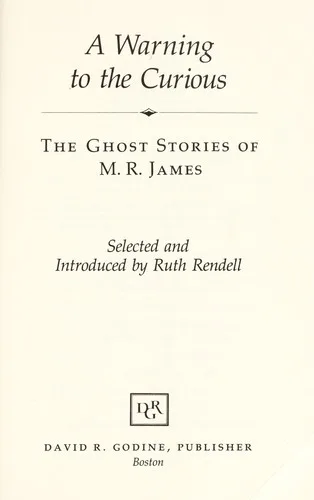
A warning to the curious and other stories
 70
70

A warning to the curious and other stories



By Alaric Kestrel (Metaphysical Studies Reviewer) — Montague Rhodes James stands as a titan in the subtle arts of spectral narrative. 'A Warning to the Curious' offers more than mere chills; it provides intricate glimpses into the precariousness of existence when ancient, often forgotten, powers are stirred. James's genius lies in his ability to imbue everyday objects with an aura of the uncanny, hinting at deeper, often terrifying, spiritual or occult undercurrents. These stories are essential for anyone interested in the intersection of folklore, the subconscious, and the ever-present echoes of the past that can manifest in the present. A profound and unsettling masterclass.
📝 Description
70
Montague Rhodes James first published 'A Warning to the Curious and Other Stories' in 1925.
This collection gathers ghost stories by M.R. James, a medieval scholar. His tales often feature antiquarians or academics who stumble upon ancient evils through their research or finds. The settings are typically English country houses, churches, or desolate landscapes, imbued with a sense of history and decay. James's strength lies in his ability to build suspense through implication and atmosphere, rather than explicit horror. He focuses on the dread that precedes the supernatural encounter, making the reader's imagination the primary source of fear.
These narratives are characterized by their learned protagonists and their engagement with historical artifacts or locations. A character might acquire an old book, a peculiar object, or investigate a local legend, inadvertently awakening a malevolent entity. The stories often conclude with the protagonist facing dire consequences, a stark reminder of the dangers lurking beneath the surface of the ordinary world. James's prose is precise and understated, creating a chilling effect through suggestion and a carefully controlled pace.
M.R. James's ghost stories are rooted in the tradition of antiquarian horror, a subgenre he helped define. As a scholar of medieval manuscripts and history, James drew upon his knowledge of obscure lore, religious history, and architectural details to lend authenticity to his supernatural tales. His protagonists, often academics themselves, interact with ancient artifacts and forgotten sites, inadvertently unleashing forces rooted in the medieval or earlier past. This grounding in historical detail and academic pursuits distinguishes his work from more sensational ghost stories, lending a specific intellectual weight to the encroaching dread.
💡 Why Read This Book?
For seekers of arcane wisdom and practitioners of subtle arts, this collection offers unparalleled atmospheric immersion. James's narratives are imbued with the power of suggestion, hinting at hidden forces and the consequences of their disturbance. Ideal for scholars of folklore, ghost lore, and the literary exploration of the numinous, these stories provide a rich tapestry for contemplation and a potent reminder of the mysteries that lie just beyond our perception.
⭐ Reader Reviews
Honest opinions from readers who have explored this book.
❓ Frequently Asked Questions
What makes M.R. James's ghost stories unique?
James revolutionised the genre by focusing on atmosphere and suggestion over overt horror. He masterfully transforms mundane settings and objects into sources of profound dread, drawing the reader into a world where the ordinary becomes unnervingly strange.
Are these stories suitable for beginners in esoteric literature?
Absolutely. While rich in symbolism and atmosphere, James's prose is accessible, making these stories an excellent entry point for those curious about the mystical and the supernatural without being overly academic.
What is the role of symbolism in James's stories?
Symbolism is paramount. Ordinary objects like carvings, pictures, or even specific architectural elements often carry hidden meanings, acting as conduits or warnings of the supernatural forces at play, inviting deeper interpretation.
Can these stories be considered 'divination' in a traditional sense?
While not direct divination tools, James's stories explore the consequences of uncovering forbidden knowledge or disturbing ancient powers, mirroring the cautionary aspects often found in divination practices concerning future or hidden truths.
What kind of atmosphere can I expect from this collection?
Expect an atmosphere of creeping dread, intellectual unease, and subtle terror. James excels at building suspense through implication, making the unseen far more frightening than any explicit depiction.
🔮 Key Themes & Symbolism
The Fragility of Order and the Unseen
James's narratives frequently explore the thin veneer of civilization and order, highlighting how easily it can be breached by ancient, often malevolent, forces. The stories suggest that our perceived reality is but a fragile construct, susceptible to disruption by powers that lie dormant in forgotten places or within cursed artifacts. This theme appeals to esoteric traditions that emphasize the constant interplay between the material and the spiritual realms, and the potential for the latter to intrude upon the former.
The Perils of Forbidden Knowledge
A recurring motif is the danger inherent in seeking out or stumbling upon knowledge that is best left undisturbed. Characters often find themselves drawn to ancient texts, mysterious symbols, or ancestral secrets, only to unleash forces that bring about their downfall. This echoes occult warnings about the responsibility that comes with gnosis, and the potential for certain truths to be overwhelming or destructive if not approached with proper preparation and respect.
The Power of Suggestion and Psychological Terror
James's genius lies in his masterful use of suggestion to evoke fear. Instead of graphic depictions, he relies on subtle hints, atmospheric details, and the reader's own imagination to create a sense of profound unease. This approach aligns with psychological approaches to magic and spiritual practice, where the mind's capacity to manifest and perceive is as crucial as any external ritual or artifact. The terror is often born from what is not seen, but deeply felt.
💬 Memorable Quotes
Direct passages from the work, attributed to the author.
“Things are not always what they seem.”
— This simple adage captures the core of James's tales, where ordinary objects and familiar settings conceal sinister truths and hidden dangers, urging vigilance and skepticism.
“It is the unexpected that is most terrifying.”
— James capitalizes on the unknown, suggesting that true horror lies not in what is revealed, but in the subtle hints and the vast possibilities of what lurks just beyond perception, playing on primal fears.
“The veil between worlds is thinner than we think.”
— James's stories often imply that the supernatural is not entirely separate from our reality, but rather a latent presence waiting to manifest when disturbed, suggesting a porous boundary between the mundane and the mystical.
“Some doors are best left unopened.”
— This cautionary statement underscores the theme of forbidden knowledge and the potential for catastrophic outcomes when one transgresses boundaries, whether physical, intellectual, or spiritual.
💡 Key Ideas
Editorial paraphrase of the work's core concepts — not direct quotes.
Beware the lure of the ancient.
This quote serves as a direct warning against the seductive yet perilous nature of exploring forgotten histories and archaic powers, which often carry unforeseen and devastating consequences.
🌙 Esoteric Significance
Tradition
While not explicitly aligned with a single esoteric tradition, James's work deeply appeals to themes found in Hermeticism, folk magic, and the darker currents of occultism. His stories often touch upon the dangers of meddling with primal forces, the significance of ancient symbols and artifacts, and the concept of lingering spiritual residue or elemental spirits. The narratives serve as cautionary tales for those who might dabble in forbidden lore without proper understanding or protection, reflecting a universal esoteric principle of 'as above, so below' and the interconnectedness of all things.
Symbolism
James masterfully employs symbolic imagery, imbuing seemingly mundane objects with potent dread. A crooked carving might represent a distorted spiritual essence, a faded range a forgotten pact, or a specific architectural feature a gateway to another realm. These symbols are not overtly explained but are woven into the narrative fabric, inviting the reader to intuit their meaning, much like in dream analysis or symbolic interpretation within grimoires. The recurring motif of the 'curious' individual who unearths something ancient and malevolent highlights the symbolic danger of unchecked intellectual pursuit without spiritual grounding.
Modern Relevance
In an age saturated with information and often superficial engagement, James's emphasis on atmosphere, suggestion, and the power of the unseen remains profoundly relevant. His stories encourage a deeper, more contemplative engagement with the world, urging readers to look beyond the obvious and consider the subtle energies that permeate our environment. For modern seekers, his work serves as a potent reminder of the ancient mysteries that still hold sway, and the enduring human fascination with the 'other' that lies just beyond the veil of everyday perception, prompting introspection on our own relationship with the unknown.
👥 Who Should Read This Book
This collection is indispensable for a diverse readership. For the **beginner seeker** of the mystical, it offers an accessible yet deeply atmospheric entry into ghost lore and the uncanny. **Scholars** of literature and folklore will find James’s craftsmanship and subtle commentary on societal anxieties invaluable. **Practitioners** of esoteric arts may discover a rich source of symbolic resonance and cautionary narrative, reinforcing the importance of respect and caution when engaging with ancient forces. Ultimately, anyone with a discerning palate for suspense, intellectual depth, and the enduring allure of the unknown will find 'A Warning to the Curious' a deeply rewarding and unsettling experience.
📜 Historical Context
M.R. James penned these chilling tales in the late Victorian and Edwardian eras, a period marked by a fascination with the occult, spiritualism, and the lingering shadows of ancient folklore. This era saw a surge in interest in collecting antiquities, exploring forgotten histories, and questioning the rationalistic certainties of the Enlightenment. James's stories, often set in venerable academic institutions, ancient country houses, and remote landscapes, perfectly captured this zeitgeist. His meticulous attention to detail, often referencing obscure historical texts and local legends, lent his supernatural narratives an air of verisimilitude that was both unsettling and deeply immersive, transforming the ghost story into a sophisticated literary form.
📔 Journal Prompts
Reflect on an ordinary object in your environment that, if imbued with sinister intent, could become a source of dread. Describe its transformation and the fear it evokes.
Consider the concept of 'forbidden knowledge.' What areas of study or discovery might be considered dangerous, and why? What precautions might one take?
James's stories rely on suggestion. How does the unseen or implied create a greater sense of fear than explicit depictions of horror?
Explore the idea of ancient places or artifacts holding residual energies. How might these energies manifest in the modern world?
Write about a time when you felt a subtle sense of unease or premonition, and how that feeling evolved. Connect it to the themes of hidden forces.
🗂️ Glossary
Numen
A divine power or spirit, often associated with a specific place or object. In James's stories, the numen is frequently ancient, malevolent, and easily disturbed by human intrusion.
Vestige
A trace or remnant of something that is disappearing or no longer exists. James’s tales often deal with the lingering vestiges of ancient evils or forgotten presences.
Gnosis
Spiritual knowledge, enlightenment, or insight, often esoteric or mystical in nature. The pursuit of gnosis can be a dangerous path, as highlighted in James's narratives.
Aura
The distinctive atmosphere or quality that seems to surround and be generated by a person, thing, or place. James excels at creating a palpable aura of dread around his settings and objects.
Archetype
A very typical example of a certain person or thing; a recurring symbol or motif in literature and mythology. James's spectral entities often embody primal fears and ancient archetypes.
This book appears in 3 collections
🔮 Readers Also Liked
Browse all →



![The Widow Ching Pirate [5 stories]](/img/thumb/the-widow-ching-pirate-5-stories-jorge-luis-borges.webp)


More by Montague Rhodes James
All books →

From the “Tarot” Collection
View all →







More Free Divination & Tarot Books
View all →