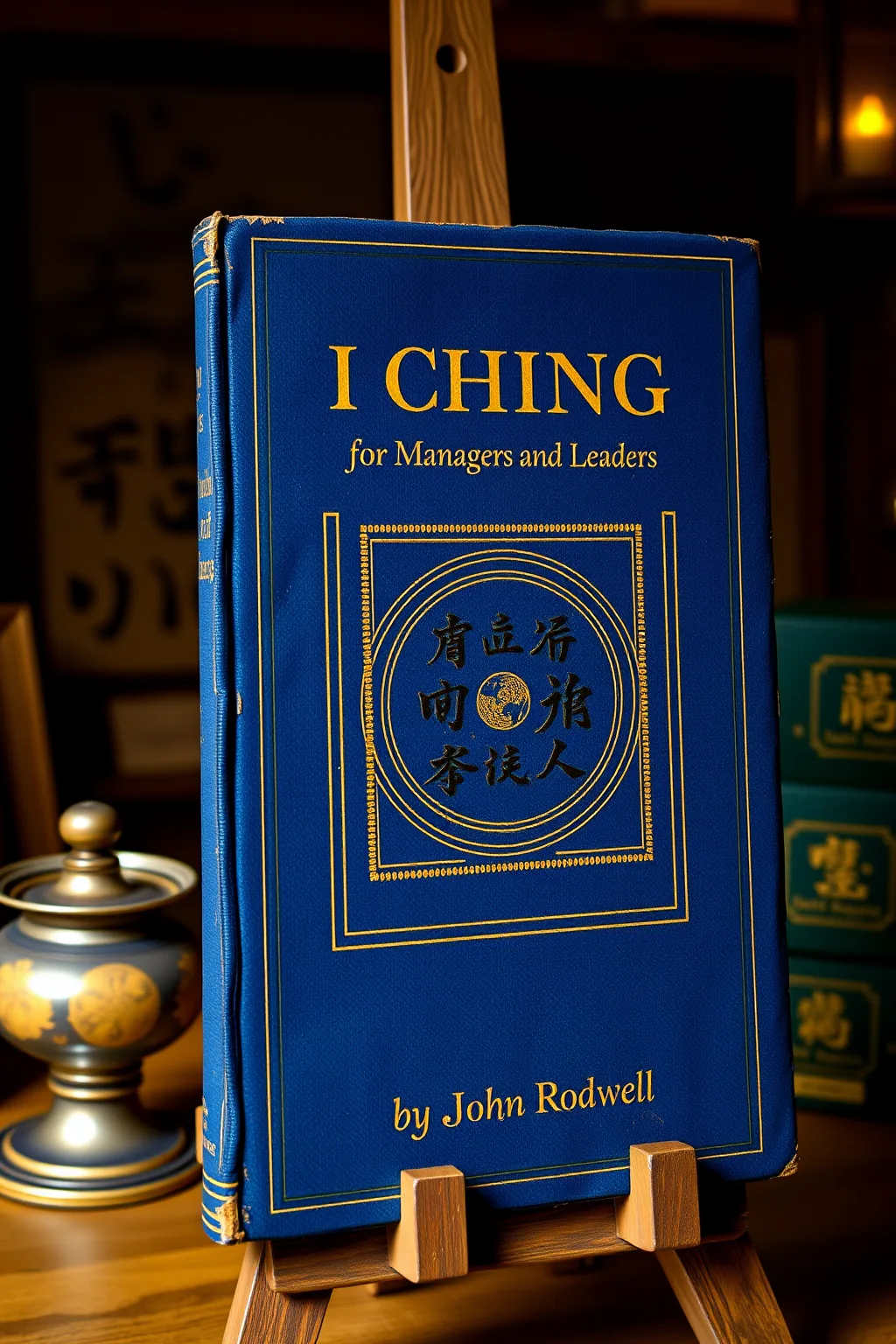
I Ching for Managers and Leaders
 61
61

I Ching for Managers and Leaders



Sophia Crane (Associate Editor) — John Rodwell's 'I Ching for Managers and Leaders' is a revelatory work, elegantly bridging the ancient esoteric world of the Book of Changes with the pragmatic demands of contemporary leadership. Rodwell doesn't shy away from the I Ching's mystical depths, instead, he skillfully extracts its profound philosophical underpinnings, translating complex symbolism into actionable insights. He illuminates how the hexagrams offer a framework for understanding situational dynamics, strategic decision-making, and fostering harmonious organizational change. This book is an indispensable resource for leaders who seek a more nuanced, insightful, and spiritually grounded approach to their roles, offering a profound path to wisdom beyond conventional management theory.
📝 Description
61
John Rodwell's 2006 book applies the I Ching's hexagrams to modern management.
This book adapts the I Ching, the ancient Chinese oracle, for contemporary leaders and managers. John Rodwell moves beyond the I Ching's divinatory uses to show how its hexagrams offer a framework for understanding change and decision-making. The text encourages readers to see the archetypal images of the I Ching as reflections of leadership challenges and possibilities.
It presents the I Ching as a source for principles like balance, adaptability, and strategic thinking. The book aims to provide insight into influence and decision processes, connecting them to the subtle dynamics that shape success and personal development. It is written for leaders, students of ancient philosophy, and anyone seeking a deeper understanding of these subjects.
The I Ching, or Book of Changes, is one of the oldest Chinese classic texts. Its origins are traced to the Western Zhou dynasty (c. 1046–771 BCE), with its philosophical depth developing over centuries. Traditionally used for divination, it comprises 64 hexagrams, each composed of six stacked lines. These lines represent yin (broken) or yang (unbroken) and are interpreted through complex symbolic associations. The text is central to Taoist and Confucian thought, influencing Chinese culture and philosophy for over two millennia.
💡 Why Read This Book?
Discover the ancient secrets of the I Ching to navigate complex leadership challenges with profound insight. This book offers a unique blend of esoteric wisdom and practical application, revealing how to understand cyclical change, make balanced decisions, and cultivate strategic foresight. Ideal for leaders, aspiring executives, and anyone seeking a deeper connection to timeless principles for effective influence and personal growth.
⭐ Reader Reviews
Honest opinions from readers who have explored this book.
❓ Frequently Asked Questions
Is prior knowledge of the I Ching required?
No prior knowledge is strictly necessary. Rodwell provides a clear, accessible introduction to the I Ching's core concepts and hexagrams, making it suitable for newcomers to the text while offering fresh perspectives for those already familiar.
How does the I Ching apply to modern leadership?
The I Ching's principles of change, balance, and adapting to circumstances offer timeless wisdom applicable to strategic decision-making, risk assessment, team dynamics, and fostering resilience in the face of uncertainty.
What is the core philosophy behind using the I Ching for leadership?
The core philosophy lies in understanding the natural flow of events and aligning actions with these underlying patterns. It encourages mindful observation, adaptability, and making choices that foster harmony and long-term success.
Can this book help with personal development as well as professional leadership?
Absolutely. The I Ching's wisdom is deeply introspective, offering profound insights into personal growth, self-awareness, and navigating life's various challenges, making it equally valuable for personal spiritual development.
What makes this interpretation of the I Ching unique?
Rodwell's unique contribution is his focused application of I Ching principles to the specific context of leadership and management, making its ancient wisdom directly relevant and actionable for contemporary decision-makers.
🔮 Key Themes & Symbolism
The Dance of Yin and Yang
Explore the fundamental esoteric principle of Yin and Yang, the primal forces that govern all existence and manifest in the dynamic interplay of opposing yet complementary energies. Within the I Ching, these forces are visually represented by broken (Yin) and unbroken (Yang) lines, forming the building blocks of its sixty-four hexagrams. Understanding this duality is key to perceiving the cyclical nature of change, the ebb and flow of power, and the essential balance required for effective leadership. This theme studies how recognizing and harmonizing these forces allows leaders to navigate complex situations with greater discernment and foresight, fostering a more integrated and responsive approach to challenges.
Hexagrammatic Archetypes of Situations
Discover how each of the sixty-four hexagrams serves as an archetypal representation of a specific life situation or energetic configuration. These ancient symbols are not mere random arrangements of lines but profound maps of human experience and cosmic forces at play. Rodwell guides readers to interpret these archetypes as powerful metaphors for the challenges and opportunities faced in leadership roles. By understanding the inherent nature and potential outcomes associated with each hexagram, leaders can gain a deeper, intuitive grasp of their current circumstances, enabling them to make more aligned and effective decisions, much like a navigator consulting celestial charts.
The Art of Strategic Adaptation
Explore the I Ching's profound teachings on adaptability, a central to successful leadership. The oracle emphasizes that true strength lies not in rigid adherence to a single path, but in the fluid and intelligent response to ever-changing circumstances. This theme illuminates how the wisdom embedded within the hexagrams provides guidance on when to act decisively, when to yield, and when to remain observant. It explores the esoteric concept of aligning one's actions with the 'Tao' or the natural way of things, fostering resilience and enabling leaders to navigate periods of flux with grace and strategic foresight, transforming potential crises into opportunities for growth.
💬 Memorable Quotes
Direct passages from the work, attributed to the author.
“Observe the patterns, then act.”
— Emphasizes the importance of mindful observation and understanding underlying currents before making decisions, a principle vital for both spiritual insight and strategic leadership.
“Change is the only constant.”
— A direct nod to the I Ching's fundamental message about the impermanence of all things, urging acceptance and proactive adaptation rather than resistance.
“Seek harmony within the flux.”
— Highlights the esoteric goal of finding inner balance and peace amidst the inevitable shifts and transformations of life and leadership.
“Wisdom is found in the silent spaces.”
— Suggests that profound understanding and insight often emerge not from external noise, but from introspection, contemplation, and mindful stillness.
💡 Key Ideas
Editorial paraphrase of the work's core concepts — not direct quotes.
The greatest strength lies in yielding.
This quote expresses a core tenet of Taoist philosophy and the I Ching: true power often comes from flexibility and adaptability, rather than brute force or rigid resistance.
🌙 Esoteric Significance
Tradition
Rooted in ancient Chinese cosmology and philosophy, the I Ching is a central to Taoist and esoteric thought. It represents a sophisticated system for understanding the fundamental forces of the universe – Yin and Yang – and their dynamic interplay. Its practice involves divination as a means of seeking guidance from the 'Tao,' the natural order of things. This tradition emphasizes cyclical change, balance, and the profound interconnectedness of all phenomena, offering a framework for living in harmony with the cosmic flow.
Symbolism
The I Ching's primary symbolism lies in its sixty-four hexagrams, each composed of six lines (broken for Yin, unbroken for Yang). These lines and their combinations create archetypal images that represent a vast spectrum of human experiences and universal situations. Key symbols include the trigrams (groups of three lines), representing fundamental elements like Heaven, Earth, Water, and Fire, and their interactions. The changing lines within hexagrams signify potential transformations, offering dynamic insights into the unfolding of events.
Modern Relevance
In the modern era, the I Ching's esoteric significance lies in its profound capacity to foster mindfulness, adaptability, and ethical decision-making. Its cyclical view of change provides a powerful antidote to the anxieties of an unpredictable world. For leaders, it offers a unique lens for strategic thinking, encouraging a deeper understanding of situational dynamics and the consequences of action. Its emphasis on balance and harmony speaks to contemporary desires for holistic well-being and sustainable practices, making its ancient wisdom remarkably relevant to navigating contemporary challenges.
👥 Who Should Read This Book
This invaluable text is a must-read for contemporary leaders and aspiring managers seeking to transcend conventional approaches. Scholars of ancient wisdom traditions, particularly Chinese philosophy and divination, will find Rodwell's insightful interpretations informative. Seekers of deeper self-understanding and personal growth will discover a profound tool for introspection. Practitioners of esoteric arts will appreciate the rigorous yet accessible exploration of a foundational divination system. Ultimately, anyone interested in the intersection of ancient wisdom and modern strategy, or those seeking to cultivate a more nuanced and balanced approach to life's challenges, will find immense value within these pages.
📜 Historical Context
The I Ching, or 'Book of Changes,' boasts a history stretching back over three millennia, originating in ancient China during the Shang Dynasty. It evolved from early divination practices and cosmological theories, becoming a foundational text of Confucianism and Taoism. Its compilation and commentary involved numerous scholars and philosophers, including King Wen, the Duke of Zhou, and Confucius himself, each adding layers of philosophical depth. During the Han Dynasty, it solidified its status as one of the Five Classics, deeply influencing Chinese governance, ethics, and culture. Its transmission across Asia and eventually to the West introduced a profound system of thought that has continuously inspired mystics, philosophers, and strategists seeking to understand the nature of reality and human endeavor.
📔 Journal Prompts
Reflect on a recent leadership challenge. Which I Ching hexagram might best represent this situation, and what guidance does it offer?
Consider the concept of 'yielding' in your professional life. Where can you practice more flexibility and adaptability to achieve better outcomes?
How does the interplay of Yin and Yang manifest in your current team dynamics or personal relationships?
What 'changing lines' are present in your current professional path, and what potential transformations do they suggest?
Meditate on the idea of 'harmony within flux.' How can you cultivate greater inner peace and balance amidst external change?
🗂️ Glossary
Hexagram
A symbol composed of six stacked lines, each either solid (Yang) or broken (Yin). The sixty-four hexagrams represent archetypal situations and principles of change in the I Ching.
Trigram
A symbol composed of three lines (solid or broken). There are eight basic trigrams, representing fundamental elements and concepts like Heaven, Earth, and Water.
Yin
The feminine, passive, dark, receptive, and yielding principle in Chinese philosophy, represented by a broken line (--) in the I Ching.
Yang
The masculine, active, light, assertive, and creative principle in Chinese philosophy, represented by a solid line (—) in the I Ching.
Tao (Dao)
The fundamental principle of the universe in Taoist philosophy; the 'Way.' It represents the natural order, the flow of existence, and the ultimate source of all.
This book appears in 3 collections
🔮 Readers Also Liked
Browse all →







More by John Rodwell
All books →

From the “I Ching” Collection
View all →









More Free Divination & Tarot Books
View all →