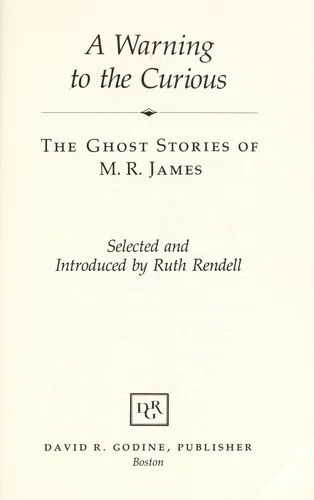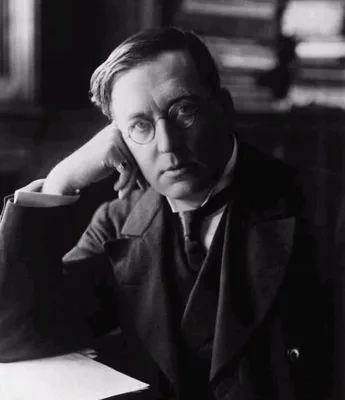
Montague Rhodes James
Montague Rhodes James was a renowned medieval scholar and author of influential ghost stories.
Montague Rhodes James (1862–1936) was a distinguished English medieval scholar and author, recognized for his significant contributions to both academia and literature. He held prominent positions, serving as provost of King's College, Cambridge, and later Eton College, and also as Vice-Chancellor of the University of Cambridge. While his scholarly research remains highly valued, James is most celebrated for his ghost stories, which are widely considered among the finest in English literature and have profoundly shaped modern horror writing.
James initially shared his tales as Christmas Eve entertainment for friends and students, gaining wider recognition upon their publication in various collections. He revitalized the ghost story genre by moving away from Gothic conventions, incorporating realism and dry humor to ground his narratives and create a compelling contrast with supernatural elements. His work is often associated with the "antiquarian ghost story" and "folk horror" due to his skillful use of ancient folklore and the rural landscapes of East Anglia, themes that continue to resonate through numerous adaptations of his stories.
Scholarly Contributions and Antiquarian Interests
Beyond his literary fame, Montague Rhodes James was a prolific and respected medievalist scholar. His academic expertise deeply informed his creative writing, particularly his fascination with folklore and historical artifacts. James's scholarly pursuits included cataloging manuscript libraries in Cambridge colleges and extensive research into medieval art and texts. A notable achievement was his role in the excavation of the Abbey at Bury St Edmunds, prompted by his discovery of a manuscript fragment, which led to the rediscovery of twelfth-century abbots' graves. He also published significant works on the sculptured ceiling bosses of Norwich Cathedral, edited the authoritative Latin hagiography of Æthelberht II of East Anglia, and translated John Blacman's biography of King Henry VI. His popular works, such as 'Suffolk and Norfolk' and 'Abbeys,' presented complex historical knowledge in an accessible manner. Furthermore, his directorship of the Fitzwilliam Museum saw the acquisition of important paintings and manuscripts, including works by Titian.
The Art of the Ghost Story
James redefined the ghost story, moving beyond traditional Gothic tropes to create a distinct style often referred to as 'Jamesian.' His tales typically feature a scholarly protagonist who stumbles upon an ancient object or text, inadvertently attracting supernatural attention. James's method emphasized realism and understated humor, grounding the narrative in mundane details to heighten the impact of the uncanny. He masterfully employed implication and suggestion, allowing readers to infer the horrific events. His philosophy on ghost stories stressed the importance of atmosphere and a gradual build-up of dread, advocating for malevolent entities rather than benevolent spirits. Despite advocating for reticence in writing, his stories often contained vivid and disturbing depictions of violence, a characteristic that has led to interpretations of deeper psychological undercurrents.
Key Ideas
- Antiquarian ghost story
- Folk horror
- Reticence in horror writing
- Atmosphere and crescendo in storytelling
- Malevolent supernatural entities
Notable Quotes
“put the reader into the position of saying to himself, 'If I'm not very careful, something of this kind may happen to me!'”
“Two ingredients most valuable in the concocting of a ghost story are, to me, the atmosphere and the nicely managed crescendo. ... Let us, then, be introduced to the actors in a placid way; let us see them going about their ordinary business, undisturbed by forebodings, pleased with their surroundings; and into this calm environment let the ominous thing put out its head, unobtrusively at first, and then more insistently, until it holds the stage.”
“Another requisite, in my opinion, is that the ghost should be malevolent or odious: amiable and helpful apparitions are all very well in fairy tales or in local legends, but I have no use for them in a fictitious ghost story.”
“Reticence may be an elderly doctrine to preach, yet from the artistic point of view, I am sure it is a sound one. Reticence conduces to effect, blatancy ruins it, and there is much blatancy in a lot of recent stories. They drag in sex too, which is a fatal mistake; sex is tiresome enough in the novels; in a ghost story, or as the backbone of a ghost story, I have no patience with it. At the same time don't let us be mild and drab. Malevolence and terror, the glare of evil faces, 'the stony grin of unearthly malice', pursuing forms in darkness, and 'long-drawn, distant screams', are all in place, and so is a modicum of blood, shed with deliberation and carefully husbanded; the weltering and wallowing that I too often encounter merely recall the methods of M G Lewis.”
Books by Montague Rhodes James
3 free public domain books · Read online or download