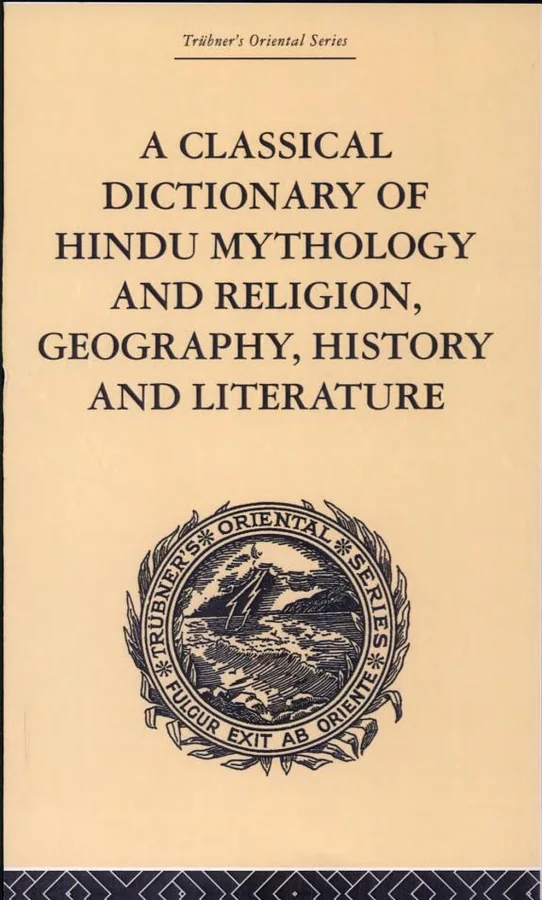
A Classical Dictionary of Hindu Mythology and Religion, Geography, History and Literature
 81
81

A Classical Dictionary of Hindu Mythology and Religion, Geography, History and Literature
John Dowson’s dictionary, first released in 2000 as a Routledge imprint, remains a remarkably thorough, if somewhat dated, compendium. Its strength lies in its sheer breadth; attempting to catalogue the entirety of Hindu mythology, religion, geography, history, and literature is an ambitious undertaking, and Dowson largely succeeds in providing concise definitions for an immense number of terms. The section on geographical locations, for instance, offers quick reference to places central to Indic narratives and practices. However, the work is undeniably a product of its time, reflecting late 19th/early 20th-century scholarship, which means its interpretations can occasionally feel reductionist or framed by colonial-era perspectives. A passage detailing the concept of 'karma' might be precise in its definition but could lack the nuanced philosophical unpacking found in more contemporary scholarship. Despite these limitations, for initial orientation and quick lookups, it is an invaluable resource. It serves as a solid, albeit sometimes simplistic, entry point for serious academic study.
📝 Description
81
John Dowson compiled A Classical Dictionary of Hindu Mythology in 1879 to explain Indic traditions to Western readers.
John Dowson's A Classical Dictionary of Hindu Mythology and Religion, Geography, History and Literature, first published in 1879, serves as a reference for understanding Hindu traditions. It defines terms, deities, historical figures, and places for a Western audience unfamiliar with the subject. The book explains concepts from the Hindu pantheon like Vishnu and Shiva, alongside philosophical schools and epic narratives such as the Mahabharata and Ramayana. It also covers important geographical sites used in religious pilgrimage.
Dowson aimed to organize and present this information accessibly. The dictionary offers explanations for those encountering Hindu concepts for the first time, aiming to provide context for academic or personal study. It addresses a need for clear scholarly resources on Eastern philosophies and religions, emerging during a period of increased Western interest in these subjects.
This dictionary addresses a Western interest in Indic traditions that grew in the late 19th century. It presents Hindu mythology, religion, and philosophy in a structured format, making complex concepts accessible to those outside the tradition. By defining deities, scriptures, and philosophical schools, it acts as a gateway for understanding the esoteric dimensions of Hinduism for a non-specialist audience.
💡 Why Read This Book?
• Gain precise definitions for a vast lexicon of Hindu terms, such as 'Brahman' and 'Atman', which are critical for understanding philosophical texts. • Access foundational information on key mythological figures like 'Rama' and 'Krishna', enabling a clearer grasp of epic narratives. • Understand the historical context of Indic geography, learning about significant locations mentioned in religious and historical accounts from the period.
⭐ Reader Reviews
Honest opinions from readers who have explored this book.
❓ Frequently Asked Questions
What is the original publication date of A Classical Dictionary of Hindu Mythology?
While the 2000 Routledge edition is referenced, the original publication date for John Dowson's A Classical Dictionary of Hindu Mythology and Religion, Geography, History and Literature is much earlier, reflecting its status as a foundational text in Indology.
Is this dictionary suitable for beginners in Hinduism?
Yes, the dictionary is structured for accessibility, providing clear, concise definitions of complex terms and concepts for those new to the study of Hinduism.
Does the book cover modern interpretations of Hindu mythology?
The dictionary primarily reflects the scholarship and understanding prevalent at the time of its original compilation, offering historical context rather than contemporary analyses.
What kind of information can I find on Hindu deities?
Entries detail the major and minor deities of the Hindu pantheon, including their myths, iconography, and roles within religious traditions.
How does the book address Hindu geography?
It lists and describes important geographical locations, such as sacred rivers, mountains, and cities, that hold significance in Hindu mythology, history, and religious practice.
Is John Dowson a recognized scholar in the field?
John Dowson was a noted scholar whose work in the 19th century contributed significantly to the Western understanding and cataloging of Hindu mythology and religion.
🔮 Key Themes & Symbolism
Deities and Divine Manifestations
The dictionary meticulously catalogues the Hindu pantheon, detailing the origins, attributes, and associated myths of deities like Brahma, Vishnu, and Shiva, as well as numerous minor gods and goddesses. It explains their roles not just as divine figures but as personifications of cosmic principles and forces, offering insight into the complex polytheistic and monotheistic currents within Hinduism. The entries provide a structured way to understand the relationships between these divine beings and their significance in worship and philosophical discourse.
Cosmology and Creation Narratives
Central to understanding Hindu thought are its creation stories and cosmological frameworks. Dowson's work illuminates concepts such as the cosmic egg (Hiranyagarbha), the cyclical nature of time (Yugas), and the role of primal forces in the universe's formation. It explains the structure of the cosmos as understood in Hindu traditions, including the various lokas (worlds) and the concept of Pralaya (dissolution). This provides a framework for appreciating the grand scale and cyclical perspective inherent in Hindu cosmology.
Sacred Texts and Epics
The dictionary serves as a guide to the foundational scriptures of Hinduism, including the Vedas, Upanishads, Puranas, and the great epics, the Ramayana and Mahabharata. Entries on these texts describe their content, significance, and the key characters and events they contain. For instance, understanding figures like Rama or Krishna is made easier by referencing their narrative arcs as presented in these sacred literary works, highlighting their importance in both religious practice and cultural identity.
Pilgrimage and Sacred Geography
Dowson's compilation extends to the geography of religious significance within India. It details important pilgrimage sites (tirthas), sacred rivers (like the Ganges), and mountains, explaining their mythological importance and their role in devotional practices. Understanding these locations is crucial for grasping the lived experience of Hinduism, where physical geography is deeply intertwined with spiritual belief and practice, forming a map of the sacred landscape.
💬 Memorable Quotes
Direct passages from the work, attributed to the author.
“The term 'Avatara' refers to the descent of a deity, typically Vishnu, to Earth in a physical form.”
— This entry highlights a key concept in Vaishnavism, explaining how divine intervention manifests in the mortal realm through specific incarnations to restore cosmic order or guide humanity.
“'Brahman' is the ultimate, unchanging reality, the supreme spirit from which all existence emanates.”
— This definition points to the Vedantic concept of the Absolute, the impersonal, all-pervading essence that underlies the manifest universe, a central to Hindu philosophical inquiry.
“The 'Rigveda' is the oldest of the four Vedas, containing hymns and prayers to various deities.”
— This entry situates one of Hinduism's most ancient and sacred texts, emphasizing its foundational role in Vedic religion and its importance for understanding early Indian religious thought.
“'Samsara' denotes the continuous cycle of birth, death, and rebirth.”
— This defines a fundamental concept of suffering and transmigration that pervades Indian religions, underscoring the goal of liberation (moksha) from this cycle.
“The 'Mahabharata' is an epic poem detailing the conflict between the Pandavas and Kauravas.”
— This entry introduces one of the world's longest epic poems, known for its philosophical discourse, including the Bhagavad Gita, and its exploration of dharma and duty.
🌙 Esoteric Significance
Tradition
While not explicitly aligned with a single esoteric lineage like Theosophy or Hermeticism, Dowson's dictionary serves as a crucial reference for many Western esoteric traditions that draw heavily from Indic sources. It functions as a foundational text for those exploring Neo-Vedanta, modern Yoga philosophy, and various forms of comparative mysticism that seek to synthesize Eastern and Western spiritual insights. Its value lies in providing accessible definitions for terms central to these syncretic paths.
Symbolism
Key symbols like the 'Om' (Aum) symbol, representing the primordial sound and the ultimate reality, and the 'Swastika', an ancient symbol of auspiciousness and well-being, are defined. Dowson's work explains their traditional meanings within Hindu iconography and cosmology, offering a starting point for esoteric practitioners to understand their deeper significance beyond superficial interpretations.
Modern Relevance
Contemporary practitioners of yoga, meditation, and mindfulness often engage with Hindu concepts defined in Dowson's work, even if indirectly. Thinkers and authors in the New Age and spiritual self-help movements frequently reference figures like Krishna or concepts like karma, often relying on foundational dictionaries like this for their initial understanding. Its enduring utility lies in providing a clear lexicon for concepts that remain central to global spiritual discourse.
👥 Who Should Read This Book
• Students of comparative religion seeking to understand the foundational elements of Hinduism and its diverse philosophical schools. • Researchers in Indology or South Asian studies requiring a quick reference for mythological figures, historical events, and geographical locations. • Aspiring practitioners of Yoga or Vedanta looking for clear, concise definitions of core terminology and concepts central to these disciplines.
📜 Historical Context
John Dowson's A Classical Dictionary of Hindu Mythology and Religion, Geography, History and Literature emerged in an era marked by intense European scholarly interest in the East, particularly during the late 19th and early 20th centuries. Works like this were instrumental in translating and codifying Indic traditions for Western audiences, often within the academic frameworks of Indology and comparative religion. This period saw the rise of figures like Sir Edwin Arnold, whose 'The Light of Asia' popularized Buddhist themes. Dowson's dictionary competed with, yet also complemented, the efforts of scholars from institutions like the Asiatic Society of Bengal, which had been publishing foundational texts since 1784. While aiming for academic rigor, such works inevitably carried the imprint of colonial perspectives, influencing how Hinduism was perceived and studied globally. The book's initial reception was largely academic, serving as a reference for scholars and students grappling with the vastness of Hindu literature and philosophy.
📔 Journal Prompts
The concept of 'Brahman' as ultimate reality: how does it compare to other ultimate principles you've encountered?
The cyclical nature of time (Yugas) described in Hindu cosmology: what does this perspective suggest about human history?
The role of 'Avatars' like Vishnu: reflect on the divine descending into the human realm.
The significance of the 'Ganges' river: consider the spiritual importance attributed to natural elements.
The epic 'Mahabharata': contemplate the ethical dilemmas presented in its narrative.
🗂️ Glossary
Agni
The Vedic god of fire, a messenger between humans and deities, central to sacrificial rituals and symbolizing purification and transformation.
Dharma
A fundamental concept encompassing duty, righteousness, moral law, and the inherent nature of things; it guides individual conduct and cosmic order.
Indra
King of the Devas (gods) and lord of Svarga (heaven), associated with thunder, lightning, storms, and warfare; a prominent figure in Vedic hymns.
Maya
An illusion or deceptive appearance that conceals the true nature of reality; a concept central to Advaita Vedanta, suggesting the phenomenal world is illusory.
Moksha
Liberation or emancipation from the cycle of birth, death, and rebirth (samsara); the ultimate spiritual goal in Hinduism.
Puranas
A vast genre of Sanskrit literature containing narratives about cosmology, deities, kings, heroes, and sages, often serving to popularize Vedic teachings.
Upanishads
A collection of philosophical texts forming the theoretical basis of Hinduism, exploring concepts like Brahman, Atman, karma, and moksha.
This book appears in 1 collection
🔮 Readers Also Liked
Browse all →






From the “Hinduism” Collection
View all →








More Free Sacred Texts & Gnosticism Books
View all →