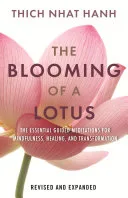
The Blooming of a Lotus
 78
78

The Blooming of a Lotus
Thich Nhat Hanh’s approach in The Blooming of a Lotus is characterized by its disarming simplicity and profound efficacy. The strength of this collection lies in its directness; the guided exercises feel less like abstract instructions and more like intimate conversations with a wise elder. He adeptly guides the reader to observe, rather than judge, the inner workings of the mind and body. A passage detailing the practice of "looking deeply" at anger, acknowledging its roots without succumbing to its force, exemplifies this compassionate methodology. However, for those already deeply immersed in advanced contemplative traditions, the foundational nature of some exercises might feel less novel. Still, the gentle, persistent invitation to return to the present moment remains an indispensable tool. The book offers a clear, actionable path toward inner peace.
📝 Description
78
Thich Nhat Hanh's 2022 book offers thirty-four guided mindfulness exercises.
Published in 2022, The Blooming of a Lotus presents thirty-four guided mindfulness exercises from Zen Buddhist monk Thich Nhat Hanh. The book provides accessible practices for cultivating presence and awareness, aiming to help individuals connect with their physical sensations, emotions, relationships, and the world. It functions as a guide for integrating mindfulness into daily life, fostering peace and understanding.
This collection suits both newcomers to meditation and experienced practitioners looking to deepen their practice. It offers gentle guidance for those dealing with difficult emotions like anger or feelings of separation. Individuals interested in applying spiritual principles to everyday challenges, improving family dynamics, or connecting more with their environment will find value within its pages.
Thich Nhat Hanh, a prominent figure in Buddhist teachings, published this work during a time of growing interest in Eastern contemplative practices. His extensive career, including his exile from Vietnam and subsequent teaching in the West, established him as a link between Buddhist philosophy and Western audiences. The book draws from the Mahayana Buddhist tradition, specifically the Plum Village practice he founded. This approach emphasizes engaged Buddhism and the practical application of dharma principles in secular life, distinguishing it from more academic or strictly monastic interpretations.
💡 Why Read This Book?
• You will learn to transform difficult emotions like anger by applying the "looking deeply" practice, as detailed in the exercises, enabling you to understand and dissolve them rather than suppress them. • You will gain practical techniques for connecting with your physical body and breath, drawing from the Plum Village tradition’s emphasis on embodied mindfulness, as presented throughout the thirty-four exercises. • You will discover how to foster deeper connections within your family and community by practicing "mindful listening" and "loving speech," concepts Thich Nhat Hanh integrates into the exercises.
⭐ Reader Reviews
Honest opinions from readers who have explored this book.
❓ Frequently Asked Questions
When was Thich Nhat Hanh's 'The Blooming of a Lotus' first published?
The Blooming of a Lotus was first published on February 15, 2022, making it a relatively recent offering from the esteemed Zen master.
What is the core philosophy behind Thich Nhat Hanh's mindfulness exercises?
The core philosophy is rooted in Mahayana Buddhism, emphasizing "interbeing" and the dissolution of ego through mindful awareness to cultivate compassion and reduce suffering.
Are the exercises in 'The Blooming of a Lotus' suitable for beginners?
Yes, the book is designed for both beginners and experienced practitioners, offering accessible guided exercises that build foundational mindfulness skills.
How does this book address difficult emotions like anger?
It teaches a method of "looking deeply" at emotions like anger, acknowledging their causes and conditions without judgment, thereby facilitating their transformation.
What is 'interbeing' as discussed by Thich Nhat Hanh?
Interbeing is the concept that nothing exists independently; everything relies on everything else for its existence, fostering a deep sense of interconnectedness and compassion.
Can this book help improve relationships?
Yes, through practices like mindful listening and loving speech, the book offers guidance on communicating more compassionately and understanding others better.
🔮 Key Themes & Symbolism
Mindfulness as Presence
The book consistently emphasizes mindfulness not as a detachment from reality, but as a deep engagement with the present moment. Hanh guides readers to anchor themselves through breath awareness and body sensations, transforming mundane activities into opportunities for profound presence. This practice, central to the Mahayana tradition, serves as the primary tool for dissolving mental afflictions and fostering clarity. The exercises aim to make this state of alert, compassionate awareness accessible in everyday actions, from eating to walking.
Interconnectedness and Compassion
A core part of Hanh's philosophy, "interbeing," is explored through the exercises, revealing how separation is an illusion. By recognizing our deep connection to all beings and phenomena, the book encourages a natural outgrowth of compassion. This understanding is presented as a potent antidote to anger and conflict, both internal and external. The practices are designed to cultivate empathy, breaking down perceived barriers between oneself and others, and promoting a sense of shared existence.
Transforming Difficult Emotions
Rather than advocating for the suppression of negative emotions, Hanh offers a method for their mindful examination. The concept of "looking deeply" allows practitioners to confront emotions like anger, fear, or sadness by understanding their origins and impermanent nature. The guided exercises provide a safe space to observe these feelings without being overwhelmed, facilitating their dissolution and replacement with equanimity. This approach aligns with Buddhist psychology's focus on skillful means for managing mental states.
Engaged Spirituality in Daily Life
The Blooming of a Lotus is a prime example of engaged Buddhism, demonstrating how spiritual practice can be directly applied to worldly concerns. Hanh integrates spiritual principles into actionable exercises for improving personal well-being, family life, and societal interaction. The book bridges the gap between esoteric teachings and practical application, showing that mindfulness is not confined to a meditation cushion but can permeate every aspect of existence, fostering peace and understanding in the mundane.
💬 Memorable Quotes
Direct passages from the work, attributed to the author.
“Breathing in, I calm my body. Breathing out, I smile.”
— This simple couplet expresses the essence of mindful breathing. It suggests that the act of inhalation can bring physical stillness, while exhalation, paired with a gentle smile, can foster emotional ease and acceptance.
“We have to practice dying every day to be free.”
— This provocative statement refers to the Buddhist practice of contemplating impermanence and letting go of attachments. It suggests that a daily "dying" to ego, desires, and fixed views is necessary for achieving true liberation and freedom.
“You have to love your suffering in order to transform it.”
— This highlights a key aspect of mindful emotional processing. It implies that instead of resisting or denying pain, approaching it with compassion and understanding allows for its eventual transformation and healing.
“Mindfulness is the energy which keeps in contact with reality.”
— This definition emphasizes mindfulness as an active, vital force. It is the awareness that connects us authentically to our present experience, enabling us to perceive reality clearly without distortion.
💡 Key Ideas
Editorial paraphrase of the work's core concepts — not direct quotes.
The miracle is not to walk on water. The miracle is to walk on the living earth.
This quote reframes the concept of miracles, shifting focus from extraordinary feats to the profound wonder inherent in ordinary existence. It highlights the spiritual potential found in mindful engagement with the present moment and the tangible world.
🌙 Esoteric Significance
Tradition
This work is firmly situated within the Mahayana Buddhist tradition, specifically the Chan (Zen) school, filtered through Thich Nhat Hanh's unique "Engaged Buddhism" lens. While not typically categorized alongside Western esoteric traditions like Hermeticism or Kabbalah, it shares the core Buddhist aim of liberation from suffering through inner transformation. The emphasis on direct experience, insight into the nature of reality (emptiness/interbeing), and the cultivation of wisdom and compassion aligns with the soteriological goals found in many esoteric paths, albeit with distinct philosophical underpinnings and practices.
Symbolism
The titular "Lotus" is a potent symbol in Buddhism, representing purity, spiritual awakening, and enlightenment, as it rises unstained from muddy waters. The "Blooming" signifies the unfolding of consciousness and the realization of one's true nature. Other implicit symbols include the "breath" as the anchor to the present moment and the "body" as the sacred vessel for awakening. Hanh uses these natural elements and processes to illustrate the potential for growth and beauty inherent even in challenging circumstances, mirroring the lotus's journey.
Modern Relevance
Thich Nhat Hanh's teachings, including those in The Blooming of a Lotus, continue to exert a profound influence on contemporary mindfulness-based interventions (MBIs) like MBSR and MBCT. His emphasis on secularized mindfulness for well-being and stress reduction has been widely adopted in psychology, healthcare, and education. Thinkers and practitioners in fields ranging from positive psychology to contemplative neuroscience draw upon the principles of mindful awareness and compassion he popularized, making his work a foundational text for modern secular spirituality.
👥 Who Should Read This Book
• Individuals seeking practical, secular methods to manage stress and anxiety, who will find thirty-four step-by-step exercises designed to cultivate calm and presence. • Practitioners of other contemplative or spiritual disciplines, including Western esoteric traditions, who wish to explore Buddhist mindfulness techniques and their application to emotional regulation. • Those experiencing interpersonal difficulties or emotional distress, such as anger or loneliness, who can benefit from Hanh's compassionate approach to understanding and transforming suffering.
📜 Historical Context
Thich Nhat Hanh, a globally recognized Zen master and peace activist, first gained significant attention in the West following his exile from Vietnam in 1966. The Blooming of a Lotus, published in 2022, arrives in an era saturated with mindfulness resources, yet it draws upon a deep lineage rooted in Mahayana Buddhism. Hanh's work is a prominent example of engaged Buddhism, a movement that seeks to apply Buddhist principles to social and political issues. His teachings, particularly those emanating from his Plum Village community established in France, often contrasted with more scholastic or purely monastic interpretations of Buddhism that were prevalent in academic circles or among certain Western converts. While figures like Alan Watts introduced Eastern philosophies more broadly in the mid-20th century, Hanh offered a distinctly practical, gentle, and accessible approach to meditation and applied dharma. His prolific writing and global teaching tours ensured his message reached millions, fostering a widespread appreciation for contemplative practices beyond their Asian origins.
📔 Journal Prompts
The miracle of mindful breathing: How does the simple act of returning to the breath alter your perception of a difficult moment?
Interbeing in practice: Identify one object or being you interacted with today and reflect on its interconnectedness with your existence.
Transforming anger: Describe a recent experience of anger and apply the "looking deeply" concept to explore its roots without judgment.
The blooming lotus within: What aspect of yourself feels ready to "bloom" with mindful attention and care?
Smiling meditation: How does consciously smiling during exhalation affect your physical and emotional state during a brief meditation?
🗂️ Glossary
Mindfulness
The practice of paying attention in a particular way: on purpose, in the present moment, and non-judgmentally. It is the state of active, open attention on the present.
Interbeing
A concept taught by Thich Nhat Hanh, signifying that all phenomena exist in mutual dependence and interconnectedness, challenging the notion of independent existence.
Looking Deeply
A practice of mindful investigation into the nature of emotions, thoughts, or situations to understand their causes and conditions, rather than reacting impulsively.
Plum Village Tradition
The specific lineage of Zen Buddhism founded by Thich Nhat Hanh, emphasizing engaged Buddhism and practical mindfulness in daily life.
Engaged Buddhism
A movement applying Buddhist teachings and practices to social, political, and environmental issues, aiming to alleviate suffering in the world.
Dharma
In Buddhism, the teachings of the Buddha, the truth about the nature of reality, or the cosmic law and order.
Soteriology
The doctrine of salvation or deliverance from sin, error, or evil. In Buddhism, this refers to liberation from suffering (Nirvana).