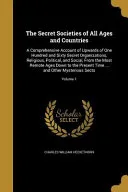
SECRET SOCIETIES OF ALL AGES &
 72
72

SECRET SOCIETIES OF ALL AGES &
Heckethorn’s "Secret Societies of All Ages" offers a vast panorama of clandestine groups, presenting a detailed historical survey that largely eschews sensationalism for academic rigor. Its strength lies in the sheer breadth of its coverage, from antiquity to the 19th century, meticulously detailing the known structures and alleged doctrines of orders like the Assassins and the Bavarian Illuminati. A particularly illuminating section details the transition of Templar lore into subsequent Masonic traditions. However, the work's considerable age, despite its 2016 republication, means its scholarship, while thorough for its time, is naturally superseded by modern historical and archaeological findings. For instance, its treatment of pre-Christian mystery cults sometimes relies on interpretations now considered speculative. Nonetheless, it remains an indispensable reference for its comprehensive cataloging of historical secret societies. It serves as a foundational text, a detailed historical map rather than a philosophical treatise.
📝 Description
72
Charles William Heckethorn's 1897 book details clandestine organizations from antiquity to his era.
First published in 1897, Charles William Heckethorn's "Secret Societies of All Ages" compiles historical accounts of various hidden groups. The work meticulously details organizations from the Eleusinian Mysteries and Knights Templar to Freemasonry, examining their rituals, organizational structures, and their alleged influence on historical events. Heckethorn grounds his narrative in extensive research, drawing upon primary sources and historical records to reconstruct the histories of these clandestine orders.
This volume is suited for serious students of history, comparative religion, and esoteric traditions. It will interest readers seeking the historical foundations of occult practices and secret societies. Those who wish to understand the development of Western esoteric thought, the origins of fraternal organizations, and the ongoing role of hidden knowledge in civilization will find this book valuable. It addresses both the academic and the dedicated amateur.
Heckethorn's work emerged in the late 19th century, a period marked by significant interest in occultism and secret societies, alongside figures like Helena Blavatsky. The book reflects a scholarly attempt to place these groups within historical and philosophical frameworks, predating later, more spiritualized interpretations of esotericism. It focuses on documented practices and historical accounts of groups such as the Rosicrucians and Carbonari, rather than abstract metaphysical theories.
💡 Why Read This Book?
• Gain a comprehensive historical overview of secret societies, learning about the specific rituals and hierarchies of groups like the Knights Templar and the Rosicrucians, as detailed in Heckethorn's extensive research. • Understand the evolution of Western esoteric thought by examining how concepts of hidden knowledge and initiatory traditions were presented and transmitted through societies Heckethorn traces from antiquity. • Discover the historical context of fraternal organizations and their perceived influence on societal structures, with specific examples like the Carbonari and their documented political activities in 19th-century Europe.
⭐ Reader Reviews
Honest opinions from readers who have explored this book.
❓ Frequently Asked Questions
What historical periods does Charles William Heckethorn's "Secret Societies of All Ages" cover?
The book spans a vast historical spectrum, beginning with ancient mystery cults and extending through the medieval period, the Renaissance, and up to the 19th century, documenting groups like the Eleusinian Mysteries and the Bavarian Illuminati.
Is "Secret Societies of All Ages" a primary source or a modern analysis?
It is a historical compilation and analysis from the late 19th century, drawing on existing historical accounts and documents available at the time of its original publication.
What types of secret societies are discussed in the book?
Heckethorn examines a wide array, including religious orders, philosophical fraternities, political conspiracy groups, and chivalric organizations, such as the Knights Templar, Freemasons, and Rosicrucians.
Is the book available online for free?
Yes, "Secret Societies of All Ages" is in the public domain and can often be found available for free online through various digital archives and libraries.
Does the book provide evidence for the existence of these societies?
The work presents historical accounts, references to documents, and scholarly interpretations from its era to support the existence and activities of the societies it discusses.
Who was Charles William Heckethorn?
Charles William Heckethorn was a writer and historian active in the late 19th century, known for his research into historical societies and esoteric subjects.
🔮 Key Themes & Symbolism
Transmission of Ancient Wisdom
Heckethorn posits that secret societies act as conduits for preserving and transmitting esoteric knowledge across generations. The work explores how doctrines and symbols from ancient mystery schools, such as those of Egypt or Greece, allegedly survived through medieval orders like the Knights Templar and later found expression in groups such as the Rosicrucians. This theme emphasizes the continuity of hidden philosophical and spiritual traditions, suggesting a lineage of secret knowledge keepers guiding civilization.
The Role of Clandestine Organizations in History
This theme focuses on the impact of secret societies on historical events and political movements. Heckethorn details how groups like the Carbonari or the Bavarian Illuminati were perceived to influence revolutions, shape political landscapes, and challenge established authority. The narrative suggests that behind public history, these hidden networks played significant, often unseen, roles in societal change and the dissemination of new ideas or subversions.
Ritual and Symbolism in Initiatory Orders
The book extensively documents the ritualistic practices and symbolic language employed by various secret societies. Heckethorn attempts to decipher the meaning behind the ceremonies of Freemasonry, the rites of ancient cults, and the allegorical teachings of groups like the Rosicrucians. This theme highlights the use of symbolic systems for spiritual instruction, moral development, and the creation of a shared esoteric identity among initiates.
The Evolution of Esoteric Lineages
Heckethorn traces the supposed development and mutation of esoteric traditions through different historical epochs. He examines how earlier forms of occult philosophy and mystical practice were adapted, reinterpreted, and integrated into new organizations. The work explores the idea that modern secret societies are not isolated phenomena but are part of a long, evolving chain of Western esotericism, each group contributing to or altering the overall current of hidden knowledge.
💬 Memorable Quotes
“The Eleusinian Mysteries were the most celebrated of all the mysteries of Greece.”
— This statement underscores the significance Heckethorn places on ancient cults as foundational to later esoteric traditions, highlighting the Eleusinian Mysteries as a prime example of early, influential secret rites.
“The Knights Templar were accused of heresy and idolatry by the Inquisition.”
— This points to the dramatic historical conflicts surrounding secret orders, illustrating how accusations of heresy and unorthodox practices often led to the suppression or persecution of influential clandestine groups.
“Freemasonry claims to be the successor of the ancient mysteries and the Templars.”
— This highlights the theme of lineage and continuity in esoteric traditions, showing how later organizations actively sought to connect themselves to ancient, powerful predecessors to legitimize their own teachings and rituals.
“The Carbonari were instrumental in the Italian Risorgimento.”
— This illustrates the concept of secret societies influencing political events, positioning groups like the Carbonari as significant, albeit hidden, actors in nationalistic movements and struggles for independence.
“Rosicrucianism appeared in Germany in the early 17th century.”
— This provides a specific historical anchor for the emergence of a key esoteric movement, marking a point of significant development in the history of Western occultism as documented by Heckethorn.
🌙 Esoteric Significance
Tradition
This work aligns with the Western Esoteric Tradition, particularly its historical and comparative aspects. It attempts to chart a continuity of initiatory practices and hidden philosophies from ancient mystery cults through medieval orders to 19th-century fraternal societies. While not strictly Hermetic or Kabbalistic in its primary focus, it draws heavily on the historical narrative that these traditions are passed down through secret lineages, a core concept in many esoteric schools.
Symbolism
Heckethorn engages with symbols primarily as historical markers and conveyors of doctrine. He discusses the symbolic language of Freemasonry, referencing tools and architectural motifs, and touches upon the allegorical meanings within the rituals of ancient cults like Eleusis. The work often interprets symbols as keys to understanding the moral or spiritual teachings of secret groups, viewing them as a consistent, albeit evolving, form of esoteric communication across ages.
Modern Relevance
Contemporary students of comparative religion, historical occultism, and the sociology of secret societies find value in Heckethorn's compendium. Thinkers and practitioners exploring the roots of Western esotericism, the historical development of Freemasonry, or the socio-political impact of clandestine groups can use this work as a foundational reference, albeit one requiring critical engagement with modern scholarship. It informs discussions on the enduring human fascination with hidden knowledge and communal initiation.
👥 Who Should Read This Book
• Researchers of Western Esotericism: Individuals studying the historical development of occult traditions and secret societies will find Heckethorn's extensive catalog and historical tracing invaluable for understanding foundational texts and movements. • Students of Comparative Religion: Those interested in the evolution of religious and philosophical ideas across cultures and eras will benefit from the book's examination of ancient mystery cults and their potential influence on later groups. • Enthusiasts of Fraternal and Historical Societies: Readers curious about the origins, structures, and alleged histories of organizations like the Knights Templar, Freemasons, or Rosicrucians will appreciate the detailed accounts presented.
📜 Historical Context
Charles William Heckethorn's "Secret Societies of All Ages" emerged in the late Victorian era, a period marked by intense public and scholarly interest in history, archaeology, and the occult. This milieu fostered works that sought to uncover hidden narratives and connect contemporary esoteric practices to ancient traditions. The book was published around the time figures like Helena Blavatsky were popularizing Theosophy, a competing yet related fascination with spiritual lineages and hidden wisdom. Heckethorn’s work, however, leaned more towards historical documentation and compilation than the speculative spiritualism of some contemporaries. While not widely censored, its reception was within circles interested in antiquarianism and esoteric lore, rather than mainstream academic discourse, which often viewed such subjects with skepticism. Its focus on documented historical accounts distinguishes it from purely speculative occult literature of the era.
📔 Journal Prompts
The concept of continuous esoteric lineage as presented in the text.
Alleged rituals of the Eleusinian Mysteries and their possible symbolic meanings.
The historical impact attributed to groups like the Carbonari.
The methods Heckethorn uses to connect different secret societies across centuries.
The role of accusations of heresy in the suppression of secret orders.
🗂️ Glossary
Eleusinian Mysteries
Ancient Greek initiation rites held annually at the Sanctuary of Demeter and Persephone near Eleusis. Their exact nature and teachings remain secret but are believed to have involved profound spiritual insights and promises of a better afterlife.
Knights Templar
A Catholic military order founded in the 12th century, originally tasked with protecting pilgrims to the Holy Land. They amassed great wealth and power before being suppressed in the early 14th century on charges of heresy.
Freemasons
A fraternal organization originating in the late 16th to early 17th century from stonemasons' guilds. It is known for its elaborate rituals, symbolic teachings, and claims of descent from ancient builders and orders.
Rosicrucians
A secret society or philosophical movement that first appeared in Germany in the early 17th century. Associated with alchemy, mysticism, and esoteric knowledge, its early history and influence are debated.
Carbonari
A secret revolutionary society active in Italy in the early 19th century. They were involved in movements for Italian unification and independence from foreign rule, using a system of secret oaths and rituals.
Bavarian Illuminati
A secret society founded in Bavaria in 1776 by Adam Weishaupt. It aimed to oppose superstition, prejudice, and the influence of religion and state power, advocating reason and enlightenment ideals.
Esoteric
Relating to or accessible only by a small number of people with a specialized knowledge or interest. In philosophy and religion, it refers to inner teachings or doctrines understood by initiates.