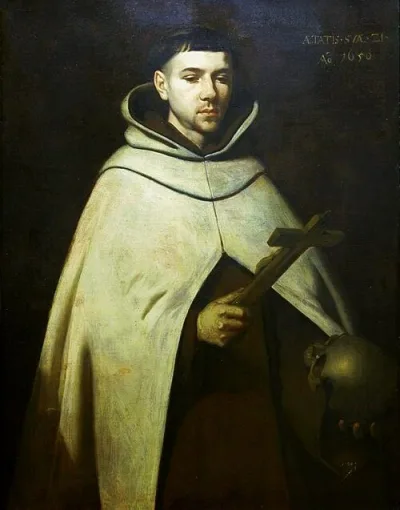
John of the Cross was a Spanish Carmelite mystic, poet, and Doctor of the Church, known for his spiritual writings and role in reforming the Carmelite order.
Born Juan de Yepes y Álvarez in 1542, John of the Cross was a Spanish priest, mystic, and Carmelite friar who became a significant figure in the Counter-Reformation. Influenced by Teresa of Ávila, he was instrumental in establishing the Discalced Carmelites, a reformed branch seeking a return to stricter Carmelite observances. His writings, encompassing both poetry and theological treatises on the soul's journey, are considered seminal works of Christian mysticism and Spanish literature. He articulated a framework for the spiritual life involving purgative, illuminative, and unitive stages, marked by 'dark nights' of the senses and soul.
His early life was marked by poverty and humble origins. After receiving a basic education and working in a hospital, he joined the Carmelite Order and later studied theology and philosophy at Salamanca University. His encounter with Teresa of Ávila led him to abandon plans to join the Carthusians and instead dedicate himself to her reform movement. He played a key role in founding the first Discalced Carmelite friary. His efforts to reform the order led to significant tensions with traditional Carmelites, resulting in his imprisonment and mistreatment in Toledo. Despite these hardships, he continued his spiritual work and writing.
Mystical Theology and Spiritual Development
John of the Cross is celebrated for his profound contributions to Christian mystical literature. His writings detail a structured approach to the spiritual life, often described as progressing through purgative, illuminative, and unitive ways. These stages are characterized by periods of spiritual difficulty, famously termed the 'dark night of the senses' and the 'dark night of the soul,' representing profound purification and detachment necessary for union with God. His poetic works, such as the 'Spiritual Canticle,' are deeply interwoven with his theological insights, expressing the soul's intense longing for and union with the divine in lyrical and powerful terms. These concepts have had a lasting and significant impact on Catholic spiritual traditions.
Role in the Carmelite Reform
A pivotal figure in the Carmelite reform movement, John of the Cross collaborated closely with Teresa of Ávila. Together, they sought to re-establish the primitive Carmelite rule, emphasizing a return to stricter observances, including poverty, solitude, and contemplative prayer. This reform led to the establishment of the Discalced Carmelites, distinguished by their austerity and barefoot practice. John's commitment to this reform led him to found new communities and serve as a spiritual director, though it also placed him in conflict with established Carmelite authorities, ultimately resulting in his imprisonment and persecution.
Early Life and Education
Born Juan de Yepes y Álvarez in 1542 to a family of humble origins, John of the Cross experienced poverty from a young age. His father's death left the family in difficult circumstances, leading them to move several times. He received a basic education, serving as an altar boy and later studying the humanities at a Jesuit school. After entering the Carmelite Order and adopting the name John of St. Matthias, he pursued higher studies in theology and philosophy at Salamanca University, where he encountered influential scholars.
Key Ideas
- Purgative, illuminative, and unitive ways of the spiritual life
- Dark night of the senses
- Dark night of the soul





















![The Dark Night of the Soul [microform]](/img/thumb/the-dark-night-of-the-soul-microform-saint-1542-1591-john-of-the-cross-359215.webp)