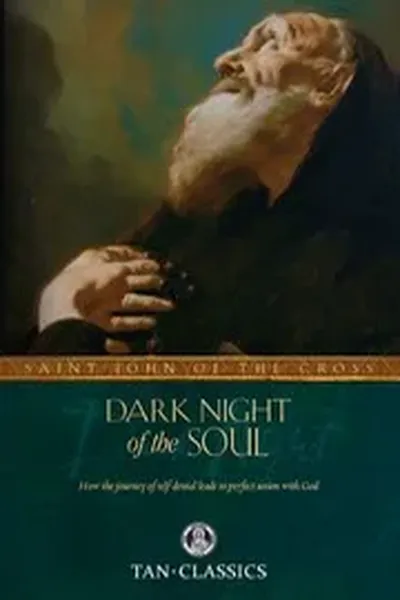
Dark Night of the Soul (16pt Large Print Edition)

 83
83

Dark Night of the Soul (16pt Large Print Edition)
Saint John of the Cross's 'Dark Night of the Soul' remains a formidable text for anyone navigating spiritual desolation. This 16th-century account, penned from the depths of personal suffering, offers a starkly unsentimental portrayal of the soul's journey toward God. The clarity with which Saint John outlines the stages of purification—from sensory detachment to the profound 'night of the spirit'—is remarkable, particularly given the turbulent era of his own life. A significant strength lies in its systematic approach; it doesn't merely describe the darkness but provides a roadmap, albeit an arduous one, through it. However, the sheer intensity and uncompromising demand for detachment can be overwhelming for the uninitiated, requiring considerable spiritual maturity to fully absorb. The passage describing the soul's passive suffering during the night of the spirit, where God Himself seems to withdraw, vividly illustrates the core challenge. This edition's large print is a welcome accessibility feature for sustained reading. It stands as an essential, if demanding, guide to the profound trials of spiritual growth.
📝 Description
83
Saint John of the Cross wrote 'Dark Night of the Soul' in a Toledo prison around 1578.
This 16-point large print edition presents Saint John of the Cross's influential 16th-century spiritual treatise, 'Dark Night of the Soul.' The work describes the soul's difficult movement toward union with God. It details a spiritual cleansing process marked by feelings of emptiness and divine absence. Saint John provides a structured approach to the spiritual trials encountered on this path. He stresses the importance of letting go of worldly desires and the self.
This text is for individuals committed to spiritual seeking, especially those practicing contemplative prayer and engaging with mystical paths. It speaks to those experiencing spiritual dryness or doubt, offering understanding and direction through these difficult periods. Readers interested in Christian mysticism, the history of contemplation, and the psychological aspects of faith will find much to consider and apply. It is also useful for students of religious history and comparative spirituality.
Penned by a Spanish Carmelite friar during the Counter-Reformation, 'Dark Night of the Soul' arises from a rich tradition of Christian mysticism. Written during personal hardship and facing scrutiny, the treatise reflects a period of intense spiritual inquiry. It stands alongside the works of contemporaries like Teresa of Ávila, who also explored the inner life. The book's focus on the soul's direct experience of God, particularly through periods of trial, places it within a lineage of contemplative theology that emphasizes inner transformation.
💡 Why Read This Book?
• Understand the 'night of the spirit' directly from Saint John of the Cross's 16th-century writings, gaining a framework for interpreting profound spiritual dryness that transcends mere psychological states. • Learn the necessity of 'despojo' (detachment) as described by Saint John, enabling a deeper appreciation of how relinquishing worldly affections can lead to spiritual liberty. • Grasp the role of 'uncreated grace' in the soul's purification, as detailed in the text, offering a theological perspective on direct divine encounter beyond conventional spiritual practices.
⭐ Reader Reviews
Honest opinions from readers who have explored this book.
❓ Frequently Asked Questions
What is the 'dark night' according to Saint John of the Cross?
The 'dark night' refers to a spiritual purification process where the soul experiences a profound sense of divine absence and detachment from worldly comforts. Saint John of the Cross describes two phases: the night of the senses and the night of the spirit, both aimed at achieving union with God.
When was 'Dark Night of the Soul' written?
Saint John of the Cross wrote 'Dark Night of the Soul' around 1577-1578 during his imprisonment in Toledo, Spain. This edition's original publication date is listed as 2012-09-24.
Is 'Dark Night of the Soul' a religious text?
Yes, it is a seminal work of Christian mysticism, written by a 16th-century Spanish Carmelite friar. It explores the soul's journey towards union with God through rigorous spiritual discipline and purification.
What does 'detachment from the world' mean in this book?
In 'Dark Night of the Soul,' detachment means actively reducing one's reliance on and emotional investment in material possessions, sensory pleasures, and worldly achievements. This 'despojo' is considered essential for the soul's liberation and direct experience of God.
Who was Saint John of the Cross?
Saint John of the Cross (1542-1591) was a Spanish mystic and Carmelite friar. He was a key figure in the Counter-Reformation and is renowned for his profound spiritual writings on the soul's journey toward divine union, often co-authored with Teresa of Ávila.
What is the purpose of the 'dark night' experience?
The purpose of the 'dark night' is to purify the soul, removing imperfections and attachments that hinder direct communion with God. Through this process, the soul becomes more receptive to divine wisdom and love, leading to spiritual illumination.
🔮 Key Themes & Symbolism
The Two Nights of Purification
The core of Saint John's treatise lies in differentiating the 'night of the senses' and the 'night of the spirit.' The former purges the soul's attachment to sensory pleasures and external consolations, making it ready for deeper spiritual work. The latter, a more intense and passive phase, involves the spirit itself being darkened and humbled, stripping away even spiritual gratifications to prepare for direct, unmediated union with God. This distinction is crucial for understanding the progression from initial spiritual dryness to profound existential surrender.
Detachment and Spiritual Liberty
Central to the 'dark night' is the concept of 'despojo,' or detachment from all created things. Saint John argues that the soul cannot truly possess God while remaining attached to anything else, however seemingly spiritual. This radical detachment is not about nihilism but about achieving ultimate freedom from the ego and worldly dependencies. This liberation allows the soul to become a pure vessel for divine love and wisdom, experiencing God not as an object of pursuit but as the very ground of its being.
The Role of Faith and Hope
During the profound obscurity of the 'dark night,' the theological virtues of faith and hope become paramount. As sensory and even intellectual consolations cease, the soul must rely solely on faith in God's unseen presence and hope in His ultimate promise of union. Saint John emphasizes that these virtues, though often unfelt during the night, are the stable anchors guiding the soul through the darkness. They represent the soul's active surrender and trust in the divine process, even when it feels abandoned.
Divine Wisdom and Love
The ultimate outcome of enduring the 'dark night' is the soul's reception of divine wisdom and the passionate experience of divine love. By dying to self and the world, the soul becomes capable of comprehending and partaking in God's own understanding and affection. This illumination is not merely intellectual but transformative, infusing the soul with a love that mirrors God's own. The arduous journey is presented as the necessary crucible for forging this profound spiritual transformation.
💬 Memorable Quotes
Direct passages from the work, attributed to the author.
“The soul that is attached to anything, however much the thing may be in the eyes of God, does not permit itself to be detached and transformed by God.”
— This highlights Saint John's core message on detachment. It warns that even seemingly good spiritual or worldly pursuits can become obstacles if they foster attachment, preventing the soul from reaching its full potential for divine union.
“In order to arrive at having pleasure in everything, desire to have pleasure in nothing.”
— A paradoxical instruction emphasizing that true fulfillment comes not from seeking pleasure directly, but from relinquishing the desire for it. This surrender opens the soul to a deeper, more abiding form of divine joy.
“The soul walks securely through the darkness, for it is guided by faith, though it perceives nothing.”
— This speaks to the passive aspect of the 'dark night.' Even without sensory or intellectual confirmation, faith serves as the unseen guide, enabling progress towards God amidst profound spiritual obscurity.
“The passive night is a very great purgation, and it is the most grievous to the soul.”
— This acknowledges the intense suffering of the 'night of the spirit.' It is passive because the soul endures it rather than actively striving, making it a profound test of endurance and trust in God's hidden work.
“God... transforms the soul by the denial of the senses and the spirit.”
— This concisely states the mechanism of transformation. The 'dark night' strips away the soul's reliance on its own faculties and experiences, allowing God to remake it through a process of negation and purification.
🌙 Esoteric Significance
Tradition
While rooted in Catholic mysticism, 'Dark Night of the Soul' functions as a foundational text for a broad spectrum of esoteric traditions. Its emphasis on inner purification, the dissolution of the ego, and direct experiential knowledge of the divine aligns with perennial philosophies found in Hermeticism, Sufism, and certain Gnostic traditions. Saint John's methodical approach to spiritual ascent provides a Christian framework for concepts of spiritual alchemy and the 'ascent of the soul' found in other esoteric lineages.
Symbolism
The central symbol is the 'dark night' itself, representing the soul's passage through trials and divine obscurity. Fire is another key motif, symbolizing both the purifying, transformative power of divine love and the potential for suffering. Light, often absent during the night, symbolizes divine wisdom and presence, the ultimate goal of the purification. Water, particularly in its capacity for cleansing, also appears, representing the washing away of imperfections through grace and spiritual discipline.
Modern Relevance
Contemporary esoteric thinkers and practitioners frequently reference Saint John's work. Psychologists of religion and consciousness studies draw upon his descriptions of spiritual crisis and transformation. Many modern contemplative practices, including mindfulness and certain forms of energy work, echo the principles of detachment and inner focus articulated in the 'dark night.' It remains a touchstone for those exploring the intersection of psychological well-being and spiritual development, particularly within Christian esoteric circles and comparative mysticism.
👥 Who Should Read This Book
• Advanced practitioners of Christian contemplative prayer seeking to understand and navigate profound spiritual dryness or perceived divine absence during their devotional journey. • Students of comparative mysticism and esoteric philosophy interested in the Christian expression of soul purification, ego dissolution, and direct experiential knowledge of the divine. • Individuals undergoing significant personal or spiritual crises who are looking for a rigorous, albeit challenging, theological and psychological framework to interpret their experiences of desolation and loss.
📜 Historical Context
Saint John of the Cross's 'Dark Night of the Soul' emerged from the crucible of 16th-century Spanish mysticism, a period marked by profound spiritual exploration and intense religious scrutiny. Written during his harrowing imprisonment in Toledo in 1577-1578, the work reflects the Carmelite Reform movement, spearheaded by Saint John and his close collaborator, Teresa of Ávila. This era also saw the Counter-Reformation's drive to reinforce Catholic doctrine, which led to suspicion of mystical experiences deemed potentially heterodox. The Spanish Inquisition was active, and writings that deviated from strict orthodoxy faced censorship. While contemporaries like Luis de Granada offered more ascetical guidance, Saint John's focus on the stark, often terrifying, purification of the soul presented a more radical path. The treatise’s profound theological and psychological depth has influenced Christian contemplative traditions for centuries, though its intensity initially drew cautious reception.
📔 Journal Prompts
The soul's detachment from created things: what attachments hinder your spiritual progress?
Reflect on the 'night of the senses' in your own life: what sensory comforts have you relinquished or can you relinquish?
Consider the paradox of 'desiring to have pleasure in nothing' to 'arrive at having pleasure in everything.'
How does the concept of 'uncreated grace' challenge conventional notions of spiritual attainment?
The guidance of faith during spiritual obscurity: how can you strengthen your trust when feeling lost?
🗂️ Glossary
Dark Night
A spiritual purification process characterized by a sense of divine absence and detachment from worldly and spiritual consolations, leading to deeper union with God.
Night of the Senses
The initial stage of purification where the soul detaches from sensory pleasures and external consolations, preparing it for deeper spiritual work.
Night of the Spirit
A more profound and painful stage of purification where the spirit itself is humbled and purified, often feeling abandoned by God, to achieve direct union.
Despojo
Spanish term for 'detachment' or 'stripping away.' It refers to the soul's necessary relinquishment of all attachments to created things, including spiritual consolations.
Uncreated Grace
The direct infusion of God's presence and love into the soul, as opposed to created graces (like virtues or gifts). It is the goal of the purification process.
Theological Virtues
Faith, Hope, and Charity (Love). These virtues are essential for working through the 'dark night,' providing the soul with divine guidance and strength even when unfelt.
Divine Union
The ultimate goal of the spiritual journey, where the soul achieves a profound, transformative communion with God, characterized by wisdom and love.
This book appears in 1 collection
🔮 Readers Also Liked
Browse all →





From the “Dark Night of the Soul” Collection
View all →





More Free Sacred Texts & Gnosticism Books
View all →