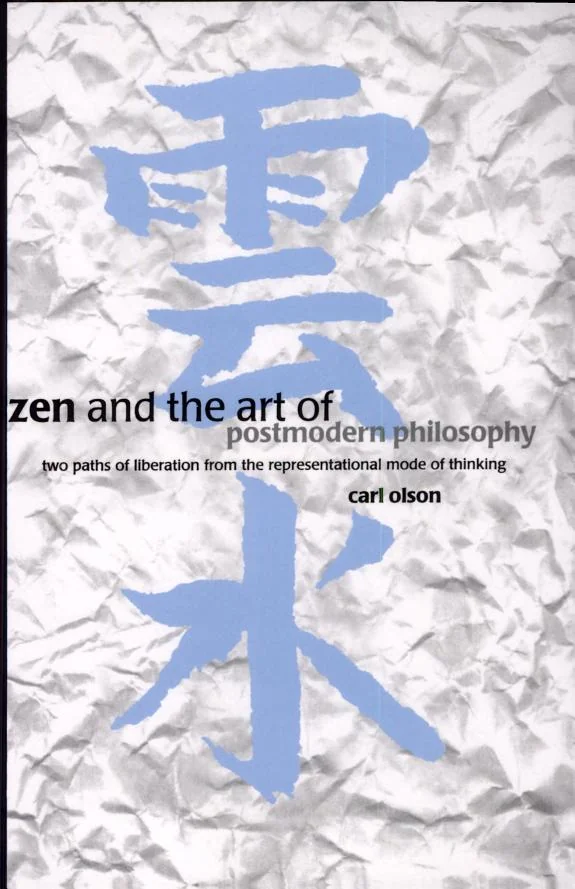
Zen and the Art of Postmodern Philosophy
 74
74

Zen and the Art of Postmodern Philosophy
Carl Olson’s "Zen and the Art of Postmodern Philosophy" is a bold intellectual exercise that attempts to find common ground between two seemingly irreconcilable philosophical landscapes. Olson skillfully avoids facile comparisons, instead demonstrating how Zen’s radical skepticism towards fixed meaning and identity can serve as a potent counterpoint to postmodernism’s deconstructive tendencies. A particularly compelling section dissects the concept of the 'self' as understood in Zen versus its critique in postmodern thought, revealing surprising parallels in their dismantling of essentialist notions. The book’s primary limitation, however, is its occasional density; the intricate arguments sometimes require a significant prior grounding in both Zen and postmodern theory, potentially alienating readers new to either field. Despite this, Olson offers a valuable perspective on navigating the philosophical currents of our time. It is a challenging but ultimately rewarding inquiry into meaning-making.
📝 Description
74
Carl Olson's 2000 book connects Zen Buddhism with postmodern philosophy.
Carl Olson's "Zen and the Art of Postmodern Philosophy," published in 2000, examines how Zen Buddhist concepts can illuminate postmodern thought. The book does not propose Zen as a simple answer but rather as a framework for understanding postmodernism's characteristic ambiguities and deconstructions. It applies Zen principles, including emptiness (sunyata) and mindfulness, to ideas like simulacra and the critique of objective truth. Olson's work engages with late 20th-century intellectual discourse, particularly the critiques of grand narratives and essentialism prevalent in post-structuralist thought. By applying a non-Western philosophical tradition to these Western constructs, the book offers an alternative perspective to analyses that were often Eurocentric.
This work is suited for scholars and advanced students in religious studies, philosophy, and cultural theory. Readers interested in comparative philosophy and integrating Eastern spiritual traditions with Western intellectual paradigms will find it valuable. Those familiar with thinkers like Jacques Derrida or Jean-François Lyotard, and who also have a background in Zen Buddhism, will appreciate its interdisciplinary approach. The book addresses the fragmentation and epistemological uncertainty inherent in postmodern thought by drawing on Zen's emphasis on direct experience and ego dissolution.
This book situates itself within a tradition of comparative philosophy that bridges Eastern contemplative practices with Western intellectual movements. It follows in a lineage that seeks to find resonance between seemingly disparate philosophical systems. By drawing parallels between Zen's experiential approach and postmodernism's deconstructive analysis, Olson engages with a discourse that has historically sought to integrate mystical or contemplative traditions into academic philosophy. The work contributes to a broader esoteric conversation about non-dual consciousness and its potential to reframe contemporary philosophical challenges.
💡 Why Read This Book?
• You will gain a nuanced understanding of how Zen Buddhist concepts like *sunyata* (emptiness) can inform and critique postmodern notions of fragmented reality, a perspective not readily found in purely Western philosophical texts. • You will explore the author's comparative analysis of the self in Zen and postmodernism, learning how both traditions challenge fixed identities, a specific intellectual exploration tied to Olson's 2000 publication. • You will discover how Zen’s emphasis on direct experience offers a potential path for engaging with postmodern uncertainty, a practical application of contemplative practice to contemporary philosophical challenges.
⭐ Reader Reviews
Honest opinions from readers who have explored this book.
❓ Frequently Asked Questions
What year was "Zen and the Art of Postmodern Philosophy" first published?
The book "Zen and the Art of Postmodern Philosophy" by Carl Olson was first published on August 24, 2000.
Who is the author of "Zen and the Art of Postmodern Philosophy"?
Carl Olson is the author of "Zen and the Art of Postmodern Philosophy." He is a Professor of Religious Studies at Allegheny College in Pennsylvania.
What is the main focus of "Zen and the Art of Postmodern Philosophy"?
The book's main focus is exploring how Zen Buddhist concepts can be used to analyze and critique the core ideas of postmodern philosophy, particularly its deconstruction of meaning and reality.
Which Western philosophical movements does the book engage with?
The book engages with postmodernism and post-structuralism, discussing concepts like simulacra and hyperreality that are central to thinkers like Jean Baudrillard and Michel Foucault.
What Zen Buddhist concepts are discussed in relation to postmodernism?
Key Zen concepts such as *sunyata* (emptiness), mindfulness, and the non-dualistic nature of reality are discussed and applied to postmodern theoretical frameworks.
What is the author's academic background?
Carl Olson is a Professor of Religious Studies. His previous works include "The Indian Renouncer" and "Postmodern Poison: A Cross-Cultural Encounter."
🔮 Key Themes & Symbolism
Zen Critique of Postmodernism
This theme examines how Zen Buddhist principles, particularly the concept of *sunyata* (emptiness) and the emphasis on direct experience, can serve as a counter-discourse to postmodernism's deconstruction of stable meaning and objective reality. Olson explores how Zen's radical non-attachment to concepts and its critique of the ego align with, and sometimes challenge, postmodern skepticism. The work posits that Zen offers a framework for understanding the fragmentation and simulacra characteristic of the postmodern condition without succumbing to nihilism.
The Deconstructed Self
The book examines the postmodern critique of the unified, essential self, drawing parallels with Zen's own teachings on the illusory nature of the ego. Olson analyzes how both traditions dismantle the notion of a fixed, independent subject, though from different philosophical starting points. Zen's focus on impermanence and interconnectedness is presented as a way to understand the fluid, constructed identities often discussed within postmodern thought, offering a contemplative approach to selfhood.
Epistemological Uncertainty and Direct Experience
Olson investigates how Zen's emphasis on immediate, experiential knowing can address the epistemological anxieties inherent in postmodern philosophy. While postmodernism often highlights the limitations of language and reason in accessing truth, Zen proposes a form of insight gained through practice that transcends conceptualization. The work explores this bridge between intellectual doubt and contemplative certainty, suggesting that direct experience offers a path to working through the ambiguities of postmodern knowledge.
Cross-Cultural Philosophical Dialogue
This theme underscores the book's broader aim: fostering a dialogue between Eastern and Western philosophical traditions. By applying Zen to postmodernism, Olson moves beyond comparative studies to a synthetic exploration. The work demonstrates the value of bringing non-Western spiritual and philosophical frameworks into conversation with contemporary Western intellectual currents, enriching both and challenging Eurocentric biases in academic discourse.
💬 Memorable Quotes
Direct passages from the work, attributed to the author.
“The author considers the postmodern critique of the self in relation to Zen's non-self doctrine.”
— This interpretation points to Olson's comparative analysis of how both postmodern philosophy and Zen Buddhism question the existence of a stable, independent ego or self, revealing shared ground in their deconstructive approaches.
“The book examines the concept of simulacra through a Zen lens.”
— This interpretation indicates Olson's attempt to apply Zen principles to understand and critique postmodern ideas about simulated realities and the blurring of the real and the image, suggesting Zen offers a unique perspective on these phenomena.
💡 Key Ideas
Editorial paraphrase of the work's core concepts — not direct quotes.
The work explores how Zen's emphasis on emptiness can challenge postmodern nihilism.
This paraphrased concept highlights the book's central thesis: that the Buddhist notion of *sunyata*, the absence of inherent existence, offers a robust philosophical counterpoint to the potential despair or meaninglessness often associated with postmodern thought.
Zen's focus on direct experience offers a way to engage postmodern uncertainty.
This paraphrased idea suggests that Olson presents Zen practice as a means to work through the epistemological challenges and fragmentation inherent in postmodernity, proposing that immediate experience can provide a grounding absent in purely intellectual discourse.
Olson's work bridges Eastern contemplation and Western critical theory.
This statement summarizes the book's ambitious scope, emphasizing its role in fostering an interdisciplinary dialogue between the contemplative traditions of the East and the analytical frameworks of Western philosophy.
🌙 Esoteric Significance
Tradition
While not strictly adhering to a single Western esoteric lineage, Olson's work engages with themes that resonate with Gnostic and Hermetic traditions concerning the illusory nature of the perceived world and the search for a more fundamental reality. By applying Zen's radical non-dualism and critique of conceptual fixation, the book offers a contemporary lens through which to view perennial esoteric concerns about overcoming illusion and achieving direct apprehension of truth. It departs from traditional Western esotericism by grounding its critique in a specific, historically developed Eastern contemplative practice.
Symbolism
The concept of *sunyata* (emptiness) serves as a primary symbolic anchor, representing not nihilism but the lack of inherent, independent existence, akin to esoteric notions of the 'unmanifest' or the void from which creation arises. The Zen practitioner's focus on the present moment, often symbolized by the simple act of breathing or awareness, can be seen as an esoteric practice of grounding oneself in direct reality, transcending the illusory constructs of the conditioned mind that postmodernism deconstructs.
Modern Relevance
Contemporary thinkers exploring embodied cognition, mindfulness-based interventions in psychology, and post-secular philosophy find resonance in Olson's work. His bridging of Zen and postmodernism informs current discussions on deconstructing Western metaphysics and finding alternative epistemologies. Practices influenced by mindfulness, now widespread in secular contexts, echo the Zen emphasis on direct experience that Olson highlights as a counterpoint to postmodern relativism and fragmentation.
👥 Who Should Read This Book
• Advanced students of comparative philosophy and religious studies seeking to understand the intersection of Eastern contemplative traditions and Western critical theory. • Scholars of postmodernism and post-structuralism interested in non-Western perspectives that challenge or reframe core tenets like deconstruction and the critique of the self. • Individuals practicing Zen Buddhism who are curious about how its principles engage with contemporary philosophical discourse and its critiques of reality and knowledge.
📜 Historical Context
Published in 2000, "Zen and the Art of Postmodern Philosophy" emerged during a period when postmodernism's intellectual dominance in academia was beginning to be critically re-examined, even as its influence remained pervasive. The late 20th century saw a proliferation of post-structuralist thought, with thinkers like Jean Baudrillard and Jacques Derrida profoundly shaping discussions on reality, language, and identity. Olson's work positions itself against this backdrop, offering a unique cross-cultural intervention. While much of the discourse on postmodernism was internally focused on Western European philosophical traditions, Olson sought to integrate insights from Zen Buddhism. This approach provided an alternative perspective to prevailing schools of thought, which often engaged with other Eastern philosophies but less frequently with Zen in direct dialogue with postmodern critique. The book’s reception within academic circles would have occurred alongside ongoing debates about globalization and the increasing interest in non-Western epistemologies, making its comparative approach timely.
📔 Journal Prompts
The concept of *sunyata* and its implications for postmodern fragmentation.
Zen's critique of the ego versus postmodern deconstruction of the self.
Direct experience as a response to postmodern epistemological uncertainty.
The potential for cross-cultural dialogue between Zen and Western philosophy.
Applying mindfulness to the challenges of understanding contemporary media and reality.
🗂️ Glossary
Sunyata
A central concept in Mahayana Buddhism, often translated as 'emptiness.' It refers to the absence of inherent existence or self-nature in all phenomena, implying interconnectedness and impermanence.
Postmodernism
A broad intellectual and cultural movement that questions the foundations of modernism, emphasizing skepticism toward grand narratives, objective truth, and universal reason.
Deconstruction
A critical approach, associated with Jacques Derrida, that analyzes the instability of meaning in texts and concepts, revealing underlying assumptions and binary oppositions.
Simulacra
A concept popularized by Jean Baudrillard, referring to copies that do not have an original, or that distort the original to the point of replacing it, creating a hyperreality.
Hyperreality
A state where the distinction between reality and its representation collapses, and the simulation becomes more real than the actual.
Non-dualism
A philosophical or spiritual concept that posits the ultimate unity of reality, rejecting fundamental distinctions such as subject/object, mind/matter, or self/other.
Ego
In Zen, the constructed sense of a separate, permanent self that is seen as an illusion to be transcended through practice.
This book appears in 1 collection
🔮 Readers Also Liked
Browse all →









From the “Zen Buddhism” Collection
View all →







More Free Occult Philosophy Books
View all →