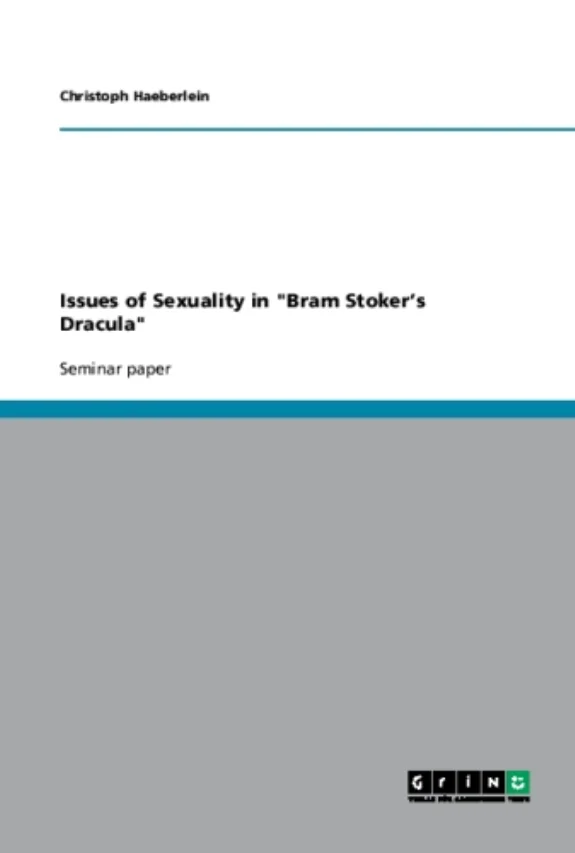
Issues of Sexuality in "Bram Stoker's Dracula"
 73
73

Issues of Sexuality in "Bram Stoker's Dracula"
Christoph Haeberlein’s seminar paper offers a sharp, if brief, dissection of the erotic currents coursing through Bram Stoker's *Dracula*. Rather than rehashing common observations, Haeberlein focuses on the vampire as a locus for societal sexual anxieties. A particular strength lies in its concise linking of Dracula's vampiric 'otherness' to anxieties about gender roles and sexual deviance in the late Victorian era. The work explores how Dracula's foreignness and aristocratic decay mirror contemporary fears about social and sexual contagion. While the paper is necessarily limited by its seminar format, its analysis of the Dracula-Mina dynamic as a perversion of Victorian marital ideals provides a valuable lens. Haeberlein avoids succumbing to the common trope of the 'sexed-up' vampire, instead grounding his analysis in the novel's specific historical and literary context. The paper’s concise exploration of the homoerotic subtext between Dracula and his male companions, for instance, is particularly insightful. This is a focused academic piece, offering a specific, critical perspective on a well-trodden text.
📝 Description
73
Christoph Haeberlein's 2009 paper examines sexuality in Bram Stoker's *Dracula*.
Originally a 2006 seminar paper, Christoph Haeberlein's work analyzes the complex themes of sexuality woven into Bram Stoker's 1897 novel, *Dracula*. Haeberlein investigates how the figure of the vampire serves as a lens through which anxieties and desires concerning sexual expression and identity are examined. The paper is aimed at those with a serious interest in English Literature, Gothic Studies, and Cultural Studies.
This study engages with critical interpretations of *Dracula* that gained prominence in the late 20th century, particularly those influenced by psychoanalytic, feminist, and queer theory. It builds upon existing scholarship while also offering new perspectives on the novel's socio-historical context and the evolution of the Gothic genre. Readers researching the various ways Stoker's work has been interpreted will find this a valuable resource.
This paper was written during a period of intense academic focus on Gothic literature, particularly on *Dracula*. It emerged within a scholarly environment where psychoanalytic, feminist, and queer theory had already reshaped understandings of classic texts. Haeberlein's work addresses interpretations that developed from the late 20th century, engaging critically with earlier readings of Stoker's novel. It contributes to ongoing discussions about the socio-historical implications of the text and the broader development of the Gothic genre.
💡 Why Read This Book?
• Gain a focused academic perspective on the sexual anxieties embedded in Bram Stoker's *Dracula*, moving beyond superficial interpretations of vampirism. • Understand how Dracula's foreignness and aristocratic decay, as analyzed in the paper, mirror late Victorian fears about social and sexual contagion. • Explore the specific dynamics between Dracula and his male companions, as Haeberlein’s work highlights the homoerotic subtext present in the 1897 novel.
⭐ Reader Reviews
Honest opinions from readers who have explored this book.
❓ Frequently Asked Questions
What is the primary focus of Christoph Haeberlein's paper on *Dracula*?
Haeberlein's paper examines the thematic exploration of sexuality and societal anxieties within Bram Stoker's 1897 novel, *Dracula*, positioning the vampire as a figure embodying repressed desires and fears.
When and where was this seminar paper originally presented?
The paper was originally presented as a seminar paper in 2006 at the University of Cologne for a course on Gothic and Neo-Gothic Fiction.
What kind of literary analysis does the paper employ?
The paper utilizes literary criticism, likely drawing on historical context and potentially psychoanalytic or queer theory, to dissect the sexual undertones and symbolism within *Dracula*.
Does the paper discuss modern vampire interpretations?
While the abstract mentions modern portrayals, the core of Haeberlein's 2006 paper focuses on the analysis of Bram Stoker's original 1897 novel and its historical context.
What is the significance of Dracula's 'foreignness' in the context of sexuality, according to the paper?
The paper suggests Dracula's foreignness serves as a metaphor for societal fears regarding sexual contagion and the transgression of established social and sexual norms prevalent in the late Victorian era.
Who is the intended audience for this academic work?
The paper is primarily intended for students and scholars of English Literature, Gothic Studies, and Cultural Studies interested in a deep dive into the sexual themes of classic literature.
🔮 Key Themes & Symbolism
Victorian Sexual Anxieties
The paper argues that Bram Stoker’s *Dracula* serves as a canvas for projecting late Victorian society's anxieties surrounding sexuality. The foreignness and aristocratic decay of the Count mirror fears of social and sexual contagion, while the disruption of traditional gender roles and marital purity highlights a cultural unease with changing sexual mores. Haeberlein connects these fears to the pervasive sense of 'otherness' embodied by the vampire, suggesting that Dracula represents transgressive desires and forbidden practices threatening the established social order of 1897 England.
The Vampire as Liminal Figure
Haeberlein's work explores the vampire's existence on the threshold between life and death, a state that allows it to embody and exploit sexual ambiguity and transgression. This liminality extends to Dracula's aristocratic yet predatory nature, blurring lines between nobility and monstrosity, civilization and primal urges. The paper suggests this ambiguous status makes the vampire an ideal conduit for exploring repressed or socially unacceptable sexualities that could not be openly discussed in the Victorian era, particularly concerning gender fluidity and forbidden desire.
Homoerotic Undertones
A significant aspect of the paper involves examining the homoerotic subtext within *Dracula*, particularly concerning the Count and his male entourage (e.g., his companions in the castle). Haeberlein suggests that the intense, often violent, interactions between these male figures, and their relationship with Dracula, can be interpreted through a lens of repressed homosexual desire. This interpretation challenges conventional readings and positions the novel as exploring not only heterosexual anxieties but also the complexities of male bonding and potential same-sex attraction within a rigidly defined social structure.
Perversion of Purity and Innocence
The paper analyzes how Dracula's interactions, especially with Mina Harker, represent a subversion of Victorian ideals of purity, domesticity, and marital fidelity. Dracula's vampiric bite and blood exchange are framed as a violation that contaminates Mina, transforming her from an emblem of Victorian womanhood into something monstrous and sexually compromised. This theme highlights the novel's engagement with fears about the loss of innocence and the corruption of the sacred feminine by invasive, predatory sexuality, as depicted in Stoker's 1897 narrative.
💬 Memorable Quotes
Direct passages from the work, attributed to the author.
“The vampire as a sexed-up figure, conveying the notion of the lascivious vamp.”
— This interpretation highlights how popular culture and critical analysis often reduce the vampire archetype to a simplistic symbol of overt sexuality, a concept Haeberlein seeks to contextualize within the novel's specific historical anxieties.
“Dracula's aristocratic yet predatory nature.”
— This phrase captures the inherent duality of the Count, suggesting a tension between his refined, noble facade and his primal, dangerous desires, a characteristic central to exploring themes of sexuality and social control.
“Homoerotic undertones in the relationships between male characters.”
— This interpretation points to a specific critical lens applied to the text, suggesting that the interactions between Dracula and his male companions reveal underlying tensions or expressions of same-sex desire.
“The perversion of Victorian marital ideals through vampiric violation.”
— This concept focuses on how the vampire's actions, particularly concerning Mina Harker, represent a symbolic assault on the sanctity of marriage and feminine purity, reflecting societal fears about sexual corruption.
💡 Key Ideas
Editorial paraphrase of the work's core concepts — not direct quotes.
The vampire figure functions as a vehicle for exploring anxieties and desires surrounding sexual expression and identity.
This paraphrased concept emphasizes the role of the supernatural in *Dracula* as a means to address taboo subjects, allowing the novel to indirectly confront societal unease regarding sexuality in the late Victorian period.
🌙 Esoteric Significance
Tradition
While not overtly aligning with a specific esoteric lineage like Hermeticism or Kabbalah, Haeberlein's work engages with the *shadow self* and repressed desires, concepts resonant in Jungian psychology and certain schools of occultism. The vampire, as a symbol of primal instinct and forbidden knowledge, touches upon themes of transformation and the darker aspects of the psyche that esoteric traditions often explore. The paper's focus on hidden sexualities and societal taboos aligns with the occult's interest in uncovering concealed truths and challenging conventional morality.
Symbolism
The core symbol is Dracula himself, representing the eruption of repressed sexuality and the 'other' into the ordered world of Victorian England. His vampirism symbolizes a transgressive life force, a perversion of natural cycles (life/death, purity/corruption) driven by insatiable desire. The blood exchange signifies an illicit intimacy, a violation of boundaries that carries both sexual and spiritual implications, mirroring rituals in some esoteric practices that involve life force transfer or symbolic union.
Modern Relevance
Contemporary explorations of gender fluidity, LGBTQ+ identity, and the critique of patriarchal structures find echoes in Haeberlein's analysis of *Dracula*'s sexual subtexts. Thinkers and artists examining the intersection of power, desire, and societal control continue to draw on the vampire mythos as a potent metaphor. The paper's insights into how societal anxieties are projected onto 'monstrous' figures remain relevant in discussions of othering, prejudice, and the ongoing negotiation of sexual norms in modern culture.
👥 Who Should Read This Book
• Students of Gothic Literature: Those studying the genre will find this paper a valuable resource for understanding the complex sexual undercurrents in Bram Stoker's foundational text. • Scholars of Sexuality in Literature: Researchers interested in how societal attitudes towards sex and gender are reflected in classic works will benefit from Haeberlein's focused analysis. • Cultural Historians: Individuals examining late Victorian social mores, anxieties, and the representation of the 'other' will find connections to broader historical contexts.
📜 Historical Context
Written in 2006 and published in 2009, Christoph Haeberlein's paper emerges from a rich tradition of Gothic literary criticism that has long grappled with Bram Stoker's 1897 novel. The late 20th and early 21st centuries saw a surge in psychoanalytic, feminist, and queer readings of *Dracula*, building upon earlier historical and symbolic analyses. This period was marked by scholars like Bram Dijkstra, who explored the misogyny inherent in late Victorian culture, and subsequent critics who applied queer theory to uncover homoerotic subtexts. Haeberlein's work fits into this ongoing scholarly conversation, offering a focused examination of sexuality that acknowledges and potentially expands upon these established critical frameworks. The paper engages with interpretations that had gained traction since the mid-20th century, moving beyond purely plot-driven or biographical readings of Stoker's text.
📔 Journal Prompts
Dracula's foreignness as a symbol for sexual anxieties.
The liminal state of the vampire and its relation to repressed desire.
Analyzing the homoerotic subtext between Dracula and his castle companions.
The perversion of Victorian purity ideals by vampiric violation.
Connecting the vampire's predatory nature to contemporary discussions of power and sexuality.
🗂️ Glossary
Gothic Fiction
A literary genre characterized by elements of horror, death, and, gloom, often featuring settings like ancient castles and themes of the supernatural, decay, and psychological terror.
Neo-Gothic
Revivals or modern interpretations of Gothic literature that draw upon its conventions while often updating themes or settings for contemporary audiences.
Liminal
Occupying a position at, or on both sides of, a boundary or threshold; relating to a transitional or initial stage of a process, or occupying an intermediate state or phase.
Homoeroticism
The representation of sexual interest between members of the same sex, often subtly or implicitly within a text.
Victorian Era
The period of Queen Victoria's reign in the United Kingdom (1837–1901), characterized by industrial expansion, social change, and strict moral codes.
Transgressive Sexuality
Sexual behaviors, desires, or identities that violate established social norms, moral codes, or legal restrictions.
Archetype
A very typical example of a certain person or thing; a recurrent symbol or motif in literature, art, or mythology.
This book appears in 1 collection
🔮 Readers Also Liked
Browse all →








From the “Vampirism” Collection
View all →




More Free Occult Philosophy Books
View all →