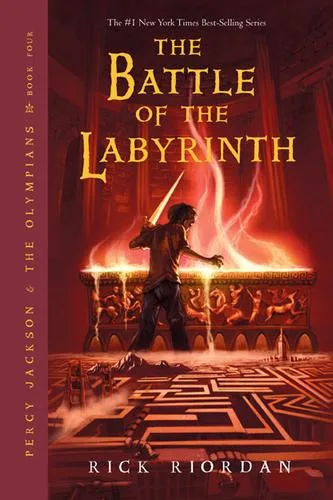
The Battle of the Labyrinth
 78
78

The Battle of the Labyrinth
Riordan’s approach to myth remains commendably direct in The Battle of the Labyrinth. He doesn't over-complicate the divine machinery, allowing the core narrative of Percy's quest to drive the action. The Labyrinth itself, a potent symbol of confusion and entrapment, serves as an effective stage for the escalating conflict. However, the sheer density of mythological figures and plot threads, while familiar to series devotees, can feel somewhat overwhelming for a casual reader encountering the narrative mid-arc. A particular strength lies in the character dynamics, especially the evolving trust between Percy and Nico di Angelo, which adds a crucial emotional layer. The pivotal scene where Percy chooses to spare Daedalus, despite his creations’ role in the unfolding disaster, highlights the series’ consistent exploration of moral ambiguity. Ultimately, the book succeeds as an engaging installment, though its intricate plotting occasionally strains against its brisk pacing.
📝 Description
78
Rick Riordan's 2008 novel, The Battle of the Labyrinth, is the fifth book in the Percy Jackson series.
The novel centers on the Labyrinth, a sprawling, ever-changing maze built by the Athenian craftsman Daedalus. Percy Jackson and his demigod friends must venture into this dangerous structure. Their goal is to stop Kronos's forces from invading Camp Half-Blood, the training ground for young demigods. The quest involves navigating the maze's unpredictable passages and confronting various mythological challenges.
This book is suitable for young adult readers who are already familiar with the Percy Jackson universe and Greek mythology. It will appeal to those who enjoy adventure stories that draw heavily on myths, featuring quick action and explorations of friendship, bravery, and predetermined futures. Readers who like complex puzzles and fictionalized versions of ancient architecture may also find it engaging.
Published in 2008, The Battle of the Labyrinth appeared during a period when young adult fantasy literature was very popular. Riordan's series stood out by concentrating on Greco-Roman mythology, reinterpreting its gods and stories for a modern audience. The early 21st century saw a renewed interest in classical studies, and Riordan's books made ancient myths accessible and exciting for a new generation.
The novel draws directly from ancient Greek mythology, specifically the myth of the Labyrinth built by Daedalus for King Minos. It reinterprets these classical stories for a contemporary young adult audience, making figures like Percy Jackson, a modern demigod, engage with the pantheon of Olympians and creatures from Greek legend. The book uses these ancient narratives as a framework for exploring themes of identity, destiny, and the struggle between order and chaos, presented through a fantastical lens.
💡 Why Read This Book?
• Gain an understanding of Daedalus's Labyrinth as a symbolic representation of life's challenges, as depicted in Chapter 5, "My First Dumb Mistake." • Experience the tension between destiny and personal choice through Percy's confrontations with prophecy, particularly concerning the Oracle's pronouncements in the latter half of the book. • Appreciate the complex portrayal of loyalty and betrayal as characters navigate the treacherous paths of the Labyrinth, mirroring the challenges faced by Nico di Angelo.
⭐ Reader Reviews
Honest opinions from readers who have explored this book.
❓ Frequently Asked Questions
What is the significance of Daedalus in The Battle of the Labyrinth?
Daedalus is the brilliant, albeit morally ambiguous, inventor who constructed the Labyrinth. His creations and past actions directly influence the events of the book, forcing Percy to confront the consequences of genius untethered from ethical responsibility.
How does The Battle of the Labyrinth connect to Greek mythology?
The novel integrates numerous figures and concepts from Greek mythology, including the Olympian gods, titans like Kronos, mythical creatures, and the legend of King Minos and the original Labyrinth of Crete.
What is the main goal of Percy Jackson and his friends in this book?
Their primary objective is to find and close the entrance to the Labyrinth that the Titans are using to invade Camp Half-Blood, thereby preventing Kronos's forces from reaching the demigod sanctuary.
Who is the antagonist in The Battle of the Labyrinth?
The primary antagonist is the Titan Lord Kronos, who is orchestrating the war against the Olympians and seeking to breach Camp Half-Blood. His influence is felt throughout the narrative, even when he is not directly present.
What role does Annabeth Chase play in the quest?
Annabeth, deeply fascinated by architecture and strategy, plays a crucial role due to her connection with Daedalus and her ability to understand the Labyrinth's patterns, making her indispensable to the quest's success.
What is Camp Half-Blood?
Camp Half-Blood is a sanctuary and training ground for demigods—children of Greek gods and mortals. It serves as the central base of operations for Percy and his allies in their fight against the Titans.
🔮 Key Themes & Symbolism
The Labyrinth as a Metaphor
The titular Labyrinth transcends its physical form, serving as a potent metaphor for the complex, often bewildering paths individuals face. Its shifting nature reflects the uncertainty of choices, the difficulty in discerning truth from deception, and the psychological entrapment that can arise from difficult circumstances. Within the narrative, the Labyrinth's construction by Daedalus underscores themes of creation and consequence, as Percy and his companions must navigate not only its physical dangers but also the moral ambiguities inherent in its design and purpose.
Fate Versus Free Will
A central tension in The Battle of the Labyrinth revolves around the interplay of prophecy and personal agency. Characters grapple with the pronouncements of the Oracle, questioning the extent to which their lives are predetermined. Percy Jackson, in particular, frequently confronts choices that seem to defy or reshape the prophesied outcomes. This exploration challenges the notion of inescapable destiny, suggesting that courage, will, and individual decisions can forge new paths, even when confronted by seemingly immutable fate.
Betrayal and Trust
The treacherous environment of the Labyrinth serves as a crucible for testing loyalty and exposing deceit. Characters are forced to constantly evaluate who they can rely on, as alliances shift and hidden motives come to light. The narrative deliberately blurs the lines between friend and foe, amplifying the sense of paranoia and the difficulty of forming genuine connections amidst conflict. This theme is particularly poignant in the relationships between Percy, Annabeth, and Nico di Angelo, highlighting the emotional stakes of war.
The Nature of Monsters
Riordan uses the creatures encountered within the Labyrinth not merely as obstacles but as extensions of the chaotic forces arrayed against the demigods. These monsters, drawn from classical myths, embody primal fears and the destructive potential of the world. Their presence forces the protagonists to confront their own vulnerabilities and the inherent dangers of their world. The book explores the idea that true monstrosity often lies not just in form but in intent and action, challenging readers to look beyond superficial appearances.
💬 Memorable Quotes
Direct passages from the work, attributed to the author.
“The Labyrinth was designed to be confusing. It was designed to be dangerous. It was designed to keep people out.”
— This statement expresses the dual nature of the Labyrinth – both a physical construct and a psychological barrier. It highlights the deliberate intent behind its creation, emphasizing its role as a defense mechanism and a symbol of the challenges one must overcome.
“Kronos was not the sort of monster you could reason with.”
— This interpretation highlights the absolute and implacable nature of the primary antagonist. It suggests that certain forces are beyond negotiation or compromise, representing a fundamental opposition that must be confronted directly rather than appeased.
“Daedalus had built the Labyrinth. He was the reason we were in danger.”
— This reflects the direct causality presented in the book, linking the architect of the Labyrinth to the perilous situation Percy and his allies find themselves in. It introduces the theme of creators being responsible for the consequences of their creations.
“We had to close the entrance. If they got into Camp Half-Blood, it would be the end.”
— This statement conveys the high stakes of the mission. It emphasizes the critical importance of their task, framing the potential failure not just as a setback but as an existential threat to the sanctuary of demigods.
💡 Key Ideas
Editorial paraphrase of the work's core concepts — not direct quotes.
It was the worst possible time for a quest. But the Labyrinth was not about finding the best time. It was about finding the way.
This paraphrased concept underscores the narrative's focus on perseverance amidst adversity. It suggests that crucial undertakings often arise during unfavorable circumstances, and the true test lies not in ideal timing but in the resolve to proceed despite obstacles.
🌙 Esoteric Significance
Tradition
While not strictly an esoteric text in the vein of Hermetic or Kabbalistic traditions, Riordan’s work taps into a popular modern interpretation of classical mythology that often carries symbolic weight for readers interested in archetypes and mythic structures. It functions as a gateway to understanding these ancient narratives, which have historically informed various esoteric schools. The series can be seen as engaging with the 'perennial philosophy'—the idea that there are universal truths underlying all religions and mythologies, presented here through the accessible lens of adolescent adventure.
Symbolism
The Labyrinth itself is a primary symbol, representing the journey of initiation, the trials of the psyche, and the confusing paths of life. Daedalus, the master craftsman, symbolizes human ingenuity, the potential for creation, and the responsibility that accompanies such power. Monsters like the Empousai and the Chimaera serve not just as antagonists but as embodiments of primal fears and chaotic forces that must be confronted and overcome for spiritual or psychological growth.
Modern Relevance
Contemporary interest in Jungian psychology, archetypal studies, and the resurgence of interest in ancient mythologies find fertile ground in Riordan's accessible narratives. Thinkers and practitioners exploring the power of myth in shaping identity and understanding the human condition often reference such works. The series’ continued popularity suggests a modern hunger for narratives that explore heroism, destiny, and the struggle against overwhelming forces, echoing themes found in various contemporary spiritual and self-help movements focused on personal growth and overcoming adversity.
👥 Who Should Read This Book
• Young adults interested in Greek mythology seeking an engaging adventure narrative that makes ancient stories accessible and exciting. • Readers of fantasy novels who enjoy fast-paced plots, complex world-building, and themes of friendship and courage. • Educators and parents looking for literature that can spark an interest in classical history and mythology in an entertaining format.
📜 Historical Context
The Battle of the Labyrinth, published in 2008, emerged within a burgeoning Young Adult fantasy market, heavily influenced by the global phenomenon of J.K. Rowling's Harry Potter series. Rick Riordan’s Percy Jackson & the Olympians series distinguished itself by drawing directly from Greco-Roman mythology, offering a distinct alternative to the prevailing European folklore-inspired fantasy. This period saw a renewed academic and popular interest in classical antiquity, which Riordan cleverly leveraged by reimagining ancient gods and heroes for a contemporary audience. While not facing overt censorship, the series’ success sparked discussions in educational circles about its role in promoting classical studies. Riordan’s work stood alongside other popular YA authors like Suzanne Collins, whose *The Hunger Games* also debuted in 2008, contributing to a landscape rich with adventure and mythic themes.
📔 Journal Prompts
The Labyrinth's shifting architecture and its effect on Percy's sense of direction.
Annabeth's fascination with Daedalus and her interpretation of his creations.
The moral choices faced by Percy when encountering trapped monsters or conflicted characters.
Nico di Angelo's initial distrust and eventual alliance with Percy.
The implications of the Oracle's prophecies for the demigods' free will.
🗂️ Glossary
Demigod
An individual who is part mortal and part god, possessing special abilities and often destined for great deeds or conflict.
Kronos
The leader of the Titans, a powerful primordial deity who seeks to overthrow the Olympian gods and regain control of the world.
Camp Half-Blood
A training ground and sanctuary for young demigods, located on Long Island, where they learn to control their powers and prepare for battles.
Daedalus
An ancient Greek inventor and craftsman renowned for creating the Labyrinth and other marvels. His creations often come with complex consequences.
Titan
A race of powerful deities who ruled during the Golden Age, preceding the Olympians. They are often portrayed as antagonists seeking to reclaim power.
Oracle of Delphi
A priestess at the Temple of Apollo who delivered prophecies from the god. In the series, the Oracle provides cryptic prophecies to the demigods.
Empousa
A type of mythical monster, often depicted as a beautiful woman with one donkey leg and one bronze leg, known for luring travelers to their doom.
🔮 Readers Also Liked
Browse all →









More by Rick Riordan
All books →




More Free Occult Philosophy Books
View all →