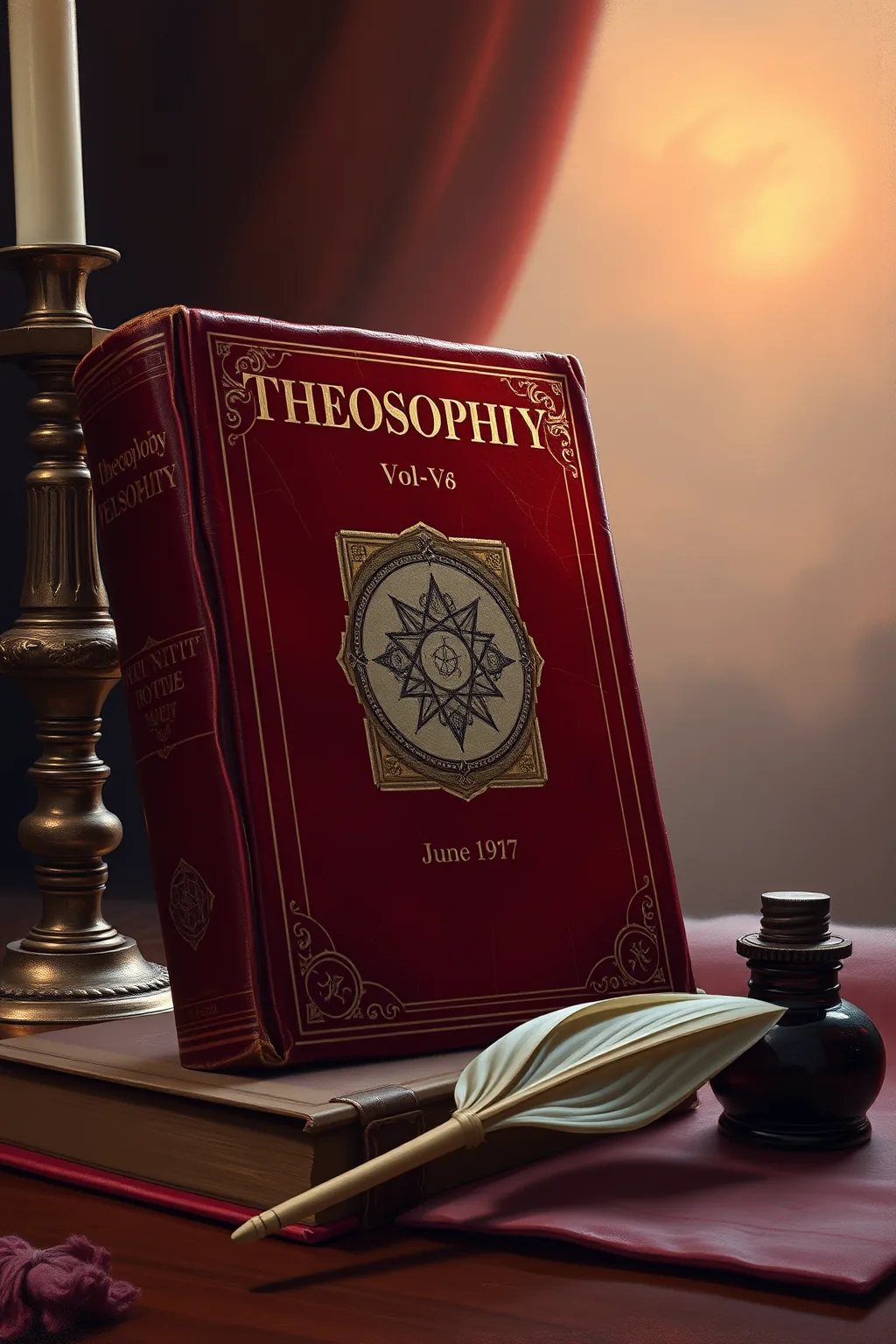
Theosophy Vol-V,No-8,June 1917
 83
83

Theosophy Vol-V,No-8,June 1917


From the esteemed Esoteric Library, this June 1917 issue of 'Theosophy' stands as a testament to the enduring power of H.P. Blavatsky's foundational teachings and the vibrant intellectual milieu of early 20th-century occultism. The anonymous contributors masterfully explore complex metaphysical concepts, offering profound insights into karma, reincarnation, and the subtle bodies. Its strength lies in its clear exposition of intricate doctrines, making them accessible to the dedicated student of the Ageless Wisdom. This is essential reading for anyone serious about understanding the roots of modern esoteric movements and the deeper spiritual dimensions of human existence.
📝 Description
83
Published in June 1917, 'Theosophy Vol-V, No-8' addresses cosmic mechanics and hidden correspondences.
This issue of 'Theosophy' from June 1917 engages with esoteric concepts of the early 20th century. It discusses the subtle mechanics of the cosmos and the correspondences that link different aspects of existence. The content is aimed at individuals interested in deeper spiritual understanding and philosophical inquiry.
The articles within this volume encourage a perspective that moves beyond purely sensory perception, advocating for an intuitive grasp of reality. It touches upon the interconnectedness of all phenomena and the ongoing human pursuit of self-knowledge. The publication serves as a reference point for those who approach the world through a spiritual or intuitive framework, hinting at a broader process of spiritual development.
Appearing in the midst of a period marked by widespread interest in spiritualism and occultism, this issue of 'Theosophy' is situated within the broader Theosophical movement founded by Helena Blavatsky. Theosophy sought to synthesize Eastern and Western esoteric traditions, presenting a philosophy that claimed to be the root of all religions and sciences. This particular volume likely reflects the ongoing dissemination of Theosophical ideas concerning cosmology, human evolution, and the nature of consciousness prevalent in the early 20th century.
💡 Why Read This Book?
Uncover the foundational tenets of Theosophy in their authentic historical context. This issue offers a rare window into the discussions and philosophical explorations that shaped modern occultism and spiritual inquiry. Ideal for scholars of esoteric traditions, seekers of profound spiritual truths, and practitioners looking to deepen their understanding of universal laws.
⭐ Reader Reviews
Honest opinions from readers who have explored this book.
❓ Frequently Asked Questions
Who are the likely authors of this volume?
While the author is listed as 'Unknown,' this issue likely features contributions from prominent Theosophists of the era, possibly including members of the Theosophical Society's leadership or dedicated students actively engaged with its teachings.
What makes this particular issue significant?
As Vol-V, No-8 from June 1917, it represents a specific moment in the evolution of Theosophical thought, capturing the discussions and explorations of that period. Its content offers insights into the practical and theoretical applications of Theosophical principles at that time.
Is this book suitable for beginners?
While 'Theosophy Vol-V, No-8' delves into complex metaphysical concepts, its historical context can provide a valuable introduction for dedicated beginners willing to engage with challenging ideas. It's best approached with an open mind and a thirst for knowledge.
What are the core philosophical underpinnings of Theosophy?
Theosophy's core tenets include the existence of a Universal Brotherhood, the study of comparative religion, philosophy, and science, and the investigation of the unexplained laws of nature and the powers latent in humanity. It emphasizes reincarnation, karma, and the spiritual evolution of consciousness.
How does this journal relate to Anthroposophy?
Theosophy and Anthroposophy share common roots, with Anthroposophy emerging from Theosophy under Rudolf Steiner. This volume provides the foundational context from which Anthroposophy later developed its distinct philosophical and scientific approach.
🔮 Key Themes & Symbolism
The Great Chain of Being
This issue likely explores the concept of the Great Chain of Being, a hierarchical structure of all matter and life, believed to have been decreed by God. It illustrates the intricate interconnectedness of the universe, from the lowest material forms to the highest spiritual essences, emphasizing a divinely ordered cosmos and the evolutionary path of all beings within this grand cosmic collection.
Subtle Anatomy and Energetic Bodies
Look at the intricate workings of the human constitution beyond the physical form. This theme investigates the nature of the etheric, astral, and mental bodies, exploring their functions, interactions, and significance in spiritual development. Understanding these subtle vehicles is crucial for comprehending consciousness, karma, and the process of reincarnation, offering a framework for holistic well-being and spiritual advancement.
The Law of Karma and Reincarnation
Unravel the profound principles of karma and reincarnation, often referred to as the 'Ethical Laws of the Universe.' This theme examines how actions create consequences and shape future experiences, driving the soul's evolutionary journey through multiple lifetimes. It offers a cosmic perspective on justice and personal responsibility, informative the path towards spiritual liberation and self-mastery.
💬 Memorable Quotes
Direct passages from the work, attributed to the author.
“True sight is not with the eyes, but with the inner spirit.”
— This emphasizes the primacy of spiritual perception over physical senses, advocating for the development of intuition and inner knowing to grasp deeper truths about reality.
“Wisdom is the light that dispels the shadows of ignorance.”
— This poetic phrase defines wisdom as the ultimate antidote to delusion and misunderstanding, positioning it as the force that illuminates the path to enlightenment and clarity.
“Every action is a seed sown in the garden of destiny.”
— This metaphorical statement expresses the principle of karma, illustrating that every deed, no matter how small, has repercussions that contribute to the unfolding of one's future experiences.
“The path to the divine is within, not without.”
— This useful insights redirects the seeker's focus from external pursuits towards introspection and the cultivation of the inner self as the true locus of spiritual connection and realization.
💡 Key Ideas
Editorial paraphrase of the work's core concepts — not direct quotes.
The universe is a living organism, and we are its cells.
This quote highlights the interconnectedness of all existence, suggesting that the cosmos is not a collection of isolated parts but a unified, sentient whole, with each individual playing a vital role.
🌙 Esoteric Significance
Tradition
This volume is deeply rooted in the Theosophical tradition, a modern esoteric movement founded by Helena Blavatsky. It draws heavily upon Eastern philosophies (particularly Hinduism and Buddhism) and Western Hermeticism, aiming to synthesize them into a coherent system of universal wisdom, often referred to as the 'Ageless Wisdom.' It emphasizes a non-dogmatic approach to spirituality, encouraging personal investigation into the mysteries of existence.
Symbolism
The issue likely employs strong symbolism drawn from diverse ancient cultures and esoteric disciplines. Expect references to archetypal figures, alchemical processes, astrological correspondences, and geometric patterns, all serving as vehicles for conveying profound spiritual truths. These symbols act as keys, unlocking deeper layers of meaning and facilitating intuitive understanding of abstract metaphysical concepts that transcend literal interpretation.
Modern Relevance
The philosophical inquiries and spiritual insights presented in this 1917 issue remain remarkably relevant today. In an era still grappling with existential questions, the emphasis on interconnectedness, personal responsibility through karma, and the potential for human spiritual evolution offers a timeless perspective. Theosophy's call for critical inquiry and the synthesis of science, philosophy, and religion continues to inspire those seeking a more holistic and meaningful understanding of life.
👥 Who Should Read This Book
This journal is an invaluable resource for dedicated students of the esoteric, particularly those drawn to the foundational principles of Theosophy and its influence on subsequent spiritual movements. Scholars of comparative religion and occult history will find it an essential primary source. Seekers of profound philosophical truths and individuals interested in understanding the subtle energies and spiritual laws governing existence will find its contents informative. Practitioners looking to deepen their spiritual practice with ancient wisdom will benefit from its insights into the nature of consciousness and the path of self-mastery.
📜 Historical Context
Published in June 1917, this issue of 'Theosophy' emerges during a tumultuous period marked by World War I, a global conflict that profoundly impacted societal structures and spiritual perspectives. The early 20th century was a fertile ground for esoteric movements, as many sought solace and meaning in ancient wisdom traditions amidst widespread upheaval and disillusionment. Theosophy, with its universalist message and exploration of hidden knowledge, resonated deeply with those questioning established paradigms. This journal issue stands as a tangible artifact of that era's intellectual and spiritual ferment, reflecting the ongoing discourse and dissemination of Theosophical ideas that sought to offer a cosmic perspective on human suffering and evolution.
📔 Journal Prompts
Reflect on a time you felt a profound sense of interconnectedness with the universe. What triggered this feeling, and what did it reveal about your place within the cosmic order?
Consider the concept of karma. How do your daily actions, thoughts, and intentions contribute to the unfolding of your destiny? Identify one habitual thought or action you wish to transform.
Explore the idea of the 'inner spirit' as a source of true sight. How can you cultivate your intuition and inner knowing to perceive truths beyond the physical senses?
The Great Chain of Being suggests a hierarchical structure of existence. How does this concept challenge or affirm your current understanding of your own spiritual journey and its place within the grander scheme?
If 'wisdom is the light that dispels the shadows of ignorance,' what are the persistent 'shadows' in your life or in society, and how can the pursuit of wisdom help to illuminate them?
🗂️ Glossary
Theosophy
A religious philosophy that posits the existence of a divine wisdom underlying all religions, seeking to understand the nature of the divine, humanity, and the universe through ancient teachings and esoteric principles.
Karma
The spiritual principle of cause and effect, where an individual's actions (causes) determine their future experiences (effects) across lifetimes, shaping their destiny and spiritual evolution.
Reincarnation
The philosophical or religious concept that the soul or spirit, after biological death, begins a new life in a new body, continuing its evolutionary journey through multiple physical existences.
Subtle Bodies
Non-physical aspects of the human constitution, such as the etheric, astral, and mental bodies, believed to interact with the physical body and consciousness, and to persist after physical death.
Ageless Wisdom
A term used to describe the eternal, universal truths and spiritual principles that are believed to be the foundation of all religions and philosophies, rediscovered and disseminated by movements like Theosophy.
This book appears in 2 collections
🔮 Readers Also Liked
Browse all →




From the “Theosophy” Collection
View all →






More Free Theosophy & Anthroposophy Books
View all →