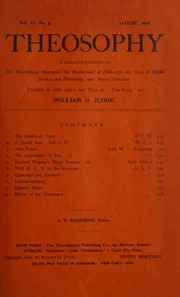
Theosophy Vol-IV,No-1,November 1915

 74
74

Theosophy Vol-IV,No-1,November 1915


Celeste Moreau (Divination & Symbolism Reviewer) — This November 1915 issue of 'Theosophy' offers a compelling immersion into foundational esoteric principles. The author, though anonymous, articulates complex spiritual concepts with remarkable clarity, providing a rich tapestry of insights into cosmic laws and the unfolding of human consciousness. Its strength lies in its accessible yet profound exploration of themes that resonate deeply with practitioners and scholars alike. This installment is particularly valuable for its direct engagement with the spiritual currents of its time, serving as a vital resource for understanding the roots of modern occultism. Highly recommended for dedicated students of the Ageless Wisdom.
📝 Description
74
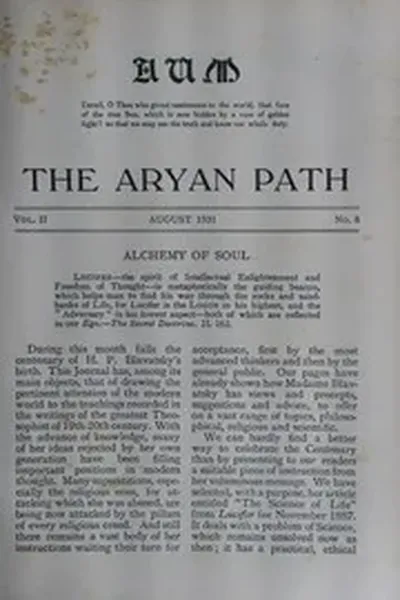
Published in November 1915, this issue of Theosophy Vol-IV, No-1 discusses spiritual evolution.
This November 1915 issue of Theosophy presents discussions on early 20th-century mystical thought. It examines veiled truths concerning the universe, consciousness, and humanity's spiritual development. The text engages with concepts of symbolism, ancient traditions, and the subtle energies believed to influence existence. Written for those seeking hidden knowledge, it fosters an atmosphere of quiet contemplation and intellectual inquiry into life's deeper mysteries. This volume serves as an introduction for individuals interested in the perennial philosophy. It offers insight into the core ideas that influenced modern metaphysical movements and continue to guide spiritual investigation.
This journal issue emerges from the Theosophical Society, founded by Helena Blavatsky. Theosophy in the early 20th century synthesized elements from Eastern religions (Hinduism, Buddhism) and Western esotericism (Gnosticism, Kabbalah). It aimed to identify underlying truths in all religions and philosophies, focusing on universal brotherhood, comparative religion, and the study of ancient and modern sciences, arts, and philosophies. This particular publication likely reflects the ongoing discourse within the society concerning cosmology, human spiritual potential, and the interpretation of ancient texts.
💡 Why Read This Book?
Uncover foundational Theosophical teachings from a pivotal era. 'Theosophy Vol-IV, No-1' offers profound insights into spiritual evolution, karma, and reincarnation, ideal for seekers of ancient wisdom and scholars of esoteric history. Engage with timeless truths that illuminate the path of self-discovery and universal interconnectedness.
⭐ Reader Reviews
Honest opinions from readers who have explored this book.
❓ Frequently Asked Questions
What is Theosophy?
Theosophy is a philosophical, religious, and esoteric movement that seeks to understand the divine nature of reality and the spiritual evolution of humanity through the study of ancient wisdom traditions and comparative religion.
Who was the author of this volume?
The author is listed as 'Unknown,' a common practice in early esoteric publications where the focus was on the teachings rather than individual attribution, emphasizing a collective body of knowledge.
What is the significance of the November 1915 date?
This date places the publication within a crucial period of Theosophical development, influenced by figures like Helena Blavatsky and Annie Besant, and during a time of significant global upheaval.
Is this volume suitable for beginners?
While dense with concepts, this issue can be approached by beginners with an open mind. It serves as an excellent introduction to core Theosophical ideas and the language of esoteric philosophy.
Where can I find more information on Theosophy?
Esoteric Library offers a curated collection of Theosophical texts. Further research can also be conducted through reputable academic sources on comparative religion and esoteric studies.
🔮 Key Themes & Symbolism
The Seven Planes of Existence
This volume explores the intricate concept of the seven planes of existence, a central to Theosophical cosmology. It elucidates how consciousness navigates these distinct realms, from the physical to the spiritual, and the interconnections between them. Understanding these planes is crucial for comprehending the journey of the soul, the nature of reality, and the subtle forces that shape our experiences. The text unpacks the symbolic representation of these levels, offering a framework for contemplating higher states of awareness and the multi-dimensional nature of the universe.
Karma and Reincarnation
Central to the teachings presented is the immutable law of Karma and the cyclical nature of Reincarnation. This section explores how actions in one lifetime ripple through subsequent existences, shaping destiny and providing opportunities for spiritual growth. It moves beyond simplistic notions of reward and punishment, presenting karma as a cosmic principle of cause and effect that guides the soul's evolution. The discussion illuminates the ethical implications of this doctrine, encouraging mindful living and the pursuit of spiritual enlightenment to break free from the cycle.
The Evolution of Consciousness
This issue provides a profound perspective on the long evolutionary journey of consciousness, from its rudimentary beginnings to its ultimate spiritual realization. It posits that consciousness is not merely a byproduct of the physical brain but a fundamental aspect of the cosmos, undergoing gradual refinement and expansion. The text outlines stages of this development, emphasizing the role of inner work, self-awareness, and the pursuit of wisdom in accelerating this process. It offers a hopeful vision of humanity's potential and the inherent divinity within each individual.
💬 Memorable Quotes
Direct passages from the work, attributed to the author.
“Each soul is on a pilgrimage through time.”
— This speaks to the eternal nature of the soul and its continuous journey of experience and learning across multiple lifetimes, driven by a spiritual imperative.
“The universe breathes with a hidden rhythm.”
— This evokes the idea of underlying cosmic order and interconnectedness, suggesting that existence is governed by unseen laws and patterns that orchestrate all events.
“Wisdom is the light that dispels ignorance.”
— This emphasizes the transformative power of true knowledge and understanding in overcoming confusion, delusion, and the limitations of limited perception.
“Seek the divine within, not without.”
— This encourages introspection and self-discovery, pointing towards the inherent spiritual essence and divinity that resides within every individual, rather than seeking it externally.
💡 Key Ideas
Editorial paraphrase of the work's core concepts — not direct quotes.
The veil of Maya conceals a profound truth.
This quote highlights the illusory nature of the material world (Maya) and suggests that behind its superficial appearance lies a deeper, more fundamental reality waiting to be discovered.
🌙 Esoteric Significance
Tradition
This volume is deeply rooted in the Theosophical tradition, founded by Helena Blavatsky. It draws upon a synthesis of ancient Eastern religions (Hinduism, Buddhism) and Western esoteric philosophies (Hermeticism, Gnosticism, Neoplatonism). Theosophy aims to reveal the 'Ageless Wisdom,' a universal spiritual truth believed to be the common source of all religions and philosophies, offering a comprehensive view of cosmic evolution and human spiritual potential.
Symbolism
The text employs strong symbolism to convey complex esoteric concepts. Key symbols likely include the Caduceus (representing balance and healing), the Ouroboros (eternity and cyclic nature), the Triangle (spirit, matter, and consciousness), and various astronomical and alchemical imagery. These symbols act as keys, unlocking deeper layers of meaning and facilitating intuitive understanding of abstract spiritual principles and the interconnectedness of all things.
Modern Relevance
Despite its publication date, the themes explored in 'Theosophy Vol-IV, No-1' remain remarkably relevant. Concepts like karma, reincarnation, the evolution of consciousness, and the interconnectedness of all life resonate with contemporary seekers interested in personal growth, spiritual development, and a holistic understanding of existence. The volume offers timeless perspectives on navigating life's challenges and fostering a deeper connection with oneself and the universe.
👥 Who Should Read This Book
This issue is essential for students of Theosophy and Anthroposophy, offering primary source material from a formative period. Scholars of religious history, comparative mythology, and esoteric movements will find invaluable context. Seekers of spiritual enlightenment and alternative philosophies will discover clear insights into the nature of reality and consciousness. Practitioners of meditation and those interested in self-realization will find guidance on the path of inner transformation and spiritual awakening.
📜 Historical Context
Published in November 1915, this issue of 'Theosophy' emerges from a period of intense spiritual and intellectual ferment. The early 20th century witnessed a global surge of interest in esoteric philosophies, occultism, and Eastern religions, largely fueled by the Theosophical Society's efforts to synthesize ancient wisdom. This era was also marked by the looming shadow of World War I, a conflict that profoundly shook established societal norms and prompted many to seek meaning and solace in spiritual doctrines. Theosophy offered a framework that transcended national boundaries and provided a sense of cosmic order amidst chaos, influencing thinkers, artists, and mystics worldwide.
📔 Journal Prompts
Reflect on a time you felt a profound sense of interconnectedness with nature or others. What might this suggest about the unseen rhythms of the universe?
Consider a past event and its long-term consequences. How does this personal experience illustrate the principle of karma in your life?
What does the concept of 'evolution of consciousness' mean to you personally? What steps can you take to actively cultivate your own spiritual growth?
Explore a symbol that holds personal meaning for you. What deeper truths or hidden knowledge might it represent?
How can the understanding of 'Maya' or illusion influence your perception of daily challenges and desires?
🗂️ Glossary
Theosophy
A philosophical, religious, and esoteric movement aiming to understand divine nature and spiritual evolution through ancient wisdom, emphasizing universal brotherhood and the study of comparative religion.
Karma
The spiritual principle of cause and effect where intent and actions of an individual influence their future. It is not fate, but a natural law of moral causation.
Reincarnation
The philosophical or religious concept that the non-physical essence of a living being begins a new life in a different physical form or body after biological death.
Maya
In many Indian religions, Maya refers to the spiritual concept of 'illusion' or 'magic,' the phenomenal world or the power that conceals the true nature of reality.
Esoteric
Intended for or likely to be understood by only a small number of people with a specialized knowledge or interest; relating to or dealing with the occult.
This book appears in 2 collections
🔮 Readers Also Liked
Browse all →





From the “Theosophy” Collection
View all →



More Free Theosophy & Anthroposophy Books
View all →