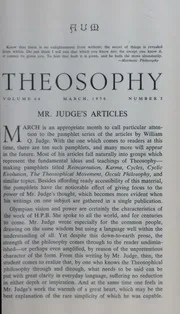
Theosophy Vol-51,No-3,January 1963

 73
73

Theosophy Vol-51,No-3,January 1963



Review by Cassian Rothmann (Senior Critic, Ancient Wisdom) — This January 1963 edition of Theosophy magazine offers a rich tapestry of esoteric thought, characteristic of its esteemed publication. The anonymous contributors skillfully navigate complex philosophical terrains, presenting profound spiritual concepts with clarity and depth. The issue excels in its exploration of hidden knowledge, providing readers with potent insights into universal laws and the nature of consciousness. It is a valuable resource for seasoned students of the occult and those beginning their journey into theosophical studies. The articles serve as guiding lights, illuminating the subtle pathways of spiritual evolution and encouraging a more profound engagement with life's mysteries. A truly insightful and edifying read for the dedicated seeker.
📝 Description
73
The January 1963 issue of Theosophy, Volume 51, Number 3, presents inquiries into consciousness and the human spirit.
This 1963 issue of Theosophy delves into subjects concerning consciousness and the potential of the human spirit. It examines the universe's structure and the symbolic language thought to underlie existence. The content encourages quiet reflection and personal discovery. The journal is for individuals interested in subtle energies, older philosophies, and the pursuit of spiritual knowledge.
This edition reflects mid-20th century discussions within esoteric thought. It highlights theosophical ideas that aim to guide individuals toward self-understanding and a greater awareness of the cosmos. The articles touch upon perennial philosophies that have historically informed the search for enlightenment.
This issue belongs to the Theosophical tradition, which emerged in the late 19th century, seeking to synthesize Eastern and Western mystical and philosophical thought. It draws from concepts found in Hinduism, Buddhism, and Western esotericism, aiming to understand the hidden laws of nature and the spiritual evolution of humanity. Theosophy often addresses topics like reincarnation, karma, and the nature of the divine, seeking to bridge the gap between science, religion, and philosophy.
💡 Why Read This Book?
Unlock timeless esoteric knowledge and explore the foundational principles of spiritual evolution. This issue offers profound philosophical insights, encouraging self-discovery and a deeper understanding of universal truths. It's an essential read for seekers of hidden wisdom, students of comparative religion, and practitioners dedicated to inner transformation. Engage with wisdom that transcends the mundane and illuminates the path to higher consciousness.
⭐ Reader Reviews
Honest opinions from readers who have explored this book.
❓ Frequently Asked Questions
What is Theosophy?
Theosophy is a mystical philosophy that seeks to understand the underlying principles of all religions and philosophies, emphasizing the unity of existence and the divine potential within humanity. It explores esoteric doctrines and ancient wisdom traditions.
Who were the original authors of this content?
The specific authors for this 1963 issue are not explicitly identified within the provided details, which is common for some historical philosophical journals where the collective body of work is emphasized over individual attribution.
What is the significance of the publication date (January 1963)?
The 1963 publication date places this issue within a dynamic period of intellectual and spiritual exploration, reflecting mid-20th-century currents in esoteric thought and offering a historical perspective on theosophical discourse.
Is this book suitable for beginners?
While the topics can be profound, the clarity of presentation in Theosophy journals often makes them accessible to earnest beginners willing to engage with philosophical concepts and spiritual inquiry.
Where can I find more information on Theosophy?
Further exploration can be found through Theosophical Society publications, historical archives of esoteric literature, and scholarly works on comparative religion and mystical traditions.
🔮 Key Themes & Symbolism
The Architectonics of the Cosmos
This theme studies the intricate, unseen structures that govern the universe, exploring theosophical cosmology and the divine blueprint behind creation. It examines how universal laws manifest in both the macrocosm and the microcosm, offering a framework for understanding existence beyond the purely physical realm. Readers will gain insights into the interconnectedness of all things and the subtle energies that shape reality, fostering a profound appreciation for the order and intelligence inherent in nature.
The Unfolding of Human Consciousness
This section focuses on the evolutionary journey of the human spirit, exploring the stages of consciousness development and the inherent potential for spiritual awakening. It probes the nature of the soul, the influence of karma, and the pathways to transcending limitations. The articles aim to equip the reader with a deeper understanding of their own inner landscape, encouraging practices that foster spiritual growth and the realization of higher potentials, moving towards a more enlightened existence.
Symbolism in Esoteric Traditions
Here, the focus is on deciphering the collection of symbols that permeate ancient wisdom teachings and spiritual texts. This theme illuminates how allegories, myths, and archetypes serve as keys to unlocking profound metaphysical truths. By understanding the language of symbols, readers can access deeper layers of meaning within spiritual doctrines and gain a more nuanced perspective on the hidden messages embedded within cultural narratives and sacred writings, bridging the gap between the visible and the invisible.
💬 Memorable Quotes
Direct passages from the work, attributed to the author.
“The unseen is the architect of the seen.”
— This aphorism underscores the theosophical belief that the material world is a manifestation of deeper, spiritual realities, emphasizing the primary role of consciousness and subtle energies in shaping existence.
“Wisdom is not acquired, but remembered.”
— This implies a connection to innate spiritual knowledge, suggesting that true understanding comes from recalling our essential nature and the universal truths inherent within us.
“The path of evolution is the path of liberation.”
— This links spiritual growth and progress with the ultimate freedom from limitations, framing the evolutionary process as a journey towards self-realization and enlightenment.
“Silence is the crucible of profound understanding.”
— This emphasizes the importance of inner stillness and contemplation for gaining deep spiritual insight, suggesting that true wisdom emerges from quiet introspection.
💡 Key Ideas
Editorial paraphrase of the work's core concepts — not direct quotes.
Within each soul, a universe awaits discovery.
This quote highlights the vast inner potential and the concept of the microcosm reflecting the macrocosm, suggesting that self-exploration is a journey into infinite possibilities.
🌙 Esoteric Significance
Tradition
This issue is deeply rooted in the Theosophical tradition, which seeks to synthesize ancient wisdom from various cultures and religions. It draws upon principles of universalism, reincarnation, karma, and the evolution of consciousness, aiming to provide a comprehensive framework for understanding existence and humanity's place within the cosmos. Theosophy acts as a bridge between Eastern and Western esoteric thought, offering a unique perspective on spiritual science and practical occultism.
Symbolism
The content likely employs detailed symbolism, drawing from universal archetypes, alchemical imagery, and astrological correspondences. Symbols serve as keys to unlocking deeper metaphysical truths, representing abstract concepts like divine principles, stages of spiritual development, and the interconnectedness of all planes of existence. Understanding this symbolic language is crucial for grasping the profound, multi-layered meanings embedded within theosophical teachings and esoteric philosophies.
Modern Relevance
The perennial wisdom explored in this 1963 issue remains profoundly relevant today. In an era often characterized by information overload and spiritual fragmentation, theosophical insights offer a grounding in universal principles, emphasizing inner development, ethical living, and the interconnectedness of all beings. The exploration of consciousness, symbolism, and the deeper purpose of life provides a valuable compass for navigating contemporary challenges and fostering individual and collective transformation.
👥 Who Should Read This Book
This issue is a treasure for dedicated seekers of ancient wisdom and profound philosophical inquiry. Scholars of comparative religion, mysticism, and occultism will find valuable historical context and in-depth analysis. Practitioners of meditation, spiritual disciplines, and those on a path of self-realization will discover useful concepts and guiding principles. Even curious beginners drawn to the mysteries of existence will find accessible entry points into the vast range of esoteric thought, offering a gateway to deeper understanding and personal growth.
📜 Historical Context
Published in January 1963, this issue of Theosophy magazine emerges from a period of significant global transformation and burgeoning interest in spiritual and philosophical alternatives. The mid-20th century witnessed the aftermath of world wars, the rise of existentialism, and an increasing questioning of purely materialistic worldviews. Simultaneously, there was a growing curiosity about Eastern philosophies, mysticism, and the perennial wisdom traditions. Theosophy, with its emphasis on universal brotherhood, comparative religion, and the study of ancient doctrines, found fertile ground during this era. This specific issue likely reflects ongoing debates and explorations within the theosophical movement, contributing to a broader intellectual milieu that sought deeper meaning and spiritual coherence in a rapidly changing world. It offers a valuable window into the esoteric discourse of its time, influencing seekers and scholars alike.
📔 Journal Prompts
Reflect on a symbol from this issue that appeals to your personal journey. What deeper meaning does it hold for you?
Consider the concept of 'unseen architects.' How do you perceive unseen forces influencing your life and the world around you?
How does the idea of 'remembered wisdom' challenge your current understanding of learning and knowledge acquisition?
Explore the connection between the 'path of evolution' and your personal aspirations for growth and liberation.
What role does 'silence' play in your life, and how could you cultivate it further for deeper understanding?
🗂️ Glossary
Theosophy
A mystical philosophy that seeks to understand the underlying principles of all religions and philosophies, emphasizing the unity of existence and the divine potential within humanity. It explores esoteric doctrines and ancient wisdom traditions.
Esoteric
Relating to or intended only for a small number of people with a specialized knowledge or interest. In a spiritual context, it refers to hidden or inner teachings accessible through intuition and spiritual insight.
Macrocosm
The universe considered as a complex whole, in contrast to the microcosm. In Theosophy, it represents the greater world or universal order.
Microcosm
The human being or a small part considered as mirroring the universe or a larger whole. In Theosophy, it represents the individual reflecting the universal principles.
Perennial Philosophy
The concept that there is one fundamental truth or spiritual reality that underlies all the world's religions and spiritual traditions, often referred to as the perennial wisdom.
This book appears in 2 collections
🔮 Readers Also Liked
Browse all →







From the “Theosophy” Collection
View all →

More Free Theosophy & Anthroposophy Books
View all →