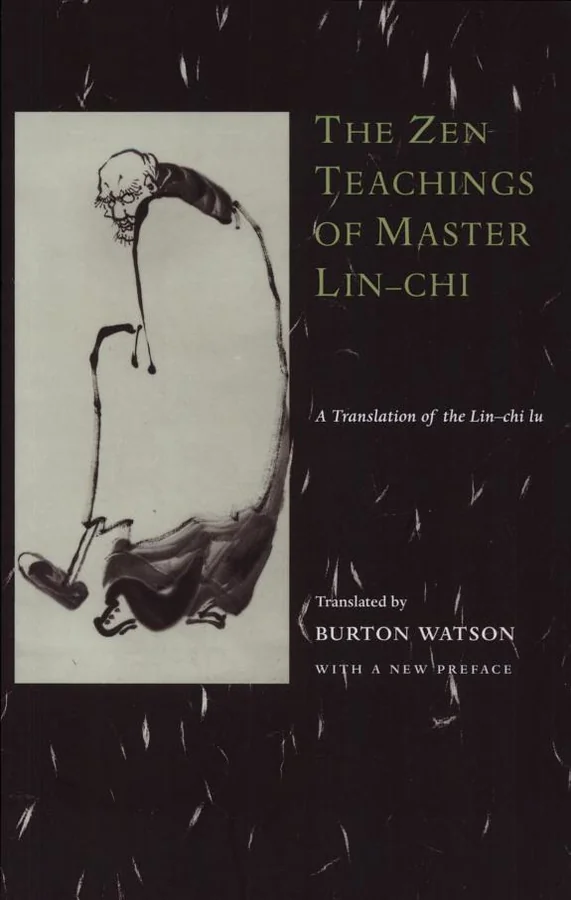
The Zen Teachings of Master Lin-chi
 82
82

The Zen Teachings of Master Lin-chi
Burton Watson's translation of The Zen Teachings of Master Lin-chi offers a stark, unvarnished window into the mind of a pivotal T'ang Dynasty Buddhist master. Unlike many devotional texts, Lin-chi's discourses, as rendered here, are often abrasive, demanding, and designed to shock the reader out of complacency. Watson's scholarship is evident in the clarity and precision of the language, allowing Lin-chi's distinctive voice to come through. A particular strength is the book's directness; passages where Lin-chi dismisses conventional understanding of Buddhist concepts – such as his repeated admonitions against seeking for Buddhas or Dharma outside of oneself – are powerfully effective. However, the very directness that makes Lin-chi compelling can also be a limitation for the uninitiated reader. Without extensive background, the seemingly contradictory pronouncements might appear nihilistic rather than revelatory. The work’s value lies not in gentle guidance, but in its radical insistence on self-reliance and the immediacy of awakening. It is an essential, albeit challenging, text for anyone serious about understanding the roots of Zen.
📝 Description
82
Master Lin-chi's direct discourses from the ninth century are collected in this volume.
The Zen Teachings of Master Lin-chi brings together the recorded sermons, dialogues, and encounters of a major figure in Chinese Chan Buddhism. Master Lin-chi, who lived in the 9th century during the T'ang Dynasty, was known for his confrontational style. This translation by Burton Watson makes his teachings accessible to a modern audience. The collection moves beyond abstract concepts to focus on the direct experience of spiritual awakening.
This book is for serious students of Buddhism, especially those interested in the historical development and practical aspects of Chan/Zen. Scholars of East Asian religions and comparative philosophy will also find it valuable. Readers who prefer direct instruction over devotional language will appreciate its unadorned approach. It requires dedication but provides deep access to Lin-chi's thought.
Master Lin-chi's teachings belong to the Lin-chi school of Chan Buddhism, later known as Rinzai Zen in Japan. This tradition emphasized a direct, experiential understanding of enlightenment, often contrasting with more intellectual or gradualist approaches. His emphasis on immediate realization and the use of startling methods to break through students' conceptual barriers places him within a lineage that prioritized awakened perception over doctrinal study.
💡 Why Read This Book?
• Understand the "death of the Buddha" concept as Lin-chi intended it – not as a historical event, but as the radical shedding of all fixed ideas and conceptual attachments that obscure one's true nature, as explored in his discourses. • Gain insight into the "man of no-rank" motif, a central idea in Lin-chi's teachings, representing an enlightened individual liberated from all worldly and spiritual hierarchies. • Apprehend the practical application of "mind-only" (citta-matra) in shattering illusions and directly realizing one's inherent Buddha-nature, a core tenet emphasized throughout the collected sermons.
⭐ Reader Reviews
Honest opinions from readers who have explored this book.
❓ Frequently Asked Questions
Who was Master Lin-chi and when did he live?
Master Lin-chi I-hsuan was a prominent Chinese Chan Buddhist monk who lived during the mid-ninth century CE, a period often referred to as the Golden Age of Chinese Buddhism.
What is the "great matter" that Master Lin-chi discusses?
The "great matter" refers to the fundamental issue of birth and death, which Lin-chi urged his disciples to confront directly and without evasion, as the key to spiritual liberation.
What is the significance of the T'ang Dynasty in relation to Lin-chi's teachings?
Lin-chi taught during the T'ang Dynasty (618-907 CE), a vibrant era for Chinese Buddhism. His teachings from this period profoundly influenced the development and transmission of Chan Buddhism.
How does Lin-chi's teaching style differ from other Buddhist masters?
Lin-chi was known for his direct, often confrontational style, using paradoxes and strong language to break through disciples' conceptual thinking, unlike more conventional or scholarly approaches.
What is the Japanese equivalent of the Lin-chi school of Buddhism?
The Lin-chi school of Buddhism in China is known as the Rinzai school in Japan, one of the major Zen lineages that greatly influenced Japanese spiritual and cultural history.
Is this book suitable for beginners in Zen?
While informative, the text's direct and sometimes challenging nature makes it more suitable for those with some prior understanding of Buddhist or Zen concepts, rather than absolute beginners.
🔮 Key Themes & Symbolism
Direct Apprehension of Mind
Lin-chi relentlessly directs practitioners to look inward, emphasizing that the mind itself is the Buddha. He criticizes reliance on external scriptures, rituals, or even the concept of enlightenment as a future attainment. The teaching centers on the immediate, direct realization of one's true nature, which is unconditioned and ever-present. This theme is crucial for understanding the active, non-dualistic approach of Chan Buddhism, urging a complete abandonment of intellectualization in favor of experiential knowing.
The "Death of the Buddha"
This concept, central to Lin-chi's discourse, is not about the historical passing of Siddhartha Gautama but signifies the annihilation of all fixed concepts, attachments, and dualistic thinking. It represents a radical letting go, a complete emptying of the self that allows for the unhindered manifestation of innate wisdom. Lin-chi uses this idea to provoke disciples into questioning their ingrained beliefs about Buddhist practice and liberation, pushing them towards a state of pure being.
The "Man of No-Rank"
Lin-chi's teachings often describe the awakened individual as the "man of no-rank." This figure is liberated from all social, spiritual, and conceptual hierarchies. They operate from a place of pure awareness, free from the burdens of ego, worldly status, or even conventional religious attainment. This concept underscores the Chan emphasis on egalitarianism in spiritual realization, suggesting that awakening is accessible to anyone, regardless of their background or perceived spiritual standing.
Confrontational Pedagogy
A defining characteristic of Lin-chi's approach is his confrontational teaching style. He employed shouts, blows, and paradoxical pronouncements to jolt students out of their habitual patterns of thought and delusion. This method, often termed "katsu" in Japanese Rinzai Zen, aimed to bypass intellectual understanding and trigger a direct, visceral experience of awakening. It highlights the belief that true realization often requires a radical disruption of the ego's defenses.
💬 Memorable Quotes
Direct passages from the work, attributed to the author.
“Stop seeking for Buddhas and stop discriminating against sentient beings.”
— This statement captures Lin-chi's core message: liberation comes not from pursuing an external ideal or judging one's current state, but from recognizing the inherent Buddha-nature already present, free from conceptualization and duality.
“I have no special Dharma to give you.”
— Lin-chi often expressed that he possessed no unique or secret teachings. This is meant to dismantle the disciple's expectation of receiving special knowledge, redirecting them to their own immediate experience as the source of truth.
“When you are hungry, eat; when you are tired, sleep.”
— These seemingly simple instructions are profound reminders to live fully in the present moment, without striving or attachment. They point to the integration of spiritual practice into ordinary, everyday activities.
“If you meet the Buddha on the road, kill him.”
— This provocative statement warns against attachment to any concept or image of enlightenment, even the Buddha himself. It signifies the need to destroy all conceptual frameworks, including spiritual ones, to achieve true freedom.
“The man of no-rank is working in the world.”
— This refers to the awakened individual who lives and acts in the world without being bound by worldly concerns or spiritual pretensions. They are free from ego and operate with pure awareness.
🌙 Esoteric Significance
Tradition
While rooted in Mahayana Buddhism, Lin-chi's teachings possess a distinctly esoteric quality due to their emphasis on direct, non-conceptual realization, bypassing the elaborate philosophical systems often associated with exoteric Buddhism. His methods align with the practical, experiential focus found in many esoteric traditions that seek immediate transformation of consciousness, rather than gradual intellectual assimilation of doctrine. The lineage emphasizes the transmission of awakened mind from master to disciple, a hallmark of esoteric spiritual paths.
Symbolism
The concept of the "man of no-rank" serves as a potent symbol of liberated consciousness, free from the social and psychological conditioning that binds ordinary individuals. The "death of the Buddha" symbolizes the annihilation of the conceptual self and all fixed spiritual ideas, clearing the ground for direct experience. Lin-chi's use of paradoxical language and sudden shouts functions symbolically as a 'diamond sword' or 'thunderclap,' designed to instantly sever delusion.
Modern Relevance
Contemporary practitioners of Zen, particularly within the Rinzai school, continue to engage directly with Lin-chi's teachings. Furthermore, his emphasis on confronting reality without illusion and his radical approach to self-inquiry resonate with modern mindfulness movements and even certain psychological therapies that focus on breaking down cognitive distortions and fostering present-moment awareness. Thinkers exploring non-dualistic philosophies often cite Lin-chi as a primary source for understanding direct realization.
👥 Who Should Read This Book
• Students of Zen Buddhism seeking to understand the foundational teachings and direct methods of the Rinzai lineage. • Scholars of East Asian religions and philosophy interested in the historical development of Chan Buddhism during the T'ang Dynasty. • Individuals drawn to direct, experiential spiritual paths who are prepared for challenging and unconventional instruction.
📜 Historical Context
Master Lin-chi I-hsuan's teachings emerged during the mid-ninth century, a period of immense vitality and influence for Chinese Buddhism, particularly Chan. This era, part of the T'ang Dynasty, saw Buddhism deeply integrated into Chinese society, though not without occasional tension, as evidenced by the Great Anti-Buddhist Persecution of 845 CE, which occurred shortly before Lin-chi's peak influence. Lin-chi's distinctive, often harsh, teaching style represented a significant development within Chan, diverging from more contemplative or scholarly approaches. His emphasis on direct experience and the shattering of conceptual frameworks became foundational for the Lin-chi school, which later flourished in Japan as Rinzai Zen. Contemporaries like Guishan Lingyou and Yangshan Huiji were also prominent figures shaping the range of Chan Buddhism, yet Lin-chi's lineage would prove particularly enduring, profoundly influencing later masters such as Hakuin Ekaku in the 18th century.
📔 Journal Prompts
The "man of no-rank" and your own place in the world.
Reflection on Lin-chi's imperative: 'When you are hungry, eat; when you are tired, sleep.'
How does the concept of the "death of the Buddha" challenge your assumptions about spiritual practice?
Identify one instance where Lin-chi's confrontational style might be applicable to your own thought patterns.
Considering the "mind-only" principle, what conceptual barriers hinder your direct perception?
🗂️ Glossary
Chan Buddhism
A school of Mahayana Buddhism that originated in China, emphasizing meditation and direct experience of enlightenment. Known as Zen in Japan.
T'ang Dynasty
A significant imperial dynasty in Chinese history (618–907 CE), often considered a golden age for art, culture, and Buddhism.
Dharma
In Buddhism, the teachings of the Buddha, the cosmic law, or the ultimate truth. Can also refer to phenomena or elements of existence.
Buddha-nature
The inherent potential for all sentient beings to attain enlightenment; the fundamental, pure essence of mind.
Sentient beings
All beings that possess consciousness and the capacity to feel or perceive.
Mind-only (Citta-matra)
A key concept in Yogacara Buddhism, suggesting that reality is fundamentally consciousness or mind, and external objects are manifestations of it.
Enlightenment
The ultimate goal in Buddhism; a state of profound wisdom, compassion, and liberation from suffering and the cycle of rebirth.
This book appears in 1 collection
🔮 Readers Also Liked
Browse all →









From the “Zen Buddhism” Collection
View all →









More Free Occult Philosophy Books
View all →