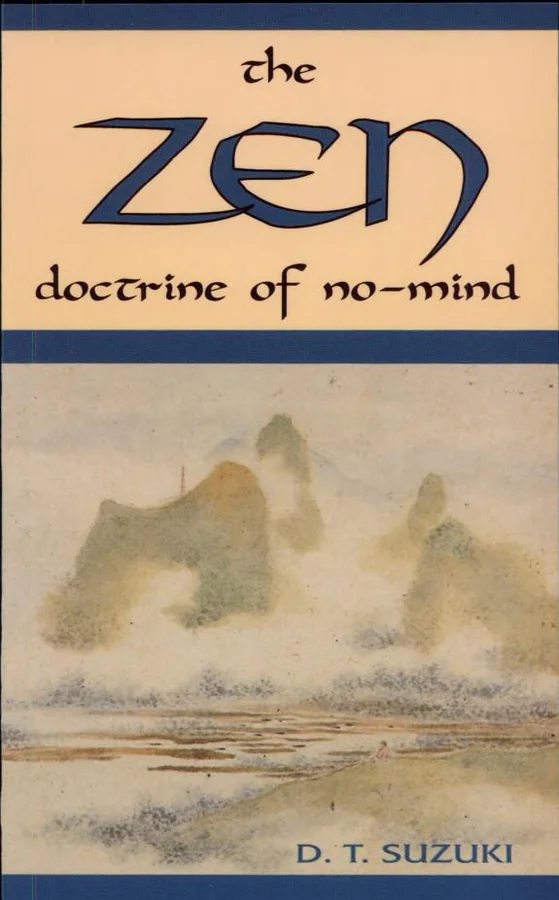
The Zen Doctrine of No Mind
 79
79

The Zen Doctrine of No Mind
Suzuki's examination of Hui Neng’s teachings in *The Zen Doctrine of No Mind* bypasses the common pitfalls of academic detachment and overly devotional prose, offering instead a direct confrontation with the practical implications of Zen training. The strength lies in its unflinching presentation of 'no mind' not as a passive state but as an active, unconditioned awareness. Suzuki’s explanation of how one moves beyond the perceived self, particularly in his analysis of the Sixth Patriarch’s struggle with the sutra’s words, is particularly compelling. However, the text occasionally assumes a prior familiarity with Buddhist terminology that might leave newcomers adrift. A limitation is the dense prose, which, while precise, demands significant reader concentration. The passage describing the mind as a mirror, reflecting without clinging, serves as a potent illustration of the doctrine's core. The book serves as a rigorous, if demanding, guide to understanding a radical approach to consciousness.
📝 Description
79
Daisetz Teitaro Suzuki's 1991 book details Ch'an Buddhism's core tenets through Hui Neng.
This volume examines the essential teachings of Ch'an Buddhism, focusing on the Sixth Patriarch, Hui Neng. Daisetz Teitaro Suzuki explains the methods of Zen training, encouraging practitioners to move beyond ordinary conceptual thought. The book stresses direct, experiential understanding over reliance on scriptures. It presents a path toward consciousness free from the divisions of dualistic thinking, aiming for an unhindered awareness.
It is suitable for serious students of Buddhism, especially those interested in Mahayana traditions and the historical development of Zen in East Asia. Practitioners seeking to deepen their meditation techniques and grasp non-dual philosophy will find value here. Scholars of comparative religion and Asian philosophy can use it as a detailed guide to a key Zen lineage. The work reflects a period of growing Western interest in Eastern thought.
The book engages with the lineage of Hui Neng, a central figure in the development of Ch'an Buddhism. This tradition emphasizes innate enlightenment, contrasting with more scholastic or devotional Buddhist schools. Suzuki's work connects this lineage to the mid-20th century surge of Western interest in Zen, offering analysis of its textual foundations and experiential practices.
💡 Why Read This Book?
• Understand the core of 'no mind' (wu-hsin) as presented through Hui Neng's lineage, moving beyond simplistic interpretations of emptiness to grasp its active, liberating quality. • Grasp the practical application of Zen training techniques that aim to transcend dualistic thinking, as detailed in the book’s sections on purpose and method. • Connect with the historical transmission of Ch'an Buddhism, appreciating the emphasis on direct experience over scriptural dogma, a stance central to the Sixth Patriarch's teachings.
⭐ Reader Reviews
Honest opinions from readers who have explored this book.
❓ Frequently Asked Questions
What is the central teaching of The Zen Doctrine of No Mind?
The central teaching is 'no mind' (wu-hsin), which refers to a state of pure, unconditioned awareness free from ego-driven thoughts and dualistic perception, as expounded through the teachings of Hui Neng.
Who was Hui Neng and why is he significant in Zen Buddhism?
Hui Neng (638-713 CE) was the Sixth Patriarch of Ch'an Buddhism, credited with establishing the Southern School of sudden enlightenment, emphasizing innate Buddhahood and direct experience over gradual cultivation.
Does the book rely heavily on Buddhist scriptures?
No, the book, reflecting Hui Neng's philosophy, emphasizes transcending reliance on scripture. While it references texts like the Diamond Sutra, the focus is on direct realization rather than textual study alone.
What does Suzuki mean by 'going beyond thought'?
Suzuki uses this phrase to describe the Zen practice of observing thoughts without identifying with them, allowing the mind to return to its natural, clear state of awareness, unburdened by conceptualization.
Is this book suitable for beginners in Zen?
While valuable, the book delves deeply into complex philosophical concepts. Beginners might find it more accessible after some foundational study of Buddhist principles and meditation.
When was The Zen Doctrine of No Mind first published?
The original publication date for this specific edition is August 1, 1991, though it draws upon earlier works and scholarship by D.T. Suzuki.
🔮 Key Themes & Symbolism
The Nature of No Mind
This theme explores 'wu-hsin,' the doctrine of no mind, presenting it not as a void but as an awakened consciousness free from egoic interference and conceptual duality. It details how the mind, when unconditioned, naturally reflects reality without attachment or aversion, akin to a clear mirror. Suzuki elucidates that this state is achieved not through suppression but through understanding the illusory nature of the self and phenomena.
Zen Training Methodology
The book details the practical methods employed in Zen training, focusing on the path illuminated by Hui Neng. It moves beyond mere theoretical exposition to describe the experiential process of realizing 'no mind.' This involves direct insight, often facilitated by a master, into the mind's true nature, emphasizing sudden enlightenment over gradual accumulation of merit or knowledge.
Beyond Scriptural Reliance
A core tenet discussed is the critique of over-reliance on scriptures and external saviors. The work highlights Hui Neng's emphasis on the inherent Buddha-nature within each individual, accessible through direct personal experience rather than adherence to dogma or ritual. This positions Zen as a path of immediate, inner realization.
Consciousness Beyond Duality
This theme addresses the Zen aspiration to move beyond the perceived separation between subject and object, self and other, mind and world. Suzuki explains how 'no mind' facilitates this by dissolving the conceptual frameworks that create these divisions, leading to a unified perception of reality and a state of non-dual awareness.
💬 Memorable Quotes
Direct passages from the work, attributed to the author.
“The mind is like a mirror; it should be kept clean and bright.”
— This analogy illustrates the ideal state of 'no mind' as pure, unobstructed awareness. The mind should reflect phenomena as they are, without clinging to impressions or allowing defilements of ego and desire to cloud its clarity.
“To know all things, one must know the mind.”
— This highlights the introspective nature of Zen. By understanding the workings and true nature of one's own mind, one gains the key to comprehending the entirety of existence, as the mind is the ground of all perception.
“When you encounter the wicked, do not let your mind be defiled.”
— This speaks to the practice of maintaining equanimity and non-reactivity. Despite external circumstances or interactions, the practitioner aims to preserve the purity and clarity of their 'no mind' state, unaffected by negativity.
“The essence of the teaching is to see into one's own nature.”
— This captures the direct, experiential goal of Zen. The ultimate aim is not intellectual accumulation but the direct, intuitive realization of one's fundamental, unconditioned self or Buddha-nature.
💡 Key Ideas
Editorial paraphrase of the work's core concepts — not direct quotes.
The Dharma is in the world; enlightenment is not separate from the world.
This quote emphasizes that spiritual realization is not found in ascetic withdrawal or abstract contemplation alone, but within the context of everyday life and worldly experience. True practice integrates understanding with action.
🌙 Esoteric Significance
Tradition
This work is foundational to the modern dissemination of Ch'an (Zen) Buddhism, a Mahayana tradition with deep roots in East Asia. While not typically categorized within Western esoteric lineages like Hermeticism or Kabbalah, Zen shares with them an emphasis on direct inner experience, the dissolution of the ego, and the attainment of gnosis or direct knowledge of reality. Suzuki’s presentation bridges Eastern contemplative practice with Western philosophical inquiry, making these esoteric concepts accessible.
Symbolism
The concept of 'no mind' itself functions symbolically, representing a state of pure consciousness unburdened by conceptual overlays. The 'mirror' metaphor, frequently invoked, symbolizes the mind's capacity to reflect reality clearly and impartially, without distortion or attachment. The 'Prajna Paramita Sutras,' particularly the Diamond Sutra, serve as symbolic guides, pointing towards emptiness (sunyata) and the illusory nature of phenomena, which are key to realizing the unconditioned mind.
Modern Relevance
Suzuki's interpretation of Hui Neng's teachings continues to influence contemporary mindfulness movements, secularized Buddhist practices, and various schools of psychotherapy that incorporate meditative elements. Thinkers and practitioners in fields ranging from cognitive science to contemplative neuroscience draw upon the principles articulated here to understand consciousness, attention, and the nature of the self. Its emphasis on non-dual awareness remains highly relevant for those seeking alternatives to fragmented modern existence.
👥 Who Should Read This Book
• Students of Mahayana Buddhism seeking a deep dive into the Ch'an tradition, particularly the influential lineage of Hui Neng, to understand its philosophical underpinnings and practice. • Meditators and contemplative practitioners aiming to move beyond basic mindfulness techniques towards a more profound realization of non-dual awareness and the nature of mind. • Scholars of comparative religion and Asian philosophy interested in the historical development of Buddhism in East Asia and its distinct emphasis on experiential insight.
📜 Historical Context
Daisetz Teitaro Suzuki's *The Zen Doctrine of No Mind*, first published in its current form in 1991, emerged from a rich intellectual lineage that profoundly shaped Western understanding of East Asian Buddhism. Suzuki himself was a key figure, whose writings throughout the mid-20th century introduced concepts like Zen and Satori to Western audiences, influencing thinkers such as Erich Fromm and Thomas Merton. This particular work focuses on the teachings of Hui Neng (638-713 CE), the Sixth Patriarch of Ch'an Buddhism, whose emphasis on sudden enlightenment and innate Buddhahood represented a significant departure from earlier, more scholastic Buddhist schools. Suzuki’s exposition arrived during a period of burgeoning interest in Eastern spirituality, particularly Zen, which offered an alternative to Western materialism and existentialism. While rival schools like Pure Land Buddhism focused on devotion to Amitabha, and scholastic traditions emphasized doctrinal study, Suzuki championed the direct, experiential path of Ch'an, making this book a key text for those seeking a non-dualistic spiritual practice.
📔 Journal Prompts
The mind as a mirror: How does attachment to transient thoughts obscure your perception of reality?
Hui Neng's emphasis on direct realization: Reflect on a moment where understanding bypassed intellectual effort.
The practice of 'no mind': Explore the challenges and liberation in observing thoughts without identification.
Transcending duality: Consider how concepts like 'good' and 'bad' shape your experience and whether they reflect ultimate reality.
Scripture versus experience: How has reliance on external validation hindered your inner inquiry?
🗂️ Glossary
No Mind (Wu-Hsin)
The central doctrine, referring to a state of pure, unconditioned awareness free from ego-centric thoughts, judgments, and dualistic perceptions. It is not a void but an active, clear consciousness.
Hui Neng
The Sixth Patriarch of Ch'an (Zen) Buddhism, revered for his teachings on sudden enlightenment and the inherent Buddha-nature, emphasizing direct experience over scholasticism.
Ch'an Buddhism
The East Asian school of Buddhism that developed from Indian Mahayana traditions, emphasizing meditation and direct insight into the nature of mind. Known as Zen in Japan.
Duality
The conceptual division of reality into opposing pairs, such as subject/object, self/other, mind/body. Zen practice aims to transcend these perceived separations.
Prajna Paramita
Literally 'perfection of wisdom.' A body of Mahayana Buddhist literature emphasizing emptiness (sunyata) and the wisdom that perceives reality as it truly is.
Satori
A Japanese Buddhist term for a sudden or intuitive enlightenment or awakening. Often associated with Zen practice.
Sunyata
The Sanskrit term for emptiness, voidness. In Mahayana Buddhism, it refers to the lack of inherent existence or self-nature in all phenomena.
This book appears in 1 collection
🔮 Readers Also Liked
Browse all →







From the “Zen Buddhism” Collection
View all →









More Free Sacred Texts & Gnosticism Books
View all →