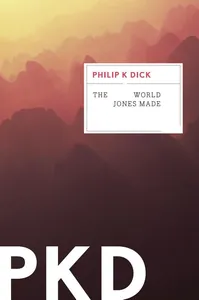
The world Jones made

 81
81

The world Jones made
Philip K. Dick’s ‘The World Jones Made’ is less a narrative and more a conceptual experiment conducted on paper. The premise – a man who definitively sees the future – is potent, and Dick uses it to dissect the philosophical quandaries of free will and determinism with characteristic intensity. The strength lies in its relentless exploration of this single, overwhelming idea, forcing the reader to confront the implications of a truly foreknown existence. However, the novel’s character development often feels secondary to its thematic ambitions; the individuals within the story serve more as conduits for Dick’s philosophical inquiries than fully realized beings. A passage where Jones grapples with the futility of his knowledge, knowing an event will occur but being unable to prevent the emotional fallout, crystallizes the book’s core tension. Ultimately, it’s a stark, intellectually rigorous work that sacrifices emotional resonance for its ambitious conceptual framework.
📝 Description
81
Philip K. Dick's 1988 novel, 'The World Jones Made,' posits a protagonist who sees the future with absolute clarity.
Jones, the central figure in Philip K. Dick's 'The World Jones Made,' possesses an unfettered ability to perceive all future events. This perfect foresight, rather than granting agency, raises questions about free will when destiny appears fixed. The narrative examines the psychological weight of knowing what is to come, turning Jones into an oracle whose pronouncements shape the world around him.
The novel, published in 1988, revisits themes common in Dick's work, such as the nature of reality and the limits of human perception. It enters into a dialogue with philosophical ideas of determinism and predestination, particularly relevant in the late 1980s context of postmodern and existentialist thought. Dick's exploration of a known future probes the impact on individual choice and the very structure of existence.
Published posthumously in 1988, 'The World Jones Made' engages with occult traditions concerning prophecy and predestination. Dick frequently explored how divine or supernatural knowledge impacts human consciousness, mirroring Gnostic ideas about a predetermined fate and the struggle for authentic perception. The book’s focus on an oracle whose knowledge dictates reality echoes ancient oracles whose pronouncements were seen as immutable truths, challenging the notion of individual agency within a seemingly fated cosmos.
💡 Why Read This Book?
• Gain insight into the philosophical implications of absolute precognition, as explored through Jones's unique ability to see every future event with certainty, challenging notions of free will. • Understand the psychological burden of knowing one's entire life path, a concept examined by Dick in the context of a predetermined future in 'The World Jones Made'. • Explore the late-career thematic concerns of Philip K. Dick, particularly his fascination with the nature of reality and human perception, as articulated in this 1988 novel.
⭐ Reader Reviews
Honest opinions from readers who have explored this book.
❓ Frequently Asked Questions
What is the central premise of Philip K. Dick's 'The World Jones Made'?
The book's central premise is about a man named Jones who possesses perfect precognition, meaning he can see the entire future with absolute certainty. This ability drives the narrative, exploring its profound impact on his life and the world.
When was 'The World Jones Made' first published?
'The World Jones Made' was first published in 1988, several years after Philip K. Dick's passing in 1982.
What philosophical concepts does 'The World Jones Made' explore?
The novel deeply explores philosophical concepts such as determinism versus free will, the nature of reality, the limits of human perception, and the psychological consequences of absolute knowledge.
Is 'The World Jones Made' related to other Philip K. Dick works?
Yes, it revisits many of Dick's recurring themes, including the questioning of reality, the nature of consciousness, and the uncanny, which are present in works like 'Do Androids Dream of Electric Sheep?' and 'Ubik'.
What is the role of 'Jones' in the narrative?
Jones is the protagonist whose absolute precognitive ability forms the core of the story. He functions as an oracle whose knowledge creates both fascination and fear, highlighting the paradoxes of a predetermined future.
Does the book offer solutions to the problems of free will?
Rather than offering solutions, 'The World Jones Made' presents a stark examination of the problems. It uses Jones's situation to highlight the tension between knowing the future and the human desire for agency.
🔮 Key Themes & Symbolism
Absolute Precognition and Determinism
The novel grapples with the philosophical ramifications of absolute precognition, embodied by the character Jones. His perfect knowledge of all future events posits a deterministic universe where free will appears to be an illusion. This concept challenges readers to consider if foreknowledge negates choice, or if the knowledge itself becomes a new form of agency. The narrative questions whether such an unfettered view of time leads to enlightenment or despair, as Jones must live with the certainty of every joy and sorrow to come.
The Nature of Reality and Perception
Dick consistently questions the solidity of reality, and 'The World Jones Made' is no exception. Jones's ability to perceive the future transcends ordinary human perception, blurring the lines between what is happening now and what is yet to occur. The work prompts reflection on how our own perceptions shape our reality and whether an objective, immutable reality exists independently of our awareness. The narrative suggests that our understanding of existence is inherently limited and subjective.
The Burden of Knowledge
Possessing absolute foresight comes at a profound personal cost. The book examines the psychological burden carried by Jones, who is aware of every tragedy, loss, and painful moment that awaits him and others. This theme explores the idea that knowledge, particularly knowledge of inevitable suffering, can be a source of immense distress and isolation. It questions whether omniscience is a blessing or a curse when faced with the unchangeable course of events.
Societal Impact of Prophecy
The existence of a perfect prophet like Jones would inevitably reshape society. 'The World Jones Made' examines how such an individual might be perceived and utilized by authorities, or how their pronouncements could incite fear and chaos. The narrative explores the tension between the desire for certainty and the potential for manipulation when future events are known. It probes the ethical dilemmas of using or suppressing such profound foresight for the perceived greater good.
💬 Memorable Quotes
Direct passages from the work, attributed to the author.
“I know what will happen. I have seen it all.”
— This statement expresses Jones's unique predicament. It's not just a prediction; it's a statement of absolute certainty that frames his entire existence and the narrative's exploration of determinism.
“What is the point of living, if every moment is already written?”
— This question directly addresses the philosophical conflict at the heart of the book: the tension between absolute foreknowledge and the human experience of choice and meaning.
“They fear what they cannot control, and I am the ultimate loss of control.”
— This highlights the societal reaction to Jones's ability. His perfect foresight makes him an anomaly, a symbol of the unknown and uncontrollable future that others try to grasp or suppress.
“The future is a solid thing, and I am merely walking through it.”
— This interpretation by Jones emphasizes the immutable nature of the future as he perceives it, portraying himself not as an agent of change, but as a passive observer of a pre-ordained path.
“Even knowing the end does not change the journey's pain.”
— This poignant observation underscores the book's examination of the burden of knowledge, suggesting that foresight does not alleviate the suffering inherent in life's predetermined events.
🌙 Esoteric Significance
Tradition
While not explicitly rooted in a single esoteric tradition, 'The World Jones Made' echoes Gnostic themes of a flawed, deterministic cosmos and the struggle for gnosis (knowledge) within it. The protagonist, Jones, possesses a form of absolute knowledge that sets him apart from the unenlightened masses, similar to the Gnostic concept of the elect who possess divine insight. His struggle with this knowledge and its implications for free will aligns with Gnostic critiques of a creator deity's potentially imperfect or controlling design.
Symbolism
The primary symbolic element is Jones himself, representing the burden and paradox of absolute foresight. His ability can be seen as a metaphor for a form of divine or cosmic awareness that transcends linear time. The concept of a predetermined future, which Jones perceives, symbolizes the illusory nature of free will within certain philosophical or theological frameworks, akin to the chains of fate described in various mystical traditions. The 'future' itself, as a tangible entity Jones navigates, represents the unfolding of destiny.
Modern Relevance
Contemporary discussions in transhumanism and artificial intelligence often touch upon themes of augmented perception and foreknowledge, drawing parallels with Dick's work. Thinkers exploring consciousness uploading or predictive algorithms can find conceptual precursors in Jones's absolute precognition. The novel's persistent questioning of free will remains relevant in ongoing debates within neuroscience and philosophy of mind, particularly concerning predictive coding models of brain function and the illusion of conscious control.
👥 Who Should Read This Book
• Speculative fiction enthusiasts interested in philosophical depth, particularly those drawn to concepts of determinism and precognition. • Readers exploring the works of Philip K. Dick, seeking to understand his later thematic concerns regarding reality and consciousness. • Individuals interested in the intersection of science fiction and philosophy, especially those pondering the implications of knowing the future and its effect on human agency.
📜 Historical Context
Published in 1988, 'The World Jones Made' arrived in a literary landscape still processing the philosophical shifts of the late 20th century, a few years after Philip K. Dick's death in 1982. Dick's work, particularly his explorations of simulated realities and altered perceptions, found kinship with emerging post-modernist thought, though he predated many of its formal articulations. The novel's examination of determinism and absolute precognition resonated with ongoing debates in philosophy and science fiction concerning free will and the nature of time. Contemporaries like Ursula K. Le Guin were also deeply engaged with ethical and societal implications of speculative concepts, albeit through different narrative lenses. While Dick's reception was often fragmented during his lifetime, by the late 80s, his reputation as a visionary writer had solidified, with 'The World Jones Made' contributing to his legacy of challenging conventional notions of reality and human agency.
📔 Journal Prompts
Jones's absolute precognition: Reflect on a moment where you felt certain about a future outcome.
The burden of knowing: How might absolute foresight impact one's emotional state and daily life?
Perception versus reality: Consider how your own perception shapes your understanding of events.
The paradox of choice: If the future is known, what does 'choice' truly mean?
Societal reactions to the extraordinary: Explore how individuals or groups might respond to someone like Jones.
🗂️ Glossary
Precognition
The ability to perceive or know future events before they happen. In 'The World Jones Made,' this is depicted as absolute and unfailing knowledge.
Determinism
The philosophical stance that all events, including human cognition, decision, and action, are causally determined by an unbroken chain of prior occurrences. The novel heavily explores this concept.
Free Will
The capacity of agents to choose between different possible courses of action unimpeded. The novel questions the existence and relevance of free will in the face of absolute determinism.
Gnosis
In a general sense, spiritual or intellectual knowledge. In Gnostic traditions, it refers to a special, intuitive knowledge of divine mysteries, often possessed by an elite few.
Oracle
A person or agency considered to be a source of wise counsel or prophetic predictions inspired by a deity. Jones functions as a human oracle in the novel.
Post-modernism
A philosophical movement that questions the grand narratives and objective truths often associated with modernism, emphasizing skepticism, irony, and subjective experience.
Theosophy
A mystical philosophy that sought to unify the wisdom of all religions and philosophies, often exploring esoteric knowledge and spiritual evolution. While not directly named, themes of hidden knowledge resonate.
🔮 Readers Also Liked
Browse all →








More by Philip K. Dick
All books →


More Free Occult Philosophy Books
View all →