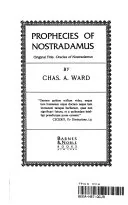
Prophecies of Nostradamus
 82
82

Prophecies of Nostradamus
Charles A. Ward’s 1993 reprint of Nostradamus’s "Prophecies" offers a direct encounter with the original text, a commendable feat given the centuries of commentary that often obscure the source. Ward’s biographical introduction, while brief, provides a necessary grounding for the enigmatic quatrains that follow. The strength of this edition lies in its fidelity to the structure and language of the 16th-century work. However, the lack of extensive annotation or comparative analysis of different interpretations leaves the reader somewhat adrift in the sea of Nostradamus's cryptic verses. A particularly striking passage is the opening quatrain of Century I, which, through its allegorical references to a "beast of the temple," sets a tone of arcane warning that defines much of the collection. While Ward presents the material, he largely refrains from guiding the reader through its labyrinthine meanings. This edition serves best as a foundational text for those already familiar with Nostradamus or committed to independent study.
📝 Description
82
Charles A. Ward compiled and introduced this 1911 edition of Nostradamus's "Les Propheties."
This volume reprints Michel de Nostredame's (Nostradamus) "Les Propheties," with an introduction and biographical sketch by Charles A. Ward. The book's primary content is the collection of quatrains, four-line verses that Nostradamus presented as forecasts of future events. Ward’s biographical notes place the 16th-century physician and astrologer within his historical setting. The original "Propheties" first appeared in Lyon in 1555, during the Renaissance, a time marked by intellectual curiosity and interest in subjects like astrology and alchemy.
The quatrains themselves are written in a mix of languages, including French, Latin, Greek, and Occitan, and are often intentionally obscure. This obscurity has led to centuries of varied interpretations. Ward’s edition aims to present the original verses, allowing readers to examine them apart from subsequent embellishments. The work is divided into "Centuries," each containing about 100 quatrains, employing a symbolic and allegorical style that presents significant challenges for direct translation and understanding.
Nostradamus's "Les Propheties" is a significant text within Western esoteric traditions, particularly concerning divination and political prophecy. Its blend of astrological observation, cryptic symbolism, and claims of foreknowledge places it alongside other Renaissance attempts to synthesize ancient wisdom with contemporary understanding of the cosmos. The work's lasting influence is tied to its ambiguous verses, which readers have applied to a wide range of historical and future events, positioning it as a key reference point for those interested in the history of prophecy and its role in occult philosophy.
💡 Why Read This Book?
• Gain direct access to the quatrains as originally presented by Nostradamus, allowing for independent analysis beyond secondary interpretations. • Understand the historical milieu of 16th-century Lyon and the intellectual climate that produced "Les Propheties" in 1555, contextualizing its creation. • Explore the foundational texts of Western predictive literature, examining the cryptic language and symbolism that have fascinated scholars for centuries.
⭐ Reader Reviews
Honest opinions from readers who have explored this book.
❓ Frequently Asked Questions
When was the original "Prophecies of Nostradamus" first published?
The original "Les Propheties" by Michel de Nostredame was first published in Lyon, France, in 1555. This edition by Charles A. Ward is a reprint of that seminal work.
What is the primary format of Nostradamus's prophecies?
Nostradamus's prophecies are primarily presented in quatrains, which are four-line stanzas. These are organized into sections known as Centuries, with each Century typically containing around 100 quatrains.
Who was Nostradamus, besides a prophet?
Michel de Nostredame (Nostradamus) was a qualified physician and respected astrologer in 16th-century France. His medical practice and astronomical knowledge informed his prophetic writings.
Why are Nostradamus's prophecies so difficult to interpret?
The prophecies are intentionally obscure, written in a mix of languages and employing complex symbolism, anagrams, and allegorical references. This ambiguity allows for multiple interpretations across different eras.
Does this book offer modern interpretations of the prophecies?
This edition primarily focuses on presenting the original text of "Les Propheties" with a biographical introduction by Charles A. Ward. It does not extensively provide modern interpretive analysis.
What historical period influenced Nostradamus's writing?
Nostradamus wrote during the European Renaissance, a time marked by scientific inquiry, occult studies, and a resurgence of interest in ancient wisdom and astrological sciences.
🔮 Key Themes & Symbolism
The Art of Quatrain Divination
This work centers on the quatrain as a primary vehicle for prophetic expression. Nostradamus's four-line verses, composed in a deliberately ambiguous style, are presented as channels for foretelling future events. The power of the quatrain lies in its conciseness and its capacity to contain multiple layers of meaning, inviting continuous reinterpretation by successive generations. The structure itself, organized into Centuries, suggests a systematic approach to chronicling time and destiny, even as the content defies easy categorization.
Astrological Determinism and Fate
A core concept underpinning the "Prophecies" is the belief in astrological influence shaping human destiny. Nostradamus, trained in astronomy and astrology, frequently references celestial configurations and their perceived impact on earthly affairs. This perspective suggests a universe governed by cosmic laws, where future events are, to some extent, predetermined by the movements of stars and planets. The text implies that by understanding these celestial patterns, one can gain insight into the unfolding of history.
Symbolic Language and Obscurity
Nostradamus employs a highly symbolic and often allegorical language, drawing from mythology, biblical references, and classical literature. This deliberate obscurity serves to protect the prophecies from direct censorship and to allow them to remain relevant across different historical contexts. The use of anagrams and coded phrases further complicates direct translation, forcing readers to engage actively with the text and to construct their own understanding of its meaning.
The Physician as Seer
The juxtaposition of Nostradamus's profession as a physician with his role as a prophet is significant. His medical background provided him with a keen observational skill and a systematic approach to understanding the human body and its ailments, which he arguably applied to the 'body' of history and society. This duality suggests a belief that understanding the mechanics of the physical world could offer insights into the patterns of the future.
💬 Memorable Quotes
Direct passages from the work, attributed to the author.
“The quatrains are the primary medium for his foresight.”
— This highlights the central role of the four-line verses in Nostradamus's prophetic system. The format itself is presented as integral to the delivery and structure of his predictions.
“He references celestial bodies and their influence.”
— This points to the astrological underpinnings of Nostradamus's worldview, suggesting that cosmic events are intrinsically linked to terrestrial happenings and future outcomes.
“The language is intentionally veiled and allegorical.”
— This acknowledges the deliberate use of obscure phrasing and symbolic imagery, a key characteristic that makes the prophecies challenging yet enduringly fascinating.
“Ward provides a biographical sketch of the 16th-century author.”
— This notes the editorial contribution of Charles A. Ward, emphasizing the inclusion of biographical context for Michel de Nostredame within the reprinted work.
“The text is organized into distinct 'Centuries'.”
— This describes the structural organization of Nostradamus's prophecies, indicating a deliberate arrangement of verses into thematic or chronological groupings.
🌙 Esoteric Significance
Tradition
Nostradamus's work sits within the Western Esoteric tradition, particularly influenced by Renaissance Hermeticism and Neoplatonism, which emphasized the interconnectedness of the cosmos and the potential for human insight into divine patterns. While not strictly Kabbalistic or Gnostic, his approach to symbolic language and prophecy aligns with traditions that seek hidden meanings in texts and events. His method of divination, blending astrology with intuitive interpretation, reflects a broader trend of seeking divine knowledge through natural and supernatural means.
Symbolism
Key symbols include astrological imagery (planets, constellations) representing cosmic influences on earthly events, and allegorical figures (beasts, leaders, nations) representing historical forces or archetypes. The recurring motif of the "quatrain" itself symbolizes a contained unit of prophetic insight, a coded message from the future. These symbols are not merely decorative but are integral to the obscure language through which Nostradamus believed he could communicate future realities.
Modern Relevance
Contemporary occultists, conspiracy theorists, and comparative religion scholars continue to engage with Nostradamus's prophecies. Modern astrological and prophetic movements often reference his work as a foundational text in predictive arts. Thinkers exploring synchronicity and archetypal patterns in history find parallels in his symbolic approach. His enduring popularity demonstrates a persistent human fascination with foretelling the future and understanding destiny's grand design.
👥 Who Should Read This Book
• Students of Renaissance occultism seeking primary source material on 16th-century divination practices. • Researchers of Western Esoteric traditions interested in the historical development of prophetic literature and its interpretative challenges. • Individuals curious about the origins of Nostradamus's fame and the textual basis for his enduring legacy in popular culture and esoteric circles.
📜 Historical Context
Michel de Nostredame's "Les Propheties" first appeared in 1555, during a period of intense religious and political upheaval across Europe. The Renaissance had spurred a renewed interest in classical learning, astrology, alchemy, and various forms of divination, positioning Nostradamus's work within a broader occult revival. His contemporaries included astrologers like Luca Gaurico and Paracelsus, who also explored hidden knowledge. Unlike the more systematic astrological treatises of the era, Nostradamus's prophecies were presented in cryptic, poetic quatrains, deliberately obscure to evade censorship and allow for flexible interpretation. This ambiguity led to both widespread fascination and suspicion. While figures like Catherine de' Medici sought his counsel, his writings were viewed with caution by religious authorities, particularly during the Counter-Reformation. The book's reception was marked by a mixture of reverence, fear, and scholarly debate that has continued for centuries.
📔 Journal Prompts
The cryptic nature of Nostradamus's quatrains.
Reflections on the astrological influences mentioned in the text.
The role of symbolism in conveying prophetic messages.
Nostradamus's dual identity as physician and seer.
Interpreting the "Centuries" as a structured prophetic framework.
🗂️ Glossary
Quatrain
A stanza consisting of four lines, the primary poetic form used by Nostradamus in "Les Propheties" to record his predictions.
Century
A collection of approximately 100 quatrains within Nostradamus's "Prophecies," forming a larger structural unit of the work.
Divination
The practice of attempting to foretell future events or discover hidden knowledge, often through supernatural means or interpretation of omens.
Astrology
The study of the movements and relative positions of celestial bodies, interpreted as having an influence on human affairs and the natural world.
Hermeticism
A religious, philosophical, and esoteric tradition based primarily upon writings attributed to Hermes Trismegistus, emphasizing divine wisdom and cosmic principles.
Allegory
A story, poem, or picture that can be interpreted to reveal a hidden meaning, typically a moral or political one.
Renaissance
The period in European history marking the transition from the Middle Ages to modernity, characterized by a revival of classical art, architecture, and literature.
This book appears in 1 collection
🔮 Readers Also Liked
Browse all →









From the “Nostradamus” Collection
View all →






More Free Occult Philosophy Books
View all →