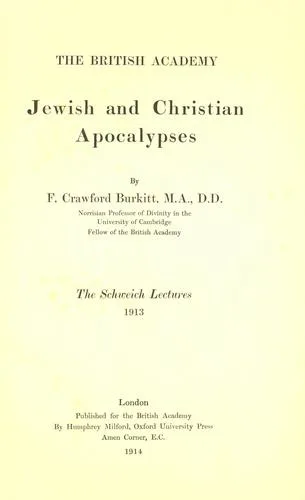
Jewish and Christian Apocalypses

 73
73

Jewish and Christian Apocalypses
F. Crawford Burkitt’s Jewish and Christian Apocalypses offers a rigorous examination of texts that shaped foundational beliefs for two major world religions. The strength of the book lies in its meticulous comparison of parallel motifs and theological trajectories, particularly concerning the development of messianic expectations. Burkitt’s analysis of the figure of the 'Son of Man' and its varied interpretations across different apocalyptic texts is especially illuminating. However, the dense academic prose, while precise, can present a barrier to readers less familiar with the specific scholarly debates of the early 2000s. A passage discussing the influence of Daniel on later apocalyptic literature, for instance, highlights the continuous thread of symbolic language and prophetic tradition. This work serves as a vital, albeit challenging, resource for understanding the intellectual and spiritual climate of the ancient world.
📝 Description
73
F. Crawford Burkitt's 2001 book examines apocalyptic literature from Second Temple Judaism and early Christianity.
Published in 2001, Jewish and Christian Apocalypses by F. Crawford Burkitt analyzes the eschatological writings that arose during the Second Temple period and in early Christianity. The book studies texts often characterized as apocalyptic, which offered ways to comprehend divine action in history and the world's final destiny. It highlights both the common conceptual ground and the specific theological shifts within these religious streams.
Burkitt's study connects with scholarship on early Christian origins and Jewish eschatology, fields influenced by figures like Albert Schweitzer. This work emerged from a late 20th and early 21st century scholarly trend that recognized the variety within Second Temple Jewish thought, moving away from a singular perspective and stressing the connections between different Jewish groups and nascent Christianity. The book supports this more detailed understanding.
This book engages with the study of apocalyptic literature, a genre significant in understanding Jewish and Christian eschatological hopes. These traditions frequently looked for divine intervention in history, anticipating future judgment and salvation. The texts examined often feature visionary experiences and symbolic language, reflecting a desire to grasp divine plans during times of political upheaval, such as the Roman rule over Judea. Burkitt's work clarifies the specific concepts and literary forms used to express these beliefs in the period surrounding Jesus.
💡 Why Read This Book?
• Gain a nuanced understanding of the 'Son of Man' concept, tracing its evolution from Jewish texts to early Christian interpretations, a key element in understanding messianic discourse. • Analyze the literary conventions of apocalyptic writing, including specific symbolic language and visionary structures, to better interpret ancient prophetic texts. • Grasp the historical context of the Second Temple period and the intellectual exchange between Jewish and Christian communities, clarifying the religious landscape prior to 70 CE.
⭐ Reader Reviews
Honest opinions from readers who have explored this book.
❓ Frequently Asked Questions
What specific Jewish texts does F. Crawford Burkitt analyze in Jewish and Christian Apocalypses?
The work extensively analyzes texts such as the Book of Daniel and Enoch, alongside other pseudepigraphal and apocryphal writings that provide crucial context for early Christian apocalyptic literature.
How does Burkitt connect Jewish and Christian apocalyptic traditions?
Burkitt highlights shared motifs, theological concepts, and literary devices, demonstrating a continuous development and adaptation of apocalyptic thought from Second Temple Judaism into early Christianity.
When was Jewish and Christian Apocalypses first published?
The book was first published in 2001, reflecting scholarship at the turn of the millennium on ancient eschatology and comparative religious studies.
What is the 'Son of Man' concept discussed in the book?
The 'Son of Man' is a messianic figure appearing in apocalyptic literature, whose interpretation varied significantly, with Burkitt examining its role in both Jewish and early Christian theological frameworks.
Is this book suitable for beginners in religious studies?
No, the book is written for an academic audience and assumes prior knowledge of biblical studies and ancient history. It offers in-depth analysis rather than introductory overviews.
What historical period does the book primarily cover?
The book focuses on the Second Temple period, roughly from the 2nd century BCE to the 1st century CE, a pivotal era for the formation of both Jewish and Christian eschatological beliefs.
🔮 Key Themes & Symbolism
Messianic Expectations
The book meticulously charts the varied expressions of messianic hope within Second Temple Judaism and their reception and transformation in early Christian circles. Burkitt examines how figures like the 'Son of Man' served as focal points for understanding divine vindication and future salvation, revealing a complex interplay of continuity and innovation in theological thought. The analysis underscores the dynamic nature of these expectations during a period of significant political and religious upheaval.
Apocalyptic Literary Forms
Burkitt studies the characteristic literary structures and symbolic language employed in apocalyptic writings. This includes analyzing the use of visionary experiences, angelic mediation, numerology, and coded historical references. Understanding these conventions is presented as essential for accurately interpreting the messages these texts conveyed to their original audiences, offering insights into their perceived relationship with the divine and the unfolding of cosmic history.
Inter-Tradition Influence
A central theme is the demonstrable influence and dialogue between Jewish and early Christian communities through their shared apocalyptic literature. The work highlights how Christian authors adapted and reinterpreted existing Jewish motifs and concepts to articulate their own unique theological claims. This exploration sheds light on the intellectual and spiritual environment in which both traditions developed, emphasizing shared roots and distinct divergences.
Divine Intervention and Judgment
The concept of divine intervention in human affairs, culminating in judgment and ultimate restoration, forms a core element of the analyzed apocalypses. Burkitt scrutinizes how these texts framed historical events within a cosmic, eschatological narrative, often portraying God’s direct action to establish justice and vindicate the righteous. This theme reveals the profound anxieties and hopes of ancient communities facing oppression and seeking divine resolution.
💬 Memorable Quotes
Direct passages from the work, attributed to the author.
“The interpretation of the Son of Man.”
— This refers to Burkitt's focused study on the figure of the 'Son of Man,' a key character in apocalyptic literature, exploring its diverse meanings and significance across different texts and traditions.
“Shared motifs between Jewish and Christian apocalyptic texts.”
— This highlights the book's emphasis on identifying common themes, symbols, and narrative structures that demonstrate the interconnectedness of Jewish and early Christian apocalyptic thought.
“The role of visionary experience in conveying divine messages.”
— Burkitt examines how dreams and visions were employed as literary devices to present prophetic revelations and theological insights within the apocalyptic genre.
“Eschatological frameworks for understanding history.”
— The work analyzes how ancient texts constructed narratives about the end times, divine judgment, and the ultimate fate of the world, offering a specific lens for interpreting historical events.
“The Book of Daniel as a foundational text.”
— This points to the significant attention given to the Book of Daniel and its influence on subsequent apocalyptic literature, both Jewish and Christian, in terms of style and content.
🌙 Esoteric Significance
Tradition
While not explicitly aligning with a single esoteric lineage, Burkitt's work is foundational for understanding the roots of Western esoteric traditions that draw heavily from Jewish mysticism and early Christian Gnosticism. The analysis of apocalyptic literature provides a crucial lens through which to view concepts of divine revelation, hidden knowledge (gnosis), and cosmic salvation that are central to many esoteric paths.
Symbolism
Key symbols explored include the 'Son of Man,' representing a divine intermediary or future redeemer, and visionary journeys through celestial realms. These motifs resonate with esoteric practices focused on spiritual ascent and the attainment of higher consciousness, offering a historical grounding for such aspirations within ancient religious frameworks.
Modern Relevance
Contemporary esoteric practitioners and scholars of comparative religion find Burkitt's work important for tracing the lineage of concepts like spiritual warfare, angelic hierarchies, and divine judgment. Thinkers in fields ranging from Theosophy to modern ceremonial magic often reference or implicitly engage with the ancient texts and ideas analyzed herein to understand the archetypal patterns of redemption and cosmic order.
👥 Who Should Read This Book
• Students of Comparative Religion: Those seeking to understand the shared origins and distinct developments of Jewish and Christian eschatological beliefs will find detailed textual analysis. • Scholars of Ancient History: Researchers interested in the religious and intellectual currents of the Second Temple period will benefit from the historical context and textual exegesis. • Advanced Biblical Studies Students: Individuals pursuing a deeper understanding of the New Testament's historical and theological background will find crucial insights into the literature influencing early Christian thought.
📜 Historical Context
Published in 2001, F. Crawford Burkitt’s Jewish and Christian Apocalypses emerges from a scholarly milieu deeply engaged with the diverse field of Second Temple Judaism and the formation of early Christianity. This era of scholarship, building on the work of figures like R.H. Charles and later scholars focusing on Jewish diversity, moved beyond viewing Judaism solely as a precursor to Christianity. Burkitt’s work contributes to understanding the intricate textual and theological exchanges between nascent Christian groups and their Jewish contemporaries. The reception of such scholarship often involved critical engagement within academic journals, where debates around the precise dating and relationship between texts like Enoch and the Gospels were common. This study positions itself amidst ongoing discussions about the Hellenistic influences and indigenous developments within Jewish thought prior to 70 CE.
📔 Journal Prompts
The 'Son of Man' figure: How does its interpretation evolve across different apocalyptic texts?
Apocalyptic literary conventions: What symbolic language is most prevalent in conveying divine messages?
Reflecting on divine intervention: How do these ancient texts frame historical events within a cosmic narrative?
The influence of Daniel: In what ways did this foundational text shape later apocalyptic writings?
Visionary experiences: What is the function of these accounts in conveying prophetic revelation?
🗂️ Glossary
Apocalypse
A literary genre or form, often characterized by symbolic language, visions, and divine revelation concerning cosmic or historical events, particularly the end times.
Eschatology
The theological study of concepts such as death, the end of the world, the last judgment, and the nature of the afterlife.
Second Temple Period
The era of Jewish history from the construction of the Second Temple by the returning Babylonian exiles (c. 516 BCE) until its destruction by the Romans (70 CE).
Son of Man
A figure appearing in apocalyptic literature, particularly in the Book of Daniel and later texts, often associated with divine authority, judgment, and messianic expectations.
Pseudepigrapha
Ancient Jewish writings purporting to be by biblical figures but not accepted as canonical by Jewish or most Christian traditions; often apocalyptic in nature.
Motif
A recurring subject, theme, or element in a literary, artistic, or musical work, used to develop a larger idea or pattern.
Gnosis
In esoteric contexts, refers to spiritual knowledge or insight, often seen as a path to salvation or enlightenment, particularly relevant in Gnostic traditions.
🔮 Readers Also Liked
Browse all →









More by F. Crawford Burkitt
All books →
More Free Occult Philosophy Books
View all →