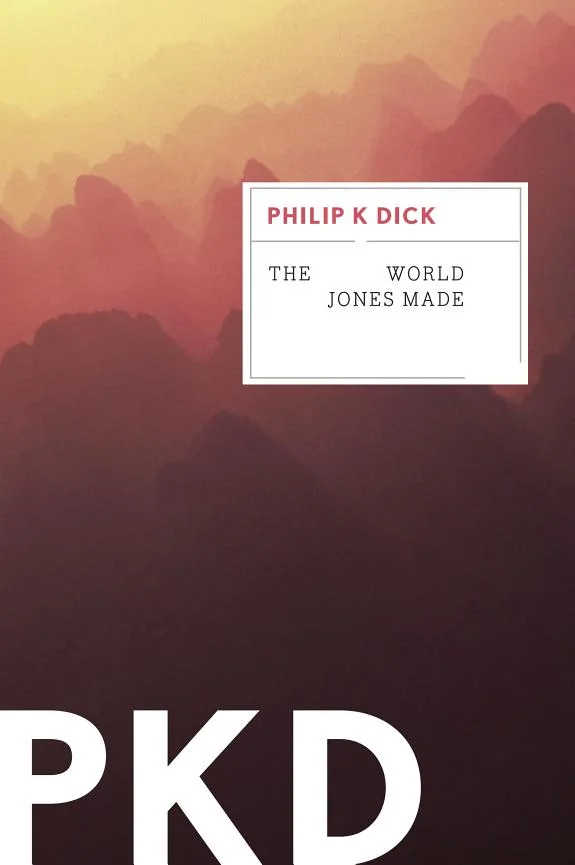
The World Jones Made
 82
82

The World Jones Made
Philip K. Dick’s "The World Jones Made" presents a compelling, if sometimes stark, vision of precognition. The novel excels in its portrayal of David Powell’s psychic burden, illustrating how foreknowledge can be less a gift and more an inescapable trap. Dick’s characteristic paranoia and distrust of established authority permeate the narrative, creating a palpable sense of unease. The central conceit, that knowing the future locks it into place, is a potent philosophical engine. However, the pacing occasionally falters, and some of the political machinations feel underdeveloped compared to the strength of Powell's internal struggle. A particular strength lies in Dick's ability to make the abstract concept of future sight feel grounded and psychologically plausible, even amidst its grander implications for global conflict. The ending, while fitting, leaves the reader with a sense of grim inevitability that is undeniably powerful. Dick’s exploration of precognition here is a stark reminder of the personal cost of seeing too clearly.
📝 Description
82
Philip K. Dick's 1956 novel imagines a world where seeing the future is a constant burden.
Philip K. Dick's "The World Jones Made" centers on David Powell, a man who sees the future with precise, if fragmented, clarity. This precognition is not a simple gift; it dictates his actions and influences global events, forcing him to confront the paradox of destiny. Knowing what will happen can either lock it into place or provide the means to change it. The story examines the psychological weight of such knowledge, showing Powell isolated by his unique perception and the immense responsibility it carries.
Dick uses Powell's ability to question the nature of free will against determinism. The narrative explores how foreknowledge affects individual choices and the broader sweep of history. It is a story for readers who enjoy speculative fiction that grapples with philosophical questions about reality and human agency. The novel rewards careful attention to its complex character and thematic concerns.
Published in 1956, "The World Jones Made" engages with mid-20th century anxieties surrounding fate and the potential for human consciousness to interact with time. It taps into a tradition of exploring psychic abilities and their implications, common in occult and metaphysical literature of the era. The novel's depiction of precognition reflects a fascination with parapsychology and the idea that the future might be accessible, influencing the present in tangible ways. This aligns with esoteric thought that considers consciousness as capable of transcending linear time.
💡 Why Read This Book?
• Gain a unique perspective on determinism vs. free will, specifically how David Powell’s precognitive abilities might paradoxically solidify future events, a concept explored through his interactions with global political figures. • Understand the psychological weight of foreknowledge, learning how Philip K. Dick portrays the isolation and moral quandaries faced by an individual burdened with seeing the future. • Explore the mid-20th century fascination with parapsychology and its influence on science fiction, contextualizing "The World Jones Made" within the speculative landscape of its publication era.
⭐ Reader Reviews
Honest opinions from readers who have explored this book.
❓ Frequently Asked Questions
What is the central conflict in "The World Jones Made"?
The central conflict revolves around David Powell's precognitive abilities. He struggles with the moral and psychological implications of knowing future events, particularly when those events involve global catastrophe and his own role in them.
How does Philip K. Dick depict precognition in this novel?
Dick depicts precognition not as a mystical gift but as a perceptual faculty that profoundly impacts the precognitive individual and those around them, raising questions about determinism and free will.
What philosophical themes are explored in "The World Jones Made"?
The novel explores themes of determinism versus free will, the nature of reality, the burden of knowledge, and the ethical responsibilities that come with extraordinary perception.
What is the significance of David Powell's character?
David Powell serves as the focal point for exploring the human experience of precognition, embodying the psychological toll and ethical dilemmas associated with seeing the future.
Is "The World Jones Made" connected to other Philip K. Dick works?
While "The World Jones Made" stands alone, its exploration of fractured realities, psychic abilities, and paranoia aligns with many of the recurring themes found throughout Philip K. Dick's extensive bibliography.
When was "The World Jones Made" first published?
Philip K. Dick's "The World Jones Made" was first published in 2012, making it a later work by the author that revisits and expands upon his characteristic thematic concerns.
🔮 Key Themes & Symbolism
The Paradox of Foreknowledge
The novel interrogates the concept of precognition, particularly through David Powell's abilities. It suggests that the very act of knowing the future might fix it, creating a deterministic loop. This theme is central to the narrative, forcing Powell to confront the ethical implications of his foresight and the potential for it to dictate events rather than merely predict them. The work explores how such knowledge can become a profound psychological and moral burden, isolating the individual and complicating their agency.
Reality as Perceptual Construct
Echoing Philip K. Dick's broader oeuvre, "The World Jones Made" questions the stability and objectivity of reality. Powell's precognitive visions offer glimpses into potential futures, blurring the lines between what is real, what might be, and what is inevitable. This theme invites readers to consider how perception shapes our understanding of existence and whether a definitive, singular reality truly exists, or if multiple, fluid timelines are always in play.
The Burden of Responsibility
David Powell's precognition is not presented as a superpower but as a heavy responsibility. He grapples with the weight of potential global disasters and his own role in them, forced to make decisions based on visions that may or may not be entirely accurate or alterable. The narrative looks at the immense psychological toll this takes, highlighting the isolation and existential dread that accompany such a profound and dangerous gift.
Political and Social Control
In "The World Jones Made," precognitive abilities become a tool and a threat within a geopolitical landscape. The potential for foreknowledge to influence or control global events is explored, reflecting Dick's frequent concerns about authoritarianism and manipulation. Powell's struggle is not just personal but also political, as his abilities could be weaponized or suppressed by those in power.
💬 Memorable Quotes
Direct passages from the work, attributed to the author.
“He knew what was going to happen. He saw it.”
— This simple statement captures the core of David Powell's precognitive burden. It highlights the passive, yet overwhelming, nature of his visions, suggesting that the future arrives whether he wishes it to or not.
“The world was not what it seemed.”
— This interpretation points to Dick's consistent theme of questioning reality. Powell's visions expose a layer of existence beyond the mundane, hinting at hidden truths and the fluid nature of perception.
“The future was a map he could not erase.”
— This interpretation conveys the inescapable nature of Powell's precognitive knowledge. It suggests a fixed destiny, where even with the map, the path is already laid out, highlighting the novel's deterministic undertones.
💡 Key Ideas
Editorial paraphrase of the work's core concepts — not direct quotes.
Knowing the future locks it in.
This paraphrased concept reflects the deterministic implications explored in the book. It suggests that foresight isn't merely observation but an active force that solidifies events, thereby questioning the existence of free will.
His gift was a curse.
This paraphrased concept directly addresses the psychological and moral toll of precognition. It emphasizes that Powell's ability to see the future brings immense suffering and difficult choices, rather than simple advantage.
🌙 Esoteric Significance
Tradition
Dick's work often skirts the edges of Gnosticism, particularly its emphasis on a flawed or illusory material world and the potential for gnosis (knowledge) to liberate the individual. "The World Jones Made" fits within this by presenting a reality that is unstable and perceived through extraordinary means. The precognitive ability can be seen as a form of heightened perception, a pathway to a deeper, albeit disturbing, truth about the universe's mechanics and predetermined nature, aligning with Gnostic views on hidden knowledge.
Symbolism
The primary symbol is precognition itself, representing an altered state of consciousness that pierces the veil of ordinary perception. David Powell, as the precognitive, embodies the seer or prophet archetype, burdened by divine or cosmic insight. The concept of 'fixed futures' or predetermined events acts as a symbol of inescapable destiny, a common theme in various deterministic philosophies and certain esoteric traditions that emphasize cosmic order or karmic chains.
Modern Relevance
Contemporary thinkers exploring simulation theory, the nature of consciousness, and the philosophical implications of quantum mechanics often find parallels in Dick's work. His questioning of objective reality and his exploration of altered states of perception are highly relevant to modern discussions in transhumanism and cognitive science. Furthermore, the idea of precognition as a psychological burden continues to resonate in fields dealing with trauma, foresight, and the ethics of predictive technologies.
👥 Who Should Read This Book
• Students of Philip K. Dick's bibliography: Those familiar with his recurring themes of altered reality, paranoia, and psychic phenomena will find "The World Jones Made" a valuable addition to understanding his thematic development. • Speculative fiction enthusiasts interested in philosophy: Readers who enjoy science fiction that poses deep questions about free will, determinism, and the nature of time will appreciate the novel's intellectual rigor. • Explorers of esoteric concepts in literature: Individuals curious about how metaphysical ideas like precognition and the malleability of reality are presented in fictional narratives will find this book a rich case study.
📜 Historical Context
Published in 2012, "The World Jones Made" emerged decades after many of Philip K. Dick’s most celebrated works, yet it revisits themes deeply rooted in the anxieties of the mid-20th century. Dick began writing in the 1950s, a period shaped by Cold War paranoia, the burgeoning field of parapsychology, and a growing distrust of established institutions. His explorations of fractured realities and psychic phenomena resonated with a counter-culture increasingly interested in alternative states of consciousness and esoteric thought. While Dick was not a direct participant in a single defined esoteric school, his work often touched upon Gnostic ideas of illusion and hidden knowledge, which were being explored by figures like Manly P. Hall and later by scholars examining early 20th-century spiritual movements. The novel’s publication in 2012 placed it in a contemporary landscape still grappling with technology's impact on perception and reality, and where concepts of simulation and alternate realities, once fringe sci-fi tropes, had become mainstream discussion points.
📔 Journal Prompts
David Powell's precognitive visions and their impact on his decisions.
The concept of a 'fixed future' versus the possibility of altering destiny.
The psychological isolation experienced by individuals with extraordinary perception.
The relationship between knowing the future and the loss of free will.
Perceptions of reality as depicted through Powell's unique viewpoint.
🗂️ Glossary
Precognition
The ability to perceive or know future events before they happen. In the novel, this is depicted as a complex and often burdensome faculty rather than a mystical gift.
Determinism
The philosophical concept that all events, including human actions, are ultimately determined by causes external to the will. The novel explores how foreknowledge might reinforce this.
Free Will
The power of acting without the constraint of necessity or fate; the ability to act at one's own discretion. This is directly challenged by the concept of precognition in the book.
Gnosis
Knowledge, especially spiritual or mystical knowledge. Dick's work often explores characters seeking or possessing a form of gnosis that reveals the 'true' nature of reality.
Timeline
A sequence of events in chronological order. The novel plays with the idea of multiple or fixed timelines, influenced by precognitive knowledge.
Existentialism
A philosophical theory emphasizing the existence of the individual person as a free and responsible agent determining their own development through acts of the will. Powell's choices under duress are central.
Parapsychology
The study of alleged psychic phenomena and other paranormal claims, encompassing abilities like precognition. Dick's work engages with these concepts.
This book appears in 1 collection
🔮 Readers Also Liked
Browse all →








From the “Precognition” Collection
View all →

![EBOOK COLLECTION ( PART 8) [ CSI][h 33t]](/img/thumb/ebook-collection-part-8-csi-h-33t.webp)



More Free Occult Philosophy Books
View all →